
Telemachus
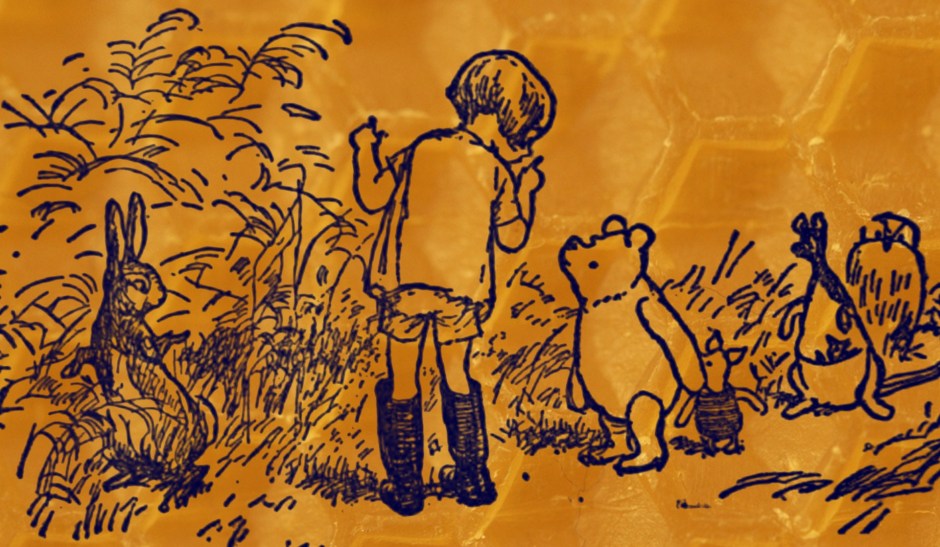
Sticky, plump Winnie-the-Pooh descended thuddingly from the tree branch on which a hive of bees hung temptingly. The remnants of a red balloon on a string, abruptly deflated, lay beside him, unsustained on the mild morning air. He held aloft a honeyed paw, licked it thrice, and assessed his fall from grace thusly: “O bother!”
So here is Pooh bear, grounded severely. Gazing skyward at the buzzing horde, he lip-smacked the remnants of the golden nectar and realized…well, not realized, as he was a bear of very little brains. But he felt his bumped and crumped stuffing and tried ignominiously to get back on his feet. He looked around this way and that way but no one was about. He felt wobbly still and so he remained stretched out on the ground, button eyes turned cloudward.
“If only Christopher Robin were here. What’s needed is a good story.”
Ah, yes. A good story is always needed. But this particular story doesn’t start with Pooh bear. Can’t start with Pooh bear. You see there was no Pooh bear, once upon a time.
“I love stories that start that way.”
Sorry, Pooh. There’s a lot to tell before you even enter the picture.
“Oh, ‘nother bother!”
That’s right. And just like a stick tossed into a roundabout creek, we’ll make our way back to you. But not for a while. Because your story doesn’t start with you. We’ve got to move backward in time to the aforementioned Christopher Robin named Billy named Moon named Milne. Find him find you.
“I’ll help you look,” said the dusty and dented denizen of these parts, grunting mildly as he rose somewhat unsteadily.
That’s okay, Pooh. We’ve got an omniscient narrator ready to help us out.
“I’m a nice ant?”
“No, silly bear. Omniscient. It means the narrator sees everything.”
“Like Owl,” Pooh added confidently.
And what our omniscient narrator sees is Christopher Robin, on his knees in a nursery, making rapid crosses in the air while his Nanny, Nou, helps him remember his prayers:
“God bless Mummy and Daddy and God Bless Edward Bear and Piglet and Eyeore—”
Childhood is a nightmare from which I’m trying to awake, thought Christopher Robin as he ambled to the bookshop awaiting his appearance. As part of a summer tour to sign and promote his autobiography, he was working his way through Somerset, Devon, Gloucestershire, Cornwall, and the general West Country. Though he was still a couple kilometers hiking distance from the typically oh-so-quaint bookstore that awaited his arrival, a lengthy queue of ardent fans was already lined up, books firmly in hand, desirous of the autograph of England’s most famous former child. As he wended his way through the English and Sessile Oak, hornbeam, alder, and field maple, he found his mind returning to the Hundred Acre Wood of his storied youth. But his thoughts were anything but childlike.
“Bloody hell,” he muttered to himself. “The same interminable questions. No better way to ruin a trip to a bookstore.”
Christopher Robin scanned the landscape to confirm his blessedly solitary status. He parked himself directly in front of a beech tree, unzipped his trousers, and had a thought about how he could open his talk in just a few minutes.
“Hi, Everyone. Sorry I’m late. I stopped on my way to pee in the woods. That was never mentioned in the books, was it? Didn’t you think it odd that I spent all that time in the forest and never answered nature’s call?”
He looked around again, musing about how much the tabloids would fork over for a picture of Christopher Robin’s unsheathed tallywacker. “Not this innings,” he mouthed defiantly as the waterworks eventually ceased to a trickle, then zipped up quickly and continued his trek through ancient time and sacred space.
He reached into his pocket and felt the reassuring clink of keys. Must get away in time for a late supper at Mulligan’s Pub and then back to the cottage. He’d rented a quite modest domicile just outside the village. Far enough away that fans couldn’t follow him. It’s not the same for ghosts. They’ll find me. They find us all. As if on cue, he had a vision of his mother. She held out a stuffed animal, but the face of the creature was blank. It had no face. Only a mirror. And when he looked into that mirror, he had no face. How odd.
No, it makes perfect sense. Christopher Robin had lost his identity as Winnie the Pooh developed his. But now that Pooh was ursidae non grata in Christopher Milne’s mind, his own identity was blurred. Two creatures, blanked by time. Now I’m an author, just like dead old Dad. Another ghost to contend with. He closed his eyes, swallowed hard, and wished he’d had a pint of stout just now. I haven’t done my stoutness exercises today. He smirked at the memory. Honeyed porter, stout. Friendly spirit. Hops to it, my good man. I can barley wait another second. Yes, seconds. Maybe thirds, too. Go forth and bring me a fifth. I have a sixth sense about these kinds of things. I’m an author, you see. I paint pictures in your mind. Close your eyes and see. But don’t forget that pint.
The remnants of an old mill, with a decrepit water wheel decaying in the Indian Grass and Prairie Dropseed, arrested his memory. When I was a child, there was an old mill—no, I’m wrong. It wasn’t a mill. It was a post office with a mural of an old mill on the wall, the water wheel spilling buckets of clear blue-white into the air, forever suspended in its splashlessness. Nanny Nou used to tell me that splashing in the water was good for the soul but bad for the fish. Didn’t all life come from the water? But why did some life stay behind in the water? Didn’t they all want to see what was on the other side? Why cut yourself off from spirit? Fillet of soul. I don’t deal the cards, I just play ‘em. Go fish.
Up ahead, the clearing. That must be it. Unless I’ve taken a wrong turn. He reached into his tweed jacket—of course a tweed jacket, what? The map had been misshapen by many errant foldings over many nights. Knight of the errant fold I dub thee. X marks the spot. There were lots of X’s on this particular map, each demarcating a previous appearance. Nice to meet you. Thank you for coming. I’m delighted by your interest. To whom shall I make the inscription? I’ll be crossing this entire experience out shortly after I leave the store, erasing you and the memory of your foolish, fawning sycophancy. Don’t you want readers for your book?
I didn’t write it for you.
His progress was arrested by a demon in his view. “Daimon,” he corrected. “Spirit of a dead hero. Or sometimes an evil sprite masquerading as a hero.” Once, at an earlier book signing, a girl in a wheelchair who had been patiently waiting for the rollout of the book tour approached him and shouted, “Pooh is my hero!” when she saw him. Their eyes locked for a moment and he could tell she was sincere. How sad, he thought. Pooh isn’t even my hero and he shouldn’t be yours. Heroes and villains and bears, oh my. The daimonic figure stood squatly on the undeclared path, round and spectacled, a small stack of books bearing down on his stubby forearms, a smartly tailored Eton blazer chafing at the seams. It uttered a phrase softly, whispered more than spoken, the little interloper bowing slightly in a rapid manner, teetering on unsteady trousered gams, repeating: Pitter patter pitter patter pitter patter. The words lingered in heavy summer air long after the vision disappeared. Pitter patter? Raindrops? The little feet of small children padding about? Progeny. Clare-ity. Daughter, not son, forgotten not made. Blast it all—what a fool I am. Not pitter patter.
Pity, pater!
He emerged from the past into a clearing where he could see what awaited him. Once, late at night in the nursery, unable to sleep, he tip-toed-tap-tap-tap to Nanny Nou’s room. Her door was slightly open. (“When is a door not a door? When it’s ajar” —the first joke he ever remembered his father telling him, though he had no idea how a door could change into a jar and why his father laughed slightly to himself after he told him that joke. Why is it that children always have to figure out what adults mean but adults dismiss what children say as incoherent nonsense?) He looked through the slit and saw her silhouetted as she undressed, stirrings of innocent curiosity and wonder gripping his jejune heart. The first woman I truly love. Mums not the word. This feeling I must share. But not here, not now.
The crowd was filled with individuals who collectively shared the same mistaken notion: Christopher Robin, the plucky and perennially boyish bearst friend of Winnie-the-Pooh will be the same figure from the books on my shelves in my mind in my memory in my childhood. I could wander among them lonely as a cloud and they’d never recognize a word’s worth of similarity to the man who stands before them. Long before them—even long before some of their children. Ladies and Gentlemen, Coventry Books is proud to present this evening’s star (no, make that “moon,” hee hee) attraction, a true time traveler, Christopher Robin!
Your fame is a gift to those who have not shared the fortune you’ve enjoyed, his mother explained. They were in the garden and Christopher Robin was digging for shining stones to decorate a tobacco box for his father for a gift for his birthday when he told his mother that what he wanted when his birthday came around was to be left alone by the world.
“The beauty of your situation is you shall never be alone,” she said, reaching over and clasping his face with her gardening gloves. “Anytime you wish, you can proclaim wherever you are, ‘I am the real Christopher Robin!’ and people will flock to you in love and awe. You’re extremely lucky. You don’t have to do anything to get people to love you.”
His mother went back to her gardening but he couldn’t shake that phrase from his memory. What must most people do to get other people to love them? Nanny Nou said God loves everybody, but doesn’t even He ask for people to worship him in response? I don’t want to be worshiped. In fact, mostly I want to disappear.
“So why did you write this book?” It’s the first question they usually ask. Funny, I never thought to ask that question—let alone try to answer it—until these bloody public events. One day I’ll tell them the truth: I’m used to your love for no reason, and I don’t know how I would earn it otherwise.
That’ll be ten pounds, please—twelve pounds if you’d like the inscription personalized.
Calypso
And down they went, abuzzing. A harried swarm of angry honeybees descended from their high-borne alder, aiming to make Pooh pay. The poor puffy perpetrator strived (stroved?) to swat them away but was unable to move his ex-tremities as his arms lay forlornly deposited on the nightstand. Oh bother—why did I leave them there? I didn’t leave them there. Did I? Who would take my arms while I slept? Are there arm fairies like there are tooth fairies? And why is my bedroom outside? Isn’t the inside not supposed to be outside? I don’t remember going to bed under the stars. But now there are no stars tonight. Just bees. But maybe that’s all stars are—distant buzzing masses of bees whose mad energy lights up the night sky. I’ll have to ask Rabbit about this. He’s smart. I wonder if—ouch! That also smarts! The lead bee in a vanguard wave of perturbable fuzz blight hovered just before his nose, repeatedly smiting poor Pooh’s proboscis. He felt a kind of sleepy muted pain and was inclined to lash out but he also felt, deep in his plush, an affection for the honeymakers assailing him. “Must remember they only attack when provoked,” he reminded himself of something he’d once heard Christopher Robin say. Pooh had no idea what provoked meant but as he was a bear of very little brains, he had no idea what most words meant. “Curse good and die,” he also reminded himself, something he heard once while doing a job on a Sunday.
Think happy thoughts and I shall fly like the bees, thought Pooh, but this nostrum against nostril assault proved fruitless (as that was an entirely different book.). Silly bear! You might as well click your heels three times. Gosh, my legs are so stuffly I don’t think I could even bring my heels together. Next time I do my stoutness exercises I must check to see if I even have heels. One and two and—oh bother!—what’s after two I can never remember. My rememberer doesn’t work so well some days….
“That’s okay,” said the bee in front of Pooh’s face, suddenly metastasizing into a gigantic mutated insect. “We remember.”
“Who are you?”
“I am Gregor. I’m here to remind. If necessary, with stings.” He hovered to within just a few centipeders of Pooh’s nose. “Sometimes our conscience needs to be pricked.” With that, his needling of the prostrate Pooh continued.
“Ouch ouch ouch!,”
“Physical pain is nothing compared to mental anguish. Agenbite of Inwit, dimwit. Confess!”
Pooh’s mind—well, that’s a stretch. But whatever Pooh used to process things failed to connect what the bee was saying with anything that was something.
“I got nothing,” Pooh said, wishing he had his arms so that he could rap himself in the head to help trigger his memory.
“Until you admit your crime, you will never know freedom.” His winged accuser, this mercurial muse of the meadow, glared with his pentagram eyes but in them Pooh felt he saw some warmth. But it might just have been his reflection.
“No freedom?”
“None.”
“Oh. I wonder if you could bother to tell me…what is freedom?”
Gregor’s face metamorphosized into a familiar kangaroo-shaped head.
“Honey heister!”
“Kanga?”
The face was frozen in a grimace with a lone tear streaking down its cheek and it uttered a tearful exhortation, very like a wail.
“Kanga, what have I done?”
The kangaroo’s head bowed and then was quickly swallowed by a pit of floating quicksand. Pooh reached out but, having no arms, nothing much happened. He blinked back a few polystyrene tears (“Life is a comedy for those who blink,” said Roo’s older cousin Jean Jacques, who was visiting from a forest called France.) He looked down at the pit and saw it wasn’t quicksand anymore. It was honey. And it began sucking him in.
“Well, if I must go….”
The sticky-icky sucrose sucked him in swirlingly, silencing and suffocating his shouts of sweet surrender. The next thing Pooh knew (and he knew almost nothing, being a bear of very little brains), he was sitting up in his bed, the first brilliant rays of the morning sun lighting up the heather and gorse and Scots pine that would soon beckon the baffled little bruin to a day of exploration that would change absolutely everything and nothing at the same time.
***
Do stuffed animals dream? Why shouldn’t they? After all, we dream of them. A famous child psychologist once wrote a bestselling book in which she claimed that teddy bears represented substitutions for father figures. A child’s desire to embrace these fictional stand-ins signified an absence of perceived paternal warmth. Well, Pooh had no father figure to substitute for. He was, as Christopher Robin used to say, one of a kind. (“Kind of what?” Pooh followed up, but his human companion remained mute on the point.) And so this dream lingered on the penumbra of Pooh’s conch’s nest.
But first things first: let’s eat. Pooh might have been a bear of very little brains but he was also a bear of very large appetite. He looked at the honey pots arrayed on the rickety wooden table in what today would be called a kitchenette (“I think it should be kitchen-ate,” Pooh would likely retort) and decided he’d have honey for breakfast. It was the same decision he’d made every day of his life so he felt comfortable committing to it again this particular morning. Let’s try that one over there. There’s stickiness on the rim so I choose that over the others not as sticky. Sticky is good. Every time I find myself in a sticky situation it always turns out sweetly. That’s not true for most people, but not only was Pooh not most people he was not people at all. Yet that dream seemed like the kind Christopher Robin used to talk about when he told Pooh about monsters in the nursery that only came out at night and that caused Pooh to keep a candle burning near his bedside so the monsters would think it always daytime.
“Time to cram myself into that honey pot,” Pooh announced to himself as he jammed his furry frontispiece under the crock’s cover. What’s all this? (He is a British bear, after all.) Well, this is what’s known, old friend, as a conundrum. You’ve got a whole bunch of nothing. How can nothing be something? The Sumerians wrestled with that very notion more than 5,000 years ago, creating a sort of placeholder for the space occupied between positive numbers and negative numbers. It was left to Babylonians to—
“Babble on and ons?”
Point taken, Pooh. We’ll save the algebra lesson for another day. You’ve got more immediate problems.
“Not ‘I’m-eating-it’ problems. ‘I’m-not-eating it’ problems. Oh bother. I’ve run out of honey. I must seek nourishment elsewhere. Perhaps my neighbor Kanga can help me.” And just like that the floating furry head of Kanga, its big round ears slightly drooped, appeared before Pooh, hovering in his hovel, filling the honey-less homesteader with unappetizing wonder. Kanga cocked her head slightly, peering squarely at the round-button-eyed bear who stood stiffly and stuffly, her rust-colored tongue jutting out gently, her lips parted as if she desired to communicate some dire truth to him. But she just floated mutely in the diffused morning light, saturnine and silent, an uninvited ambassador from Pooh’s fading dreamworld whose regards or remonstrance could only be guessed at.
Aeolus
G-R-R-R-R-R-R-R-R-R! A thunderous sound, frightening to a bear of very little brains, emanated (that means came from) the tree house where Owl lived. No need to freak out, Pooh. (He had never heard that expression anyway, so he wouldn’t have known how to freak out even if he was, in fact, freaking out.) It wasn’t the sound of a predator. (Not all predators are Heffalumps but all Heffalumps are predators.) The sound was not animal in nature at all. It was the grinding of the desiccated gear-works of a machine that Pooh didn’t recognize.
“Don’t get too close!”
Owl flew over to Pooh, who had meekly nuzzled his muzzle into the cramped but cozy treehouse.
“Always poking your nose in where it doesn’t belong,” Owl asserted. He knew from poked noses. (Butting into other people’s businesses was one of Owl’s talons.)
Excuse me, but are there going to continue to be so many…parent the seas?
Yes. Are you bothered by digressions, Pooh Bear?
Digressions? No, my tumbly isn’t usually rumbly unless it’s dinner time.
Fine. I’ll get back to the story at hand.
Or at nose, Pooh giggled to himself. Silly old narrator.
“If you get too close, that thing’ll eat you up!” Owl warned, but it was an unneeded cautionary note. What Owl called his “inky blinky” was just an old mimeograph machine that Christopher Robin rescued from his school after the custodian hauled it out to be trashed. Owl, however, found it a marvel of modern inventiveness and fancied himself the Gutenbird of the Hundred Acre Wood. He was hard at work putting out a special edition of his own newspaper, the Forest Leaves.
“But where does it go?” Pooh remembers thinking when Rabbit once explained what that piece of paper tacked to his front door was. The newspaper, such as it was, had been published in a semi-regular fashion. The spelling and punctuation were also semi-regular. Owl’s grasp of journalistic convention was closer to a pee style than A.P. style, but his readers forgave him because they mostly couldn’t read anyway.
“Why don’t you stand over there?” Owl said, pointing an ink-stained wing toward the back wall of his hollowed-out hovel. “Grab a book if that’ll keep you quiet.”
The mimeograph machine whirred its words, splashing small squibs of ink as it churned out its pages. Pooh tried to read the pages but they came out too fast, one on top of another, and trying to read them made him feel woozy.
“Yes—a nice still book is more my speed.” He padded over to Owl’s bookshelf and perused the selections.
“Let me see…let me see…oh I do wish Christopher Robin was here. He knows the kinds of stories I like.” Pooh selected a book with a honey-colored cover and lay down on the floor. He opened the book halfway through and laid it on his face, as he had once seen Christopher Robin do before sleeping in the sun. The pages smelled musty, the faint scent of rosewood and whetted ashes, and Pooh thought again of his dream. Did he really try to steal honey? He dared not fall asleep again, fearful that the awful accusations of last night might resurrect. But the whirring and the purring of the clanky inky blinky lulled him into some ambulance (and they usually anesthetize you anyway). So I’ll lie here, with the book on my face but my eyes open, and I’ll just read until Owl is finished. And there he lay for a very long time, open to the story he opened to.
The Tell-Tail Hart by Edgar Allan Pooh
True! Hungry—very, very dreadfully hungry I had been and am; so why will you not offer me lunch? The hunger had sharpened my senses—not destroyed—not dulled them. Above all was the sense of taste acute. I imagined tasting all things in the cupboard and the kitchen. In my mind—in my stomach—I even tasted many things rescued from the garbage. Why, then, am I still unfed? Hearken! and observe how stoutly I appear despite my ravenous appetite and the neglect of my rumbly tumbly.
It is impossible to say how first the idea entered my stomach; but once I imagined the sticky sweet taste, it haunted my breakfast, lunch and dinner time. He had never wronged me. He had never given me insult. For his wealth I had no desire. It was those honey pots! Yes, it was this! One of them resembled my cookie jar—a double temptation that very gradually made me salivate whenever I thought of it. It was then I decided to take matters into my own paws…
Pooh woke with a poke.
“Literature should be digested—not ingested!” Owl scolded, lifting the folded volume off of Pooh’s face. “Hmmph. You’ve gotten fuzz all over the typeface.”
“That’s just my type of face,” Pooh said meekly in his own defense.
“I think you better go,” he said. “I’ve got serious work to do and it won’t help my reputation to be seen with a poacher.”
Was Pooh a poacher? That’s eggzactly what Owl thinks. Pooh’s reputation was toast.
“But I’m not a…what’s a poacher?”
“It’s what you are, apparently,” Owl said curtly. “You can read all about it in the special edition I’m printing. Or in your case, eat all about it.”
“What does that mean, Owl?”
“Nuttin’, honey,” Owl said, chuckling, though his self-indulgent laughter was drowned out by the machinations of the mimeographer, spitting out ink and sputtering towards a five-star final—an ignoble prize for a Pooh Bear of very little brains but of very great guilt.
Scylla and Charybdis
Rabbit was always trying.
For seven years, he’d been living in his warren, by all appearances just another woodland creature at home in the Hundred-Acre Wood. How many woodland creatures were there? He’d often thought about making a census of his fellow inhabitants, classifying them by genus and species, perhaps expanding to include the flora and fauna of the surrounding environs. He had big ideas, always had. He felt himself exceptional. No, not felt. I am exceptional. To affirm this right and proper judgment he often recited a litany of liabilities always at the ready when he considered his fellow sentient inhabitants of the grounds that—he was sure—constituted more than one hundred acres (easily twice that, by the way, Rabbit had calculated). Ignorant. Lazy. Weak. Timid. Reckless. Pedantic. But what they mostly lacked was leadership. Isn’t that what he had been trying to provide for the last seven years? Why hadn’t they recognized his gifts as a natural commander? Oh, that’s simple. Because there’s one more quality on that list that holds them all back from becoming their best selves: jealousy.
I’ve never felt the slightest twinge of jealousy. Why should I? Who could I possibly be jealous of? An uneasy feeling gripped him, cast a pall over the affirmation of his own superiority. But there is that…well…yes, that. Can it be so? Rabbit raised his left back foot and scratched vigorously behind his ear. He had a vague remembrance of his own father, when rabbit was quite young and learning the satisfaction of vigorously scratching, telling him that he lacked self-discipline. All my itches die of neglect, he told his son. His father was always chastising him for his lack of self-control. But wouldn’t his father be proud of him now? Aren’t you, Dad? Don’t you see what a respected member of the community I’ve become? This place was positively rudder-less until I came along. It’s not my fault they don’t recognize my talents. Yes, I did just scratch. But that was just to remind myself that I can still scratch if I wish. They call that being dextrose. Pretty impressive for a rabbit of my age….
Quark! There’s that feeling again. No denying it this time. Curse, bless those hunters who came through last week. Now everything has changed, changed utterly. If only my hearing wasn’t so acute. I really am an impressive specimen. My itches might not all die of neglect, but some of them get annoyed with my dilly-dallying. That’s something, right dad?
Look there, Dad! It’s a rabbit! Can I try?
The boy seemed scarce old enough to lift the rifle. His excited voice reminded Rabbit, at first, of Christopher Robin. But he never carried a gun, and he certainly never thought about shooting anything, except maybe shooting his mouth off about what he learned at school that day. That’s why they follow him. They think he’s smart. But I’ve got keener instincts, by far. He has the instinctual response of a sloth. “Silly old bear” seems to be the limit of his life advice. Why don’t they ask me? I kind of…don’t like him. There’s a word for it. Unfortunately, Rabbit didn’t know the word “resentment.” But he felt it nonetheless. But don’t feel too bad, Rabbit. Everybody feels that way about someone, sometimes even people they love. Resentment. Word known to all people (but not all woodland creatures).
And the little boy who was walking through the woods looking for innocent animals to shoot and kill just like his father before him and his father before him excitedly placed his twitching finger on the trigger of the gun and tried to hold the barrel of the rifle steady enough to site the rabbit—our rabbit—as he prepared to fire.
No, son. Not that one. Look at him, limping along. He’s near the end of his life. Rabbits only live a few years. He’s seen more than a few winters here. He won’t make it much longer. Let’s let nature take care of that one.
The son was disappointed, sure. His jejune grin faded and he looked at his dad longingly. I really really really want to shoot it!
It’s better this way, son. We must be merciful when we can. Cheer up. There are lots of younger and healthier specimens for us to kill. What say we head over to that grove? Wouldn’t those wild birds look great mounted on the wall of your bedroom?
Ok, Dad! Race you!
Ah, juvenescence.
Mr. Hunter—a good man, after all—tramped away through the thick underbrush, keenly sighting his kinetic son racing to his next quarry. But as the Jesuits (whose presence is all but unheard of in the Hundred Acre Wood) are fond of reminding themselves, a door never closes without another door opening. Plic-en-peluche, entre!
“Good day, Rabbit. I was just wondering—”
“Oh no you don’t!” Rabbit pre-emptively bellowed. “Not this day. Not any day. Not anymore. You, I heard about.”
“Oh fluff and stuff, there’s a herd about? We should hide!” With that, the portly Pooh bear turned his back on Rabbit as he sidled behind a sapling. “There. That’s better.”
Rabbit stood there, his head cocked this-a-way, squinting in mild rebuke at his furry friend.
“You need not hide, fortunately,” he shared with the bear whose backside was bisected by the reed-like tree. “Besides, one can never hide from the truth, no matter how large the barricade you cower behind.”
Whoa. Philosopher rabbit. Don’t Socra-tease your friend here. Spell it out (even though poor Pooh doesn’t know how to spell). He Kant un-Locke your meaning unless it hits the Marx. You’re putting Descartes before the horse. Dewey seem amused? Aurelius? You are Soren need of a fresh Sartre. Just say what you mean, Rabbit. This circumlocution is probably one of the reasons you’re not respected. You’d make a Lao-tzu leader.
“Oh dear,” the downtrodden bear confessed. “I can’t understand what you mean.”
Rabbit exasperated. Rabbit exaggerated. Rabbit enervated. Rabbit emancipated. (He remembered all the angst from trying to write a series of four autobiographical novels but all he came up with were those titles. )
“The word is out about you, Pooh. And the word is knavery.”
“I remember hearing Christopher Robin use that word once. We were sailing paper boats under Poohsticks Bridge, and he was the admirable of the British knavery.”
Rabbit heaved the heavy sigh for which he had become familiarly known.
“Not navy, you naif,” Rabbit said, mispronouncing it in the way that made his pun seem appropriate. “Knavery—as in stealing honey.”
Pooh was arrested (no, sorry—that happens later). “It’s my dream,” he said, somewhat dreamily.
“Well, I’d find a higher class of subject matter to dream about if I were you.”
“No, Rabbit. It’s the dream I had last night.”
“I don’t care when it came to you. But from now on, my honey is off-limits. To you. I don’t want to contribute to the delinquency of a minor.”
“But I never dug for honey in my life. I usually have to climb trees.”
Ah, Rabbit. Stop giving the pooh guy the shaft. Does he really look like a honey thief? We’re all thieves under the skin. “But your belly didn’t get that way by a punishing regimen of pilates, Pontius.
Pooh stared at Rabbit and just blinked a few times, confused by it all. Being a bear of very little brains is sometimes frustrating. Again, bite of dimwit.
“Rabbit, I don’t know what you are talking about. I’m not a honey thief.”
“Then where do you get it.”
“From the bees.”
“And do they give it to you?”
Pooh scratched his nose. He remembered seeing Christopher Robin make such a gesture once when he was thinking. Actually he mis-remembered. Christopher Robin rubbed his chin but Pooh didn’t really have much of a chin to rub. Plus, at some point his nose might need scratching so he might as well address the problem sooner rather than later. Caput mortuum. This long strange trip to Rabbit’s house needs to end. I’m getting hungry again and he’s clearly not going to feed me.
“Rabbit, thank you for your house fatality, but I must be on my way.”
“Don’t hurry back.”
Rabbit was lucky that Pooh seemed to have no feelings—none that rose to the level Rabbit felt deserved acknowledgement. Pooh waddles through life with a studied obliviousness, Rabbit with a faux non-judgementalism. Some mushrooms look delectable but are poisonous, others never break the surface, too much truffle to root them out. Life is soup and everyone adds their own flavoring. Too sweet? Too sour? Too thin? Too thick? He ain’t heavy—he’s my broth.
“So long, Rabbit.”
I hope Pooh didn’t take Rabbit seriously! I hope Rabbit didn’t really think Pooh is a thief! I hope they’ll be friends again! Cur ita homines pati debent!

James F. Broderick is a writer and a professor of English at New Jersey City University. After starting his journalism career in rural Indiana, he worked at newspapers and online news services in Cincinnati, Suburban Chicago, New York City, and Jersey City, New Jersey. After receiving his master’s degree from Brooklyn College and his Ph.D. from the City University of New York, he published his first book in 2003, Paging New Jersey, which the New Jersey Center for the Book named one of the 10 “Notable Non-Fiction Books of the Decade.” His latest non-fiction book, a guide to the life and works of James Joyce, was published by McFarland & Co. in 2018. His five-act play, The Hamlet Experience, was produced off-off Broadway in New York City in 2021, and his novel, The Last Words of James Joyce, was published by Histria Books in February 2022.
 The Collidescope