

“Redemption comes through being truthful and honest. And to the degree that you’re not truthful and honest is to the degree that you impede the ability to be truly redeemed. Truthfulness is the issue.”
— Dan Jenkins, IFCA Director of Church and Pastoral Ministries, in Defining Redemption for Stanley Tookie Williams
“In a time of deceit, telling the truth is a revolutionary act.”
— George Orwell
“It seemed like a good idea at the time,” declared James Atlas in his 1981 New Republic essay, “The Literary Life of Crime.”The late Atlas, celebrated in New York literary circles as a writer, editor, and patron of biographies, was referring to Pulitzer Prize-winning novelist Norman Mailer’s instrumental role in getting convicted murderer Jack Abbott, acclaimed author of In The Belly Of The Beast, released from prison. Six weeks after he paroled, Abbott killed again, this time knifing to death Richard Adan, an aspiring young actor and playwright working as a waiter, over a dispute about the use of the restaurant’s toilet.
Atlas concluded his New Republic essay with this assertion: “No one would claim that our system of justice is not without egregious flaws, or that our prisons are even tolerable; the question is whether writers are proper judges of who gets paroled.” Illustrating the seductive nature of prison writing as a tantalizing glimpse into a mysterious and forbidden world, as well as the far-too-unrecognized fact that unfettered deception and manipulation flourishes when time for personal interaction with prisoners is so limited, nearly three decades later Atlas was about to involve himself in the literary works and quest for freedom of another inmate who, like Abbott, was state-raised and extraordinarily violent: convicted murderer Kenneth Hartman.
***
When I first met Hartman, he had just won the prestigious Templeton Foundation Power of Purpose Award for A Prisoner’s Purpose, his essay on the Honor Program, of which he was considered by many to be the “founder.” The article spoke of how Hartman, who was sentenced to LWOP (life without parole) at age 19 for, as he put it, “killing a man in a drunken, drugged up fistfight,” had been transformed by the love of his wife Anita to become a good and decent man. This, he wrote, was his driving motivation to start the Honor Program, where prisoners would be treated humanely and given the opportunity for rehabilitation and redemption.
It was 2004. The Honor Program had been operational for a couple of years, and one day I was unexpectedly invited to volunteer there, teaching HIV prevention. At that time I was the Executive Director of the Catalyst Foundation, a nonprofit HIV/AIDS service organization I had founded in 1992 with my beloved late husband Sonny, who died of AIDS the following year.
Through Catalyst, for many years I worked side-by-side with people with HIV/AIDS, fighting for their human rights and educating our very resistant local community on the need for basic compassion and respect for these individuals.
It was far from easy. I had my tires slashed, was denigrated on local radio talk shows, and endured rocks being thrown through the windows of the Catalyst office. Yet, I loved it. I believed I was working in comradeship with those directly affected by this terrible disease in pursuit of a noble cause.
However, with the advent of powerful new medications, AIDS had been transformed into a chronic, manageable disease; and while that was truly miraculous, it had significantly changed my role in the AIDS epidemic. Never one for the good, direct, and regular approach to life, I was unconsciously in search of a new, radical cause. I found it in the Honor Program, in which the use of the word “honor” in connection with prisoners was, at the time, profoundly revolutionary.
I had been working on a new Catalyst program called Creating a Healing Society, which explored how widespread childhood trauma is the root cause and driving force of many, if not all, of our most serious societal problems, including crime, violence, and incarceration. These concepts were revealed to me when, shortly before his death, Sonny made this deeply insightful observation: “I’m not dying of AIDS, but of the delayed effects of child abuse.” I decided to teach Creating a Healing Society in the prison, believing it would be more beneficial to my students than HIV prevention.
Hartman attended one of the first Creating a Healing Society classes. Afterwards, he came up to me to say how much he had enjoyed the presentation. “I’d like to work with you to develop this class into an entire course shaped specifically for prisoners,” he suggested. “What do you think?” It seemed intriguing, and we agreed to meet the following week.
Hartman arrived at our first meeting with a 10-page, double-sided, incredibly detailed course proposal handwritten in tiny script. The quality of the work was nothing short of extraordinary, and my jaw literally dropped in astonishment.
“Didn’t expect that out of a prisoner, did you?” Hartman’s voice had a mildly sarcastic edge.
“It’s not that,” I told him. “I don’t expect to see that anywhere, free world or prison.”
After this, we began meeting every week to develop the Creating a Healing Society prison course. Soon, we began collaborating on other issues, including saving the Honor Program from frequent threatened shutdown by unsympathetic prison officials, and launching the Other Death Penalty Project, whose aim was to peacefully organize prisoners serving LWOP to end this cruel sentence nationwide.
Hartman and I also shared a love of writing. After A Prisoner’s Purpose, he began to be published extensively by media outlets around the world, building an impressive portfolio by writing about his experiences in prison and his work in prison and sentencing reform. In 2005, I asked him to edit my book, Creating a Healing Society: The Impact of Human Emotional Pain and Trauma on Society and the World, which was published the following year and was the recipient of several literary awards. I acknowledged his contribution to my achievement with the words, “To Ken Hartman, my brilliant editor: I am so grateful for your presence in my life; if not for you, this book would never have been published.”

Susan E. Lawrence testifying in the California Senate Public Safety Committee in support of the Honor Program (Author’s photo, 2007)
Around 2008, James Atlas read one of Hartman’s articles, which led to the offer of a contract to write a memoir through Atlas’ independent publishing company. The result was Mother California: A Story of Redemption Behind Bars, which was released to much critical acclaim in 2009. I helped Atlas publicize the book by serving as a liaison for editors, reporters, and others seeking to interview Hartman.
In 2013, the Other Death Penalty Project published a book, Too Cruel, Not Unusual Enough, a collection of essays by people serving LWOP, which won Best Anthology in the Independent Publisher Awards. Hartman and I worked together extensively on this effort. I flew to New York to accept the award on behalf of the Project, and mailed out 400 copies of the book to elected officials, judges, the media, and other key stakeholders to raise awareness for our cause, carting the books to the post office in huge bins. Hartman even received a personal letter from United States Supreme Court Justice Elena Kagan, thanking him for sending her a copy.
***
Hartman was exceptionally brilliant, one of the few people I had to work to keep up with, which increased the power and meaning of our connection. Through our collaboration I felt a sense of shared purpose in pursuit of a noble goal, which was very important to me. He often expressed remorse over killing his victim, Thomas Allen Fellowes; as he wrote in Mother California, “Somehow, in some vague and wholly indefinable way, I come to believe he still exists through me. I’m determined to remake myself, as it’s the only possible way I can even begin to atone for stealing his life.”
I was very moved by these statements and was certain Hartman had developed empathy and compassion for others such that he would no longer be capable of such an act. I believed he had transformed himself into a good, decent, and honorable man, one who had done a great deal of work on his rehabilitation.
Over time, we became very close, making a commitment to each other as “eternal family,” brother and sister for life. As I had no real family of my own, I was delighted to have Hartman as my brother and became devoted to him. I helped him financially, enlisted medical colleagues to intervene when he was seriously ill, and, while it raised the agonizing specter of hope, for many years I oversaw an intensive and ultimately successful effort to get his LWOP sentence commuted and secure his release from prison.
My relationship with Hartman was one of the most significant of my life. We spoke on the phone almost every day, ending each call with “Love you, Bro,” and “Love you, Sis.” On occasion, the prison phone system would inadvertently cut us off a few minutes early. Almost always, he would call back to tell me, “I didn’t want to end the call without saying ‘Love you, Sis.’”
Hartman was the inspiration behind my dedication to ending LWOP and my decision to become an attorney. While I was still in law school, he watched the film “Conviction,” which was finally shown at the prison after a typical several-year delay. (Based on a true story, “Conviction” is about a woman determined to free her brother, who was serving an LWOP sentence for a crime he didn’t commit, by going back to school and becoming a lawyer.) “It’s about you and me,” Hartman exclaimed during a phone call, “except I’m guilty.” We laughed warmly together, and my heart swelled with joy that I had family for whom I would go to the ends of the earth.
I firmly believed Hartman would go to the ends of the earth for me, too. In 2015, I became very ill with renal failure due to a large buildup of kidney stones. For most of that year, I underwent monthly surgeries to break up the stones, in the midst of which I was suddenly stricken with acute pancreatitis and hospitalized for many weeks. While people in the free world were too busy to visit, I could count on Hartman to call from prison every day around 4:30 pm. When I was having surgery, he would arrange for phone time so he could call me in the recovery room. I felt blessed to have such a loving, caring, and attentive brother, which only strengthened my belief in his sincere rehabilitation and redemption.
***
At long last, in April 2017, Governor Jerry Brown commuted Hartman’s sentence, making him eligible to appear before the parole board and be considered for release. I had always imagined the news of mercy from the governor would be a cause for immense joy and celebration for both of us. I could never have anticipated what actually happened.
Almost immediately, things began to change between us. Hartman was increasingly distant, and begged me for “patience” as he was overwhelmed by the thought of reentering society after thirty-eight years of incarceration. I continued to be as supportive as I could, even paying for a private lawyer to represent him at his parole hearing, but was beset with the feeling something was not right. Hartman was a self-described “stoic” and “planner,” which was not consistent with the level of emotional dysregulation he professed and with what I had observed about him during challenging times in the past. His stress was so severe, he told me, he was unable to hear any of my questions or concerns about his transition, and demanded I keep them to myself. Significantly, he refused to confirm we would have any ongoing connection in the free world, and became enraged the one time I raised this issue, his only concern being whether I was going to stop paying his lawyer and his daughter’s cellphone bills.
For months, Hartman maintained a delicate balance between pushing me away and keeping me engaged in our relationship just enough so I wouldn’t withdraw my support. After he was found suitable for parole, my anxiety about our relationship further escalated. He still called me almost every day, frequently to request things he needed, but became more and more aloof. He would not tell me who was picking him up from prison, and made it clear he did not want me to be part of his first day of freedom aside from a five-minute stop at my house to get some money.
I saw Hartman just twice after his release at the end of December 2017. He called me a few days after he got out and invited me to meet him in Los Angeles after one of his parole-mandated classes. When I expressed joy and excitement about seeing him for the first time outside of prison, he shut me down with one harsh, disdainful sentence: “Keep your expectations low.”
Despite this, I still went to meet him, desperately trying to convince myself he was struggling with the stress of reentry and before long the caring brother I knew would return. The visit, at a Starbucks in West Los Angeles, was a disaster.
“I wore my prison clothes especially for you,” Hartman started out by telling me, indicating his chambray shirt and blue jeans. “I want you to know I am the same person you knew all those years in prison. Nothing has changed.”
This was a bit reassuring, and I wanted to believe him, but there was an incongruous coldness in his eyes that belied his words. I felt no caring or affection coming from him. It was nothing like I imagined our first meeting outside prison would be.
Then he continued in an arrogant and condescending tone, “But we need to move towards a more adult relationship, Susan.” He looked at me with utter contempt.
It was unsettling to hear him call me by my first name instead of his customary “Sis.” To hear him address me as “Susan” felt like he was renouncing our family relationship. I was too stunned to even begin to refute his statement that our relationship had been anything but “adult,” but I had a sinking feeling this was code for his plan to use my history of childhood trauma as a way to blame me for his decision to cut me out of his life.
“Why don’t you call me ‘Sis’?” I asked.
“I just thought we should use our first names now,” he replied. “But the thing is, now that I’m out, I’m really busy. I have 200 texts from people trying to get at me. I don’t have time to be talking to you on the phone every day anymore. Brothers and sisters don’t do that, anyway.”
Crushed and devastated, I could not take in what I was hearing: “I don’t want you in my life, and it is your fault.” I felt overwhelming shame. Hartman was fully aware of the details of my abusive childhood, during which I was rejected by my family and my peers and had not one safe person to support me; and I believe he devised this approach precisely for the exquisitely shaming, immobilizing, and silencing effect he knew it would have on me.
Struggling to hide my anguish, I couldn’t end the meeting quickly enough. After dropping Hartman off at his transitional house, I was so confused and disoriented I got lost on the freeway and it took me hours to get home.
Over the next couple of weeks, I was still unable to make sense of it. This couldn’t be real, not after all the years of our close connection. I turned over and over in my mind all the times Hartman had told me, “I’d rather die than hurt you,” and “I made a commitment to you as family.” I scoured the many cards he had sent me over the years, telling me how valuable and important I was and signed “Much love from your Bro!” So when he called shortly thereafter asking me to loan him money for a laptop, I readily obliged. I even kept my word to purchase a package of driving lessons for him as a birthday gift. Maybe if I did those things, my caring and compassionate brother would come back. But unfortunately, that was not to be.
The second and last time I saw Hartman was a few weeks after the Starbucks meeting, when I was fighting for my life in the intensive care unit. I had had major surgery and was close to death with grave complications. The doctors told my friends I might not survive, and they should call anyone who may want to say goodbye. One of them called Hartman.
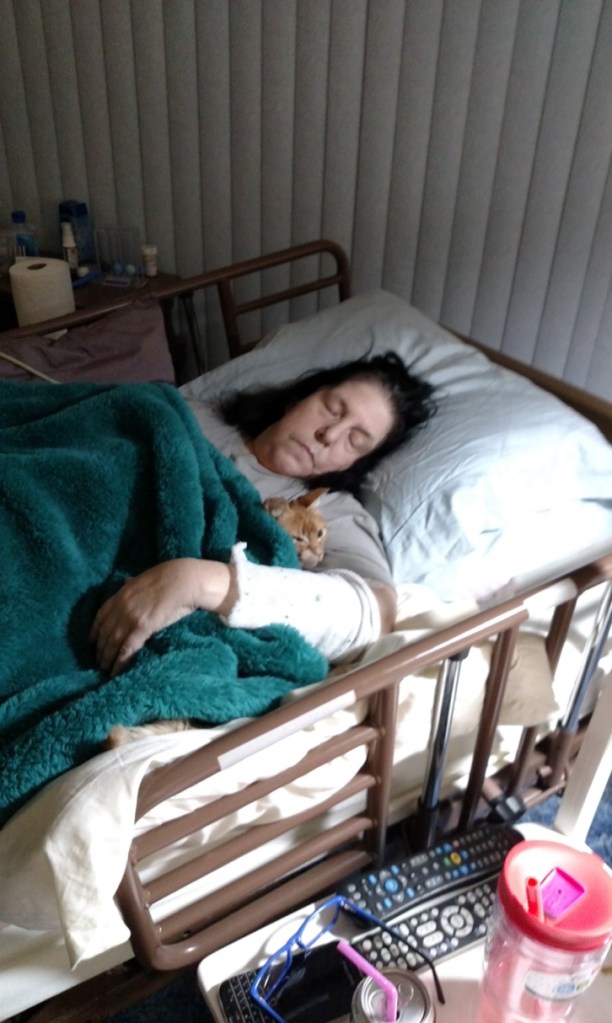
Susan E. Lawrence’s condition at the time of Hartman’s betrayal. (Author’s photo, 2018)
He was already coming to the same hospital to visit David Scott Milton, his prison writing teacher, and stopped by the intensive care unit briefly after learning Milton had already been discharged. My friends were horrified by his demeanor, as he spent most of the time talking about himself and how he was being pursued by literary agents and Hollywood producers who, captivated by his astonishing transformation and miraculous release from prison, wanted to sign him for book and movie deals. He barely mentioned my illness and never asked to speak with any of my doctors about my condition and chances for survival.
I was in the hospital for many more weeks, and then seriously ill for many more months after returning home. Hartman’s communications became less and less frequent and finally ceased altogether. Four months after his release from prison, while I remained bedbound and unable to walk, I sent him an email asking whether he was still my brother. He sent a curt, cold reply that now that he was free he needed to extricate himself from his relationship with me, because he wanted “positive” people in his life, and I was not among them, being too damaged by the effects of childhood trauma from which I had deliberately chosen not to recover. “Be adult about this,” he wrote, demanding I send him all materials in my possession relating to the Other Death Penalty Project.
I never heard from him again. Once he had everything he needed from me, he threw me away like a piece of trash even as I was facing my death.
***
Many months later, it occurred to me one day just out of curiosity that since I had paid for Hartman’s parole attorney, I should at least read the hearing transcript to see what I got for my money. In California, parole hearing transcripts are public and can be obtained simply by emailing BPHSuitabilityHearingTranscript@cdcr.ca.gov.
When Hartman’s transcript arrived in my inbox, I was rendered absolutely speechless by its contents. It revealed he had been sentenced as a juvenile to Youth Authority for crimes against women, specifically rape and kidnapping:
PRESIDING COMMISSIONER RUFF: And then, you have a rape.
INMATE HARTMAN: Yes, sir.
PRESIDING COMMISSIONER RUFF: Forcible rape.
INMATE HARTMAN: Yes, sir.
PRESIDING COMMISSIONER RUFF: Okay. And so, then what happened in this case?
INMATE HARTMAN: Well, I remember exactly what happened in this case. We saw this girl standing by her car. Came over to her and said, hey, you want to get high? And then, just — I grabbed her. And we pushed her into the car. It was her car. We drove the car around behind a — I think it was a department store of some kind if I remember right. Some kind of store, like, the loading area behind the store. And we raped her. I raped her. I forced her to give me oral copulation, raped her repeatedly. I don’t remember exactly how many times, but it was over a period of some time.
(There are actually two rapes discussed in the transcript, one of which was an assault Hartman committed on a 13-year-old girl for which the charges had been dismissed. The transcript also considers his crime of the kidnapping of another woman.)
Throughout the years of our relationship, Hartman knew I valued honesty and integrity above all else, and he made sure this was the persona he showed me. Once, he asked me to watch a movie called Sommersby, a Civil War-era film starring Richard Gere and Jodie Foster. It was the story of a brutal man who had recreated himself as a respectable human being and chose to be executed rather than harm the people he loved. “If you understand Sommersby, you’ll know who I am,” he told me. Oddly enough, when I mentioned the film to him a few months later, he had no recollection of it at all.
So what disgusted me more than the graphic description of his crime was the fact that Hartman had concealed it from me, all the while presenting himself as a redeemed and honorable man, accepting and encouraging my committed efforts to secure his release from prison.
And Hartman didn’t just deceive me about being a rapist; he likely deceived everyone. His massive body of published works contain no mention of his crimes against women, although he wrote freely about the murder of Mr. Fellowes and other acts of extreme but nonsexual violence. In the fifty articles Hartman contributed to the Hamilton College Prison Writing Archive, not one alludes to the rapes. In Mother California, he glosses over the 5-year sentence he received for rape and kidnapping this way: “I had spent most of my teen years in and out of a variety of juvenile facilities for one infraction or another.”
Not only that, Hartman must have duped the numerous prominent people with whom he corresponded and whose support for clemency he obtained: legislators (including former Senate Majority Leader Gloria Romero, who had introduced a bill in 2007 to expand Honor Programs throughout the state); celebrities (including Scott Budnick, producer of the Hangover movies turned prison reformer); and criminologists, professors, physicians, researchers, and publishers, as well as his many “fans” worldwide who, deeply moved by his writing, sent letters to Governor Brown advocating for his release. Because the records of the rapes were sealed as a juvenile offense, Hartman likely believed he could withhold the truth with impunity. None of his ardent followers had the opportunity to make an informed decision as to whether or not they wanted to support a convicted rapist (who, as the transcript also revealed, had received no sex offender treatment and likely met the criteria for a sexually violent predator) before imploring the governor to show mercy and give him a second chance.
The revelation of this information was all the more shocking because Hartman’s daughter was conceived in prison during a conjugal visit. In California, conjugal (or as they are now called, “family”) visits have been permitted since 1968, when Governor Ronald Reagan approved a pilot program at Tehachapi State Prison. Sex offenders, including juvenile offenders, have always been prohibited from having conjugal visits. The most likely explanation for why Hartman was allowed to have them is his sex offender status had escaped detection, as it was common practice in the 1980s for prison staff to consider only an inmate’s commitment offense, which in his case was murder.
In my assessment, the transcript exposed how Hartman’s treatment of me demonstrated a nexus to his crimes of rape and murder, in that he takes what he wants with no concern for the feelings and rights of others or the suffering it causes them.
In 2013, while attending law school, I made the excruciatingly painful decision to leave Catalyst, and a new Chief Executive Officer, Dave Mashore, was appointed. As my former employee who had worked with me on the prison Creating a Healing Society program, Mashore knew Hartman. In fact, many years before, when I had refused his attempts to pressure me into smuggling tobacco into the prison, Hartman secretly approached Mashore and convinced him to do it. The day I witnessed Mashore pull a wad of tobacco out of his shoe and hand it to Hartman nearly ended my relationship with both of them.
Over time, through heartfelt apologies and expressions of remorse, Hartman was able to persuade me to re-establish my belief in his decency and continue our connection. When I asked how he could possibly think it was acceptable to do such a thing, he replied, “I saw a way to get what I wanted, and I went for it.” I did not understand until many years later how profoundly revealing this statement was of Hartman’s character.
Mashore, on the other hand, never took responsibility for his role in this debacle and our relationship was permanently destroyed. For a number of reasons I chose not to fire him, including that we had trained in karate together for fifteen years and he had closed his business in order to join Catalyst. I also believed I, too, played a role in this mess because I failed to report Hartman to the prison authorities. So it should not have surprised me, then, when I saw in the transcript that at the same time Hartman was planning his exit from my life, he was once again surreptitiously colluding with Mashore, this time to get a job at the organization I had founded and loved so much:
INMATE HARTMAN: Okay. I have four job offers.
DEPUTY COMMISSIONER DENVIR: Okay.
INMATE HARTMAN: I have a job offer from the Center for Restorative Justice Works, Amalia (phonetic) Molina (phonetic)—she’s the one who does the Get On the Bus Program. I have a job offer from Wayne (phonetic) Kramer (phonetic) at Jail Guitar Doors which does rehabilitative programming in prisons and jails. I have a job offer from Dave (phonetic) Mayshore (phonetic) of Creative (sic) Catalyst Foundation. And I have a job offer from a — a totally different thing, it’s a sales place down in Orange County. I’m not, frankly, that interested in that. But it was — it’s a good job offer.
DEPUTY COMMISSIONER DENVIR: Which is of greatest interest to you, in terms of the one you’d most like to accept?
INMATE HARTMAN: I plan to start working at Jail Guitar Doors as soon as possible, assuming I was let out. And then, I will probably work at the Center for Restorative Justice Works as well. And then, when I — I’m out of transitional housing, I would probably be working at the Catalyst Foundation.
According to the Catalyst website, at the time of this writing Hartman is still working as its Prison Programs Specialist, five years after his release.
As the transcript shows, Hartman had other employment opportunities; he did not have to work at Catalyst. But he clearly had no concern for the heartache I would certainly feel when, after treating me so cruelly, he went to work at the organization that was the symbol of my love for and devotion to my husband Sonny. It is a testament to his deficiency of conscience that he would even consider this idea; but not at all surprising, because it is an act of unmitigated power and dominance, consistent with his history as a rapist. Whenever I think of Hartman polluting my memory of Catalyst with his presence, I feel defiled and violated. That is, until I remind myself Hartman is a very disturbed man who wore his mask so effectively he was able to write his way out of prison.
***
That Hartman was a convicted rapist and that he had desecrated my memory of my dearly-loved Catalyst were not the only things I learned from the transcript. I also discovered he had deceived his readers for decades with his signature tagline, “When I was nineteen I killed a man in a drunken, drugged-up fistfight,” which was a lie designed to minimize the heinous nature of his crime:
DEPUTY DISTRICT ATTORNEY WALKER: Does he [Hartman] ever recall characterizing in one of his apology letters to the victim’s family the incident…as a drug induced fistfight?
[Presiding Commissioner Ruff allows Hartman to answer.]
INMATE HARTMAN: I think I did.
DEPUTY DISTRICT ATTORNEY WALKER: Does the inmate really believe this was a fistfight?
[Presiding Commissioner Ruff again allows Hartman to answer.]
INMATE HARTMAN: No. It was an attack. And I realize that it was an attack.
DEPUTY DISTRICT ATTORNEY WALKER: And I believe the evidence at the trial, the evidence in the Probation Report, the Appellate Opinion is that Mr. Hartman actually jumped on Mr. Followes (sic) off the table or a bench and onto him? Does Mr. Hartman admit that he did that? Because I didn’t see that in the writing about the description of the crime.
[Presiding Commissioner Ruff again allows Hartman to answer.]
INMATE HARTMAN: After I hit Mr. Followes (sic), I stepped towards his head and stomped on the top of his head about 12 times.
Prior to being called out on this lie by Deputy District Attorney Walker, Hartman had used this “drunken, drugged up fistfight” catchphrase countless times in his writing to describe the crime that earned him LWOP. This includes the opening sentence of Mother California, his award-winning essay A Prisoner’s Purpose, and in numerous articles written as a contributor for the Huffington Post. What is astonishing, though, is even after the parole hearing and his release from prison in 2017, he continued to delude his audiences with the “drunken, drugged up fistfight” rhetoric, including in Life After Life (an essay published in 2019 in Harper’s), and in a presentation to students at Hamilton College the same year in which he “reflected on his time incarcerated.” After this, someone must have confronted Hartman about his use of this language because it no longer appears in any of his published writings, and his Wikipedia page was revised to state he was “convicted of murder at age 19 for beating a homeless man to death.”
In 1993, Hartman’s essay, Murderer Is Filled With Remorse For Sin, perhaps the first he ever published, appeared in the Long Beach Press-Telegram. While it makes no mention of the rapes, it is possibly the only thing Hartman ever published that was completely honest about the murder of Thomas Allen Fellowes.
“Who mourns Thomas Allen Fellowes?” wrote Hartman. “I do.”
“Thirteen years ago, I killed Thomas Allen Fellowes in a senseless act of brutality on the grounds of Ramona Park in Long Beach,” he continued. “It had been a long night of drinking and drug use and fighting in Santa Ana when I happened upon him, lying on a bench at the park. I harassed him, and after a few heated words, I struck him. He went to the ground. Enraged and insensible, I repeatedly kicked him until he was dead. I started it, I pursued the confrontation, it was wholly my fault.”
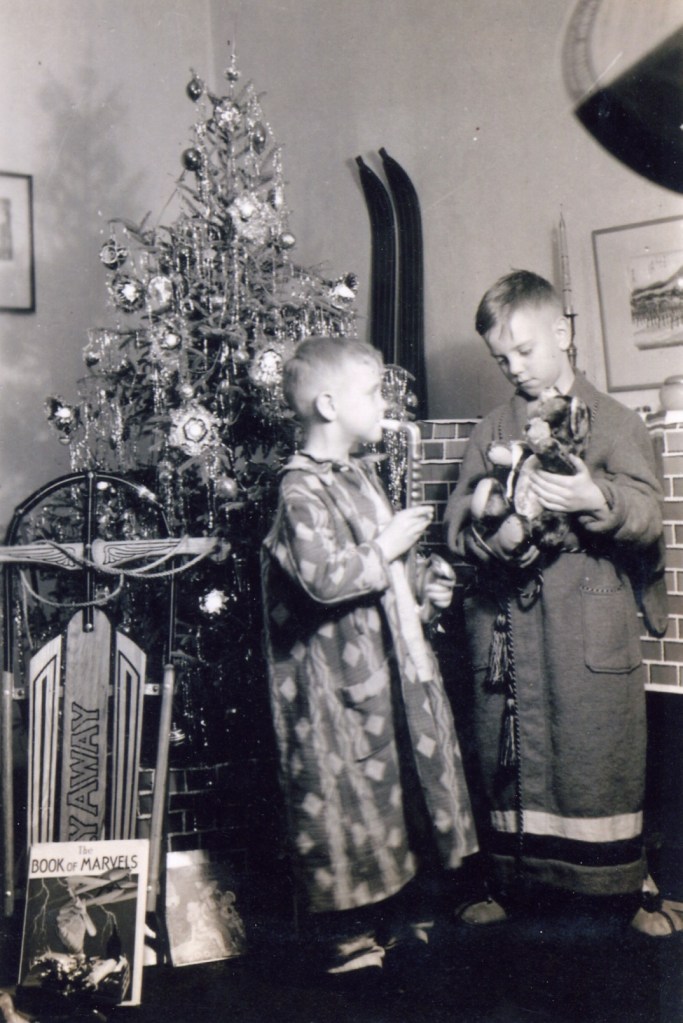
Thomas Allen Fellowes as a child, left, 1938 (public photo, Familysearch.org)
When I read that essay early in our relationship, I was filled with respect for the degree to which Hartman took responsibility for his horrible crime, and for the level of grief and remorse he expressed. It was one of the reasons I felt I could trust him. At that time, I still believed all human beings were capable of redemption, no matter how heinous their acts; and that, as Bryan Stevenson wrote in Just Mercy, “We are all worth more than the worst thing we’ve ever done.” I already had faith in Hartman, so later, when I began reading about the “drunken, drugged-up fistfight,” I paid it no mind, considering it nothing more than artistic license.
Hartman’s betrayals were devastating because they created a crisis of faith with which I struggle to this day. In essence, I feel he murdered a deep-rooted and intrinsic part of me. Who am I now without my cherished hopeful beliefs about the nature of humanity? The person I was when I wrote Creating a Healing Society, who knew with certainty we can change the world through widespread recovery from childhood trauma, has become a stranger to me and may, in fact, no longer exist. I cannot tell who or what is real, and am adrift in a confusing and frightening world where my old touchstones are gone and I have found no guiding principles to replace them.
And who am I now that I have been personally touched by evil? Although my life has been deeply affected by my own childhood trauma, I can see plainly that none of it was done intentionally. My parents were themselves victimized as children, and did not have the resources or abilities to work through their traumatic experiences so they did not pass them on to me. But their goal was not to harm me; they cared deeply about my suffering without understanding their actions were the cause. In contrast, I consider Hartman’s actions to be evil, because he purposely manipulated, deceived, and inflicted unspeakable cruelty upon me, not caring about the consequences as long as he got what he wanted. It was the insidious nature of his conduct that caused the most damage.
Of course, not all relationships work out, especially after a long incarceration. Hartman could have ended ours in a respectful, humane, and compassionate way; but for reasons known only to him, he chose to shame, humiliate, and ghost me instead. I even heard from mutual acquaintances with whom I shared my experience that he justified his conduct with the repulsive lie that he had no choice, as I was pursuing him for an unwanted romantic relationship.
In reality, nothing stopped Hartman from coming to my house, sitting beside my hospital bed, and talking to me directly and honestly about his decision. It would have been terribly painful, but at least it would have been clean; and I would not still be haunted today by so many unanswered questions, not only about our relationship but also about my life’s purpose and the causes to which I devote myself.
Apparently, that is the work I have been given for this season of my life. So far, I have no clear answers.
***
At a bizarre press conference called by Norman Mailer in 1982 to plead for a lighter sentence for Jack Abbott after his conviction for the killing of Richard Adan, he railed about how writers and artists should be above the law and given special dispensation, no matter what their crimes.
Mailer spoke arrogantly, using his immense intellect as a bludgeon. “In order to save this country’s honor and integrity, we’re willing to gamble with the nuclear future of the world, correct?” he declared. “So, yes, I’m willing to gamble with the safety of certain elements of society to save this man’s talent.” He continued, “Adan has already been destroyed. The only way we can ever get anything out of this tragedy that Richard Adan and his family have gone through, that at least Abbott should become a writer.”
Twenty years later, in a 60 Minutes interview with Ed Bradley, Mailer had clearly thought much more seriously about his role in Adan’s death. “I think a lot of people are partially responsible, and I’m the foremost of them,” Mailer said. “It’s obviously something I’m going to carry for the rest of my life.”
Unlike Mailer, Atlas died before learning the truth about Hartman and never had to grapple with his role in his release. He never had the opportunity to review the parole hearing transcript (including the section below) and understand what evil he had unknowingly helped unleash on society through his global promotion of Hartman, his writing, and the deception he perpetrated on people all over the world whom he conned into helping him get out of prison:
DEPUTY DISTRICT ATTORNEY WALKER: On behalf of the District Attorney’s Office of Los Angeles, we are opposed to a finding of suitability for Mr. Hartman….The concern for The People remains with…the lack of insight with respect to the rapes that were committed and that would appear that Mr. Hartman is probably meets the criteria to have reviews done that are on the sexually violent predator commitment. And given that, that’s a huge, huge concern of The People that Mr. Hartman be considered suitable for parole without exploring further while in custody that aspect of his criminal behavior.
Parole board commissioners are not required to adhere to the recommendations of the District Attorney; however, they must evaluate the prisoner for evidence of deception, manipulation, and minimization of the crime, findings of which would make him or her unsuitable for release. In Hartman’s case, the commissioners could have probed into why he never mentioned the rapes in any of his published writing when he had no hesitation in writing about the murder. They could have questioned him about whether his champions and “fans,” most of whom knew him only through his writing, had a right to be informed he was a convicted rapist before he asked them to support his quest for clemency. They could also have explored how he conceived a child in prison when sex offenders, juvenile and adult, are prohibited from having family visits. Finally, they could have challenged the credibility of Hartman’s professions of responsibility and remorse when he had the utter audacity to characterize the murder as a “drug-induced fistfight” in a letter of apology to Mr. Fellowes’ family. But they did none of those things. Could it simply be the commissioners avoided these details because they were enthralled by Hartman’s star power and the sheer number of highly influential individuals, including Atlas, who advocated for his parole?
***
Winston Churchill once said, “Of all the talents bestowed upon men, none is so precious as the gift of oratory. He who enjoys it wields a power more durable than that of a great king. He is an independent force in the world.”
For prisoners, separated from society and denied free communication with the outside, writing is their oratory. Gifted prison writers can be a force for good, educating the free world about abusive conditions of confinement and advocating for positive change through sharing their lived experience. They can also be, like Hartman, individuals who use their intellectual prowess and charisma to mesmerize, charm, and manipulate the unsuspecting public to accomplish their selfish aims. It is up to all of us who involve ourselves with prisoners, whether professionally or personally, to approach them with a healthy skepticism, ask important questions, and refrain from giving our blind support.
I sure wish I had.

Susan E. Lawrence, M.D., Esq. is a nationally renowned innovator, physician, lawyer, and nonconformist policy advocate connecting the impact of individual childhood trauma with our most serious societal and global problems. She is an advocate for those wounded by childhood trauma who are enduring life without parole sentences, whether through physical confinement in prison or emotional confinement as a result of experiencing irreparable harm. She is also an expert in the impact of psychopathy and the dark personality traits on criminal justice reform and society. Susan is the Founder and CEO of the Center for Life Without Parole (LWOP) Studies, a nonprofit organization helping California prisoners serving this cruel sentence and working towards balanced approaches to its abolition. She can be reached here.
 The Collidescope