
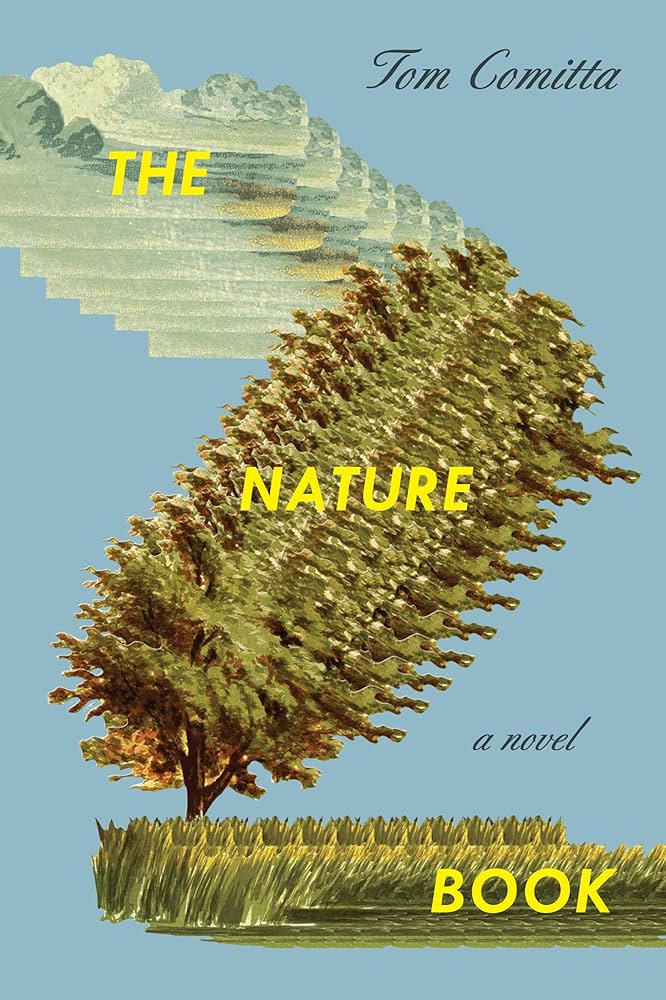
Successful conceptual art fulfills two criteria: first, the concept it’s based on is a compelling one, and second, it offers not only a concept, but also a rich aesthetic and sensory experience. Tom Comitta’s The Nature Book (Coffee House Press, 2023) satisfies both these criteria; it’s a book that deserves not simply to be contemplated as an artistic gesture, but to be entered into, dwelt inside of, experienced to the full.
Described as a “literary supercut,” The Nature Book collages nature descriptions from 300 canonical English-language novels, weaving them together to form a new narrative—one in which humans and human-made objects are entirely absent. Comitta has organized these fragments of found text into what they describe as “macropatterns” and “micropatterns.” Macropatterns consist of things like certain settings (jungles, oceans, outer space) or certain times of year (winter, summer). Within these macropatterns, micropatterns were identified, such as different times of day, different weather patterns, or different animals specific to each macropattern. This organizing schema is as interesting as the premise of the book itself, and is responsible for one of the book’s greatest achievements: its implosion of human time scales.
The result of the supercut structure, in which descriptions of the same entity or occurrence are placed next to each other, is that “events” in The Nature Book have a kind of stuttering quality to them—when something happens, it often happens multiple times in quick succession, as if seen through the refractive eyes of an insect. For example, one chapter narrates the transition between summer and autumn. The first paragraph of the chapter states that “Summer ended, and within a few hours the autumnal moon had risen.” But in fact summer has not ended—it goes on ending, repeatedly, for the next few pages, each successive paragraph narrating that end over again. Successive sentences and paragraphs cannot necessarily be assumed to be chronologically successive. Comitta doesn’t violate the arrow of time; fragments like “night was falling fast” will always precede ones like “the night advanced.” Time moves generally forward. But within that forward motion, there’s a subtle back-and-forth wiggle, a disorienting sense that each event contains a million instances of itself. The effect of this is twofold: the book summons the deep history of our planet, evoking four and a half billion years’ worth of summers ending. At the same time, it also offers a cubist portrait of each individual event—the end of this particular summer seen prismatically, from multiple angles simultaneously.
But in fact, there’s a third effect: the supercut evokes not just the repetition of earth’s cycles, but the repetition of literary tropes as well. Although The Nature Book is billed as “post-human,” it is, of course, anything but. At least as much a reflection of human writing practices as it is a reflection of the nonhuman world, it reveals interesting patterns and tendencies in our ways of describing and narrativizing “Nature.” One blurber describes the book as “biblical in tone;” the fact that such a book has a predominant tone is interesting in itself. Much of the language could be characterized as grand, epic, baroque, reverent, sublime, or intensely lyrical. Despite the fact that the source texts span nearly three and a half centuries, the dominant impression is vaguely reminiscent of 19th-century Romanticism. When tonally aberrant language appears (and it does, not infrequently, but infrequently enough to be identifiable as aberrant) it comes as a relief, a pleasure, a surprise. There are moments of humor, slang, and, occasionally, genuine linguistic experimentation, as in this rollicking passage:
Gosh, she,
huzzy, tow—Terplahs, & what difference
make!
Go brash, Tophata
offat—Xcept when tumble
boom! O Boom de boom dey
the sea is the sea—hie bash
rock—ak—bedoom
Shurning—Shurning—plop
be dosh—
Such moments offer welcome splashes of playfulness to a linguistic terrain that otherwise tends towards aggrandizement. Just as the supercut form presents us with a multitude of sunsets in quick succession, it also presents us with a multitude of humans writing about sunsets. Again and again we marvel at them, again and again we gush about their beauty. How striking it is, amid all this gorgeous, adulating prose to suddenly find Joyce’s “snotgreen” and “scrotumtightening” sea, or a description of the moon shining “white as cocaine”—a phrase which Publisher’s Weekly called “anachronistic,” thus illustrating my point: there is a kind of archaic vibe to this book, in spite of its frequent use of language from 20th– and 21st-century texts.
Might we conclude that the Western literary canon has been a little too one-note on the subject of “Nature”? In the preface to the book, Comitta writes that “The natural world described by Austen and Dickens is different from that of Plath and Baldwin and still farther from the early works of DeLillo and Atwood.” This is no doubt true—but are they different enough? Is there not room for greater experimentation, greater diversity in our depictions of the nonhuman world? “Nature” in The Nature Book often appears on a pedestal. Whether as wondrous beauty or sublime horror, it occupies a transcendental realm, a sacred realm. It is precisely that reverencing, distancing attitude which has made “Nature” into something that is “over there,” separate from humans. Timothy Morton, a theorist who has repeatedly insisted that we need an “ecology without Nature,” puts it this way:
Thinking things as Nature is thinking them as a more or less static, or metastable, continuity bounded by time and space. The classic image of Nature is the Romantic or picturesque painting of a landscape. There it is, over yonder— on the wall in the gallery. And it has over-yonder-ness encoded throughout it: look at those distant hills, that branch suggesting that we follow the perspective lines toward the vanishing point, and so on…. Objections to wind farms and solar arrays are often based on arguments that they “spoil the view.” The aesthetics of Nature truly impedes ecology…
Conceiving of Nature in this way impedes a recognition of ourselves as always and forever embedded in a series of overlapping ecosystems. By imagining ourselves outside of nature, we struggle to recognize the impact we have on other life forms. Nature is not “over there”—it’s not anywhere. There is no Nature, only beings and relations between them.
As it turns out, The Nature Book makes this fact abundantly clear. Its ostensible goal of removing the human in fact demonstrates the impossibility of such a removal. From the metaphors it employs (spider webs spread “like whispered gossip from tree to tree” and a snowy plain lies so still that it “suggested photography”), to the spatiotemporal positioning implicit in much of its syntax (“A kind of desert country began here”), The Nature Book shines with a film of unmistakably human fingerprints. We are inextricable—which is, perhaps, why attempts at extrication are so compelling. By embracing this impossible task, projects like The Nature Book welcome the inherent paradoxes of being a self imagining an other. We can imagine and we can’t imagine, simultaneously. We will never not anthropomorphize. But surely a little anthropomorphizing is better than the alternative: never considering nonhumans as anything other than objects of our gaze.
For all the critiques of Western literature which are implicit in the premises of The Nature Book, there are at least as many celebrations of it. The truth is, there are some unbelievably beautiful passages here. This language is evidence of our incredible capacity to lavish attention, and love, and astonishment on the nonhumans with whom we coexist. They have always been there, creeping into our narratives, shaping our ways of thinking and writing and being. What an exciting time it is right now, as we watch them begin to shape our literature anew. Strange, provocative, and continually surprising, The Nature Book provides an utterly original readerly experience, one which will transform your understanding of books and Nature both.

Alyssa Quinn is the author of the novel Habilis and the chapbook Dante’s Cartography, and is an Assistant Professor of Creative Writing at Kenyon College. Find them at alyssaquinn.net.
The Collidescope is an affiliate of Bookshop.org and will earn a small commission if you click through those specific links and make a purchase.
 The Collidescope