
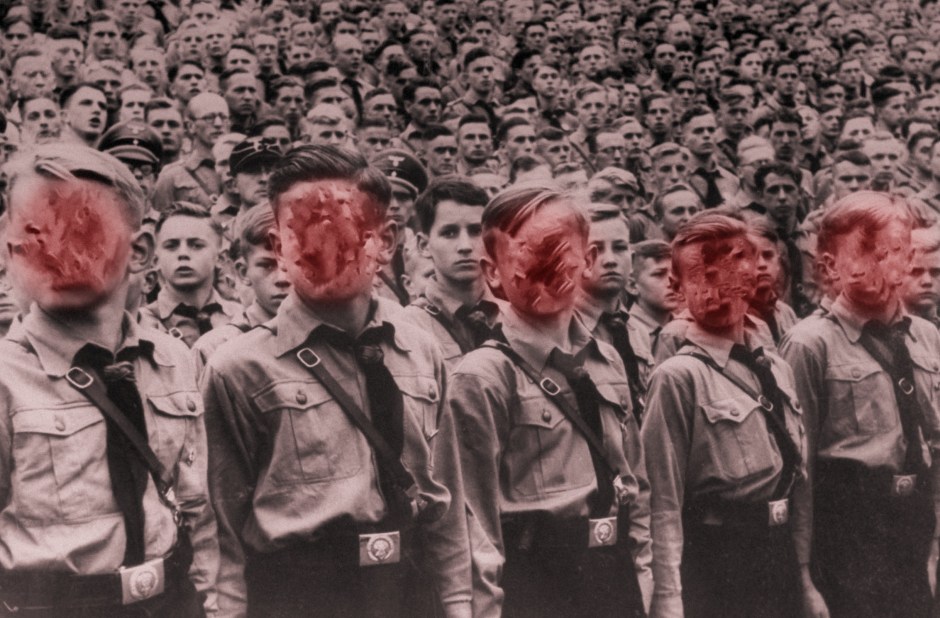
Shared culture, by definition, is ordinary. It is what we know. It is what our neighbors know, our friends, our family. It is the substance of our lives that we take for granted as being, in a sense: common. Yet how is it that something so ordinary becomes something else, something otherworldly, an anomaly in the larger historical picture of humankind?
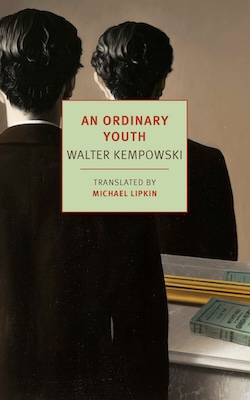
Walter Kempowski’s newly translated book, An Ordinary Youth, centers around the concept of culture: The slow seepage of culture, of ordinary things, of maddening trajectory and inertia that feels almost too banal to fight against, or, often, not even recognized at all. Yet it is these things that lead Kempowski’s youth from blissful boyhood games into one of the most prominent and awful historical events in the modern era: WWII and the Holocaust. With hindsight, we can see this. We can analyze it. We can deconstruct and apply blame. Yet, An Ordinary Youth does not feel like an analysis, a prognosis, or a prescription. Instead, the book serves as a carefully made collection of moments that otherwise seem to create disparate images but, taken on the whole, introduces many problems for the reader to square. Perhaps even more so for the modern, monolingual American reader.
The book’s beginnings are mundane and have been described as tedious, lulling one into a “mild torpor.” Yet, this is precisely the point that Kempowski is making, that perhaps the ordinary everyday sense of “mundane” can collectively add up to the word’s other connotation, the one that Melville uses when he says, “As if… the great mundane soul were in anguish and remorse for the long sin and suffering it had bred.” At the same time, the writing itself is in no way turgid. And even though the translator, Michael Lipkin, has admitted that the English version of the book comes across as more posh than its original direct style, its poetic nature still shines through.
This poeticism is a slow burn and quite a bit different from many of Kempowski’s German contemporaries who often fill every page to the brim with text. An Ordinary Youth, by contrast, has a large amount of white space, not only an abundance of paragraph breaks but full double-spaced stops and starts. Taken on the whole, the reader finds many meditations with breathing room in between. Take these musings from an early chapter, for instance, starting with the opening:
No homework was assigned for Wednesday and Saturday evenings as we had Hitler Youth those nights. When the bulletin said, ‘Bring your athletic gear,’ it meant there would be boxing.
There were extra thick gloves for Youth members so that it didn’t hurt as much. But it still hurt enough.
Later, a tone is set, boys going to a camp retreat, eager to prove themselves men:
‘The Holy Ghost will be coming tonight,’ [Eckhoff] said, ‘that much is clear.’
He was referring to the practice of someone being pinned down and smeared with shoe cream, or beaten and held under a water pump.
From here, the youth on retreat sings several songs and recites several poems. Later, while playing in the woods, we get a scene of imaginative children:
We carved a ship out of bark, pointed in front, straight at the back. We bored a hole in the middle and stuck a branch into it as a mast. We built a harbour out of moss and stones, and used a fir cone as a lighthouse.
‘Shame there is no stream here.’
Not three sections more, young Walter is in the middle of wrestling to capture the flag from another Youth member and gets hit upside the head with a bucket. To which young Walter declares:
I was a real man. I could be relied upon. Eckhoff had even cried a little.
Concluding with:
Robert teased, saying I looked like Nizam of Hyderabad. It had been a long time since I’d felt so well.
This poetic nature is a striking feature of Kempowski’s writing style as well as his subject, which one can find irksome at times, hearing about the depth and breadth of everyday civilians reciting Goethe, Hitler Youth songs, golden era Jazz, Ovid, Hymns, long dead propaganda, and nationalist poems, all hard to swallow with the horror of these same people’s destruction and destructive acts lodged in the back of the throat. As Lipkin says, aimed even at German readers of the original text, “the very obscurity of the references is an essential component of Kempowski’s realism, which tries to capture a sense of the living world as a forest of historical signs, each clamoring to be deciphered.” As expected, this rift has only widened for the English-speaking world, separated by several decades, and what is to be found in that gulf now is the question of culture. What does social progression look like now that we have all but abandoned a continuous mode of reference, one where each idea is pulled from the past to build the present? Are we better off now, overwhelmed with new content generation, up to and including reinventing the old unconsciously? How does such a strong sense of culture and community turn sour? It challenges the idea that we have progressed into something better. For instance, there is a moment in the book when a foreigner and friend of the Kempowski family is arrested for flying a plane around the town and mapping bomb sites. Walter’s mother goes to the jailer with food and pleads for his release on the grounds that the young man is only an idiot, not a spy. This eventually works, and the young man is released and goes to live with the Kempowskis for a time. Scenes like this one are the hardest to choke down because it’s difficult to imagine, in our current time and place, this sort of communal intervention as a plausible means of correcting a judicial wrong. In a time where our judicial system seems to have steeled itself from public opinion and discretion is at an all-time low, one can’t help but suffer a feeling of loss. Yet, this same communal discretion seen in the book has betrayed and torn itself apart.
Overall, An Ordinary Youth serves as a historical document more than it does a novel. Even still, as historical texts go, Kempowski’s is different. This is because the book refuses to abstract meaning into summations. Instead, Kempowski chronicles all the little pieces of everything—never once adding them up himself but leaving that to the reader. Or perhaps challenging us not to add them up, not to find a direct pathway from one thing to another that simply explains the darker facets of the human psyche, but to relay the tangled mess as it was, as still is, into our minds so that we have chance to decide what our many different meditations and glimpses make of our lives. Do the thoughtless imminences of our culture foster division and hatred? It seems Kempowski thinks that this causal relationship moves the other way around and that our cultural subjectivity is bred from those many unexamined internal pieces of our collective, mundane soul.
Kempowski’s book is highly recommended reading for anyone tired of the pedestal versions of WWII, those bureaucratic summations and reconciliations that fail, and perhaps should fail, to offer comfort to us about who we are and how we are not like those we despise.


Brenden O’Dell lives in Northwest Portland, OR with his spousal equivalent and cat. When not working on his novel he can be found playing jazz keys in the window of his apartment. More of his work can be found in the Wake Review and Rubbertop Review.
The Collidescope is an affiliate of Bookshop.org and will earn a small commission if you click through those specific links and make a purchase.
 The Collidescope