
The pandemic forced me, for better or worse, to connect better with writing that explores nostalgia or things we no longer have access to. When we shut ourselves inside, we were given a lot of time to reflect on our lives and what used to be there. For me, I satiated this hunger by shopping online and binge-watching television shows from the nineties, which helped pass the time. However, the inevitable feeling that something was missing remained. I knew I wouldn’t be able to get back any of this, the initial feeling of experiencing mundane childhood experiences for the first time. The taste of my favorite food was gone because the person who cooked it died a few years ago. My childhood home, likewise, belongs to someone else now.
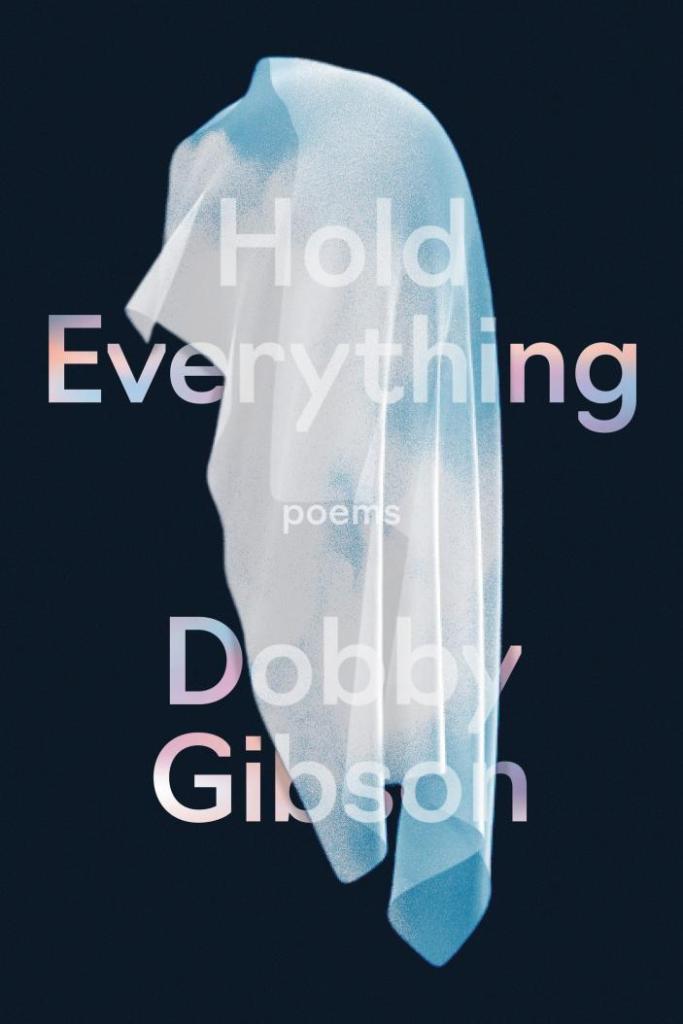
I read Dobby Gibson’s Hold Everything (Graywolf Press) as a collection of poems that intend to reclaim these moments, but it has the impossible task of doing so with memories that don’t belong to me. Nonetheless, Gibson’s collection works on so many levels: it confronts the issue of relatability—I mean this as the connection between the reader’s reality and the reality of the speaker, of course—through a mixture of hard imagery and surreal details, seemingly dreamlike.
One solution to the issue of memory and relatability can be summarized in “How to Become a Poet,” which studies the way mundanities speak to poets almost as a muse:
For Bishop, it was the twenty years she needed
to describe a moose. For Dickinson, a fly buzz.
For me, it’s the impossibility of a Wednesday,
it’s the note Kath left on the fridge this morning:
Chickpeas
Semolina flour
When will you be home? (54)
Memory is the pursuit of trying to figure out what all of this is about; therefore, it’s fitting that Gibson’s work displays a penchant for speaking to itself through the volta. An early example of this occurs in “This Is a Test of the Federal Emergency Management Agency Wireless Warning System,” which works hard to establish an intentionally paranoid tone within the collection. Evangelicals invite the speaker to eat pancakes; democracy is lost; DNA is siphoned out of the air; the simplicity of childhood disappears. Something just isn’t right in the world. Gibson assures us that art keeps us going through hardship before the turn:
For Miles, there was no wrong note,
only what comes next, and it’s had not to fear
what comes next. One summer, the emergency
is the butterflies vanish. The next,
it’s nothing but smoke. What’s really scary
are miniature horses, pink ribbons
in their tails, prancing around the fair
while everyone conceals and carries
and cotton candy fills the air. A fortune
lurks at the center of every grapefruit. (7)
The poetry frequently juxtaposes the issues of adulthood (political instability, paranoia, mental illness) with things that went wrong in our childhoods (in the case of this poem in particular, a bike that has gone missing, among other smaller things). The turn of the poem, though, shows us that we should really be concerned about the smokescreen of normality.
Gibson continues to play with the volta in a string of sonnets, “Hold Everything.” This sequence is drastically different than the American sonnets of Wanda Coleman and Diane Seuss, among others, whom he credits as inspiration; Gibson explains in the notes that this series of sixteen sonnets were written each in the time it takes to drink a cup of coffee. This is surprising, considering the level of refinement throughout the sequence. At the same time, Gibson’s process for “Hold Everything” has allowed him to naturally incorporate his turn of mood and meaning, resulting in an invigorating stream of consciousness:
Another way the day
turns its back on us, swapping masks behind
a scrim. If I believe in anything, this will draw
us closer. A thought, like breath, that comes and goes,
even in sleep. Gently falls the snow onto the swing set
and gently passes the cold through every part of me,
like a grievance. Snow clinging to one side
of each branch, expressing the tree. (35)
I think the intention of the sequence of “Hold Everything” is best summed up with Gibson’s depiction of vulnerability: “Poetry is mostly this, pointing at what’s barely there, the way / the finest lace is mostly holes” (34). The fractured feeling I get in between these sentences is like holes in lace—this is another play on memory. In all, “Hold Everything” is not only an interesting sequence but also inspiring in regard to the creative process. The same can be said of Hold Everything as a collection, which is both extremely individual in its imagery and accessible in its direction.

Garrett Ashley is the author of Periphylla, and Other Deep Ocean Attractions (Press 53, May 2024). His work has appeared in The Normal School, Sonora Review, Asimov’s Science Fiction, and DIAGRAM, among others. He teaches writing at Tuskegee University.
The Collidescope is an affiliate of Bookshop.org and will earn a small commission if you click through those specific links and make a purchase.
 The Collidescope