
Uneasy as I always am, at the edges of a city where it would, however, seduce us to see, for instance, the lovely couch-grass of the steppes grazing the foot of the extravagant erection of skyscrapers… the viscous, interstitial matter of the suburbs, and, on the maps, their cancerous halos, I’ve recently dreamt of a City that opens, cut cleanly as though by a tool and bleeding, so to speak, the lively black blood of asphalt from all of its severed arteries, onto the most fertile, most deserted, most secluded land of a wooded country. What couldn’t one hope of a city, feminine above all, that agreed, on the altar of a single aesthetic concern, to the sacrifice of that excess weight, not so much plethoric as gangrenous… The butterfly, brilliant with the colors of dreams, having emerged from its cocoon to live the briefest and… the most ill-fated of existences, would hardly evoke the idea of that fanciful vision of Paris as a vessel ready to cast off for a journey into the very depths of a dream and, with the vermin of its hull, shaking off the unavoidable remoras, the cables and rotten stays of Economic Servitude. Yes, regardless of the theater where The Golden Age was shown, it might be particularly pleasant… to set down a distracted foot, for once scarcely surprised by the caress of fresh grass, on the front steps of the Opera, to listen over the theater’s sea storms, to the piercing bell of a real cow…
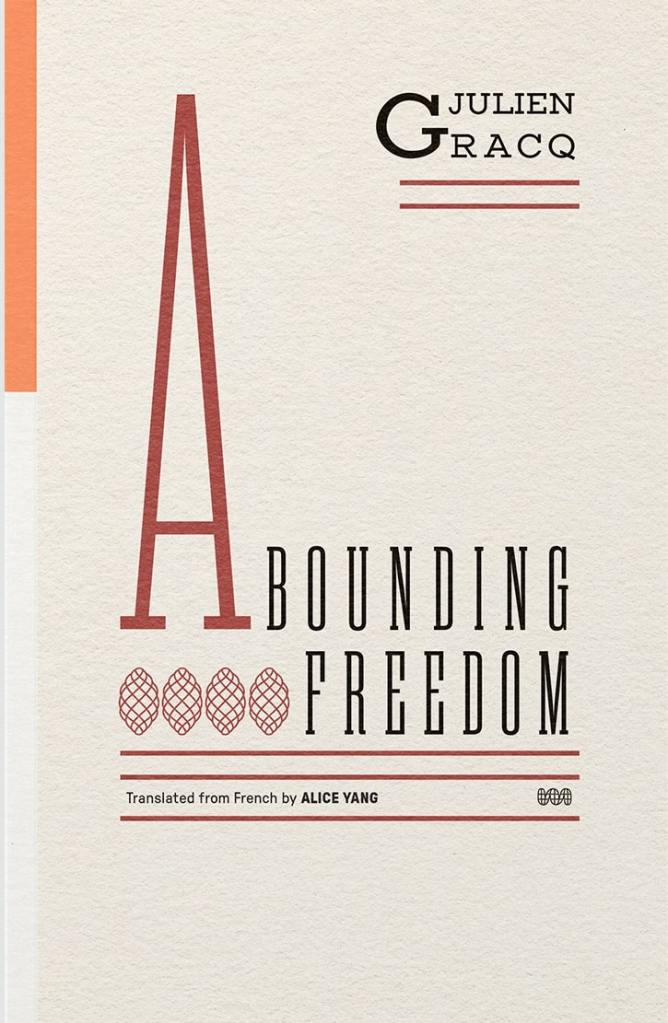
So begins the first poem—the first page—from Abounding Freedom, the new collection by Julian Gracq, translated by Alice Yang. I can offer an excerpt straight from the very first page (the poem being “Toward Urban Galvanization”) because every page is like this, every piece contains the whole. This language is found in each line, the same themes coming up, explored from new angles, renewed. These poems are slippery, strange, crystalline—their imagery unparalleled. To use its own language to describe it: it’s a work of great mineral cold. But if you know anything at all about Gracq, you’ll know this is his reputation. The striking thing for me is that Gracq writes in French, making the success of Alice Yang’s translation a main focus for me. Either she has perfectly realized Gracq’s exceptionally evocative language or, in the case that she is finding her own way to realize what is perhaps directly untranslatable from the French, she is an accomplished poet in her own right. I checked with a couple of native French readers to find that, more impressively, it is both. It’s first and foremost a faithful translation, and where creative liberties have been taken, they have been done so thoughtfully. A literal translation can often be quite awkward and stilted, and the fact that she has succeeded in translating the text faithfully without having it become so, and been able to take creative license when needed to avoid this issue in such a way that a non-French reader cannot see where Gracq ends and Yang begins—such that I questioned whether this (English) language was all Gracq transcribed or all Yang’s poetic ability—is the best testament to her skill. Thus, consider, in her own words, Yang’s intentions with this translation, from her introduction:
I sought to preserve the characteristic length of Gracq’s winding sentences, though I’ve sometimes taken syntactic liberties to recreate the sonority of his prose…. Gracq sought to write what he once called “untranslatable” prose…he aimed—as many French poets did—to create a language almost entirely of his own…. It’s the sonority and linguistic tension […] I’ve tried to capture in these pages.
More specifically, she took liberties with diction to maintain Gracq’s style, and when it came to technical words, she decided to opt for literal translations to “maintain the strangeness of the original.” This hybrid of translation approaches was an absolute success.
For me, this raised thoughts of authorship with regard to the accomplished artistry of the best translators. Obviously, translators do not get the same billing as the author; perhaps partly due to the fact it’s hard for the majority of readers to even recognize a case where maybe a translator should. And it would be up to the author or publisher before an assessment like that could be made by readers anyway. Should this work be called Abounding Freedom: Poetry Translated from Julian Gracq’s French by Alice Yang? I wouldn’t go that far, but it is unfortunate that a translated work is almost entirely perceived and discussed as 100% the author’s work, and when translation is discussed, it’s in order to determine which translation is best—pure utility. Outside of being the translator whose credit is somewhat shirked, this isn’t something one is normally worried about, and it’s not like giving a bigger spotlight to the best translators makes the general issue about “what is lost in translation” less true. But if we can speak of translations of better and worse quality, which we can, we should recognize the degree to which the best translations have shaped our experiences with world literature we otherwise would likely not have had access to. And to this last note, as I continue down this line of thought, I would posit that translators deserve a bigger share of credit inherently, regardless of quality, as in many cases, as with many works reviewed on this site, it is a miracle these books are published at all, let alone translated. It is a miracle that the greatest works of English like Ulysses were published at all, and it is arguably another that they now have the lasting reputation they do. But it’s even more of a miracle these daring works in other languages that do not have the good fortune of Joyce’s reputation get published, and then translated (and again, miraculously, a long list of examples could be given here). The alternative to many translations, like the ones given to all Collidescope-dubbed invisible books, is nothing. So, as it’s my opinion that Yang’s translation is not just inherently worthy for existing as the translated work of a great French writer, but is in fact a translation of high quality—one high enough to trigger these questions and thoughts—I wanted to give her her due. This was also my genuine experience with this work, grappling with both Gracq and Yang as I read.
Now, the fact remains, the original author of the poems found within Abounding Freedom is Julian Gracq. As Yang’s introduction details, Gracq was an outsider who more or less rejected “the literary world”; yet Gracq is ironically one of the most celebrated figures in French literature. He studied geography, which he taught throughout his whole life, was a war prisoner, and began writing at a much later age than most. Most known for his handful of novels, Abounding Freedom is his sole collection of poetry. I admit to not having read his more famous work like The Opposing Shore, and this was my first exposure to him. His aforementioned reputation of being a master of style is certainly retained and apparent within Abounding Freedom’s lines, but I was most taken and surprised by how this collection aligns with my interest in and love of ecology. It’s not a stretch at all to call these poems bucolic and pastoral, and Grace makes frequent and uncharacteristically clear allusions to feeling alienated from cities, and also highlighting the juxtaposition of the natural landscape (the country) and the manmade cityscape. Abounding Freedom contains another, smaller collection at the end of the book—six poems grouped under the title The Habitable Earth. Yang states in her introduction that Gracq intended to capture what he calls “the human plant.” It is here that Gracq is at his most pastoral and “ecological,” though it threads through all of Abounding Freedom: the tension between humanity’s way of living over the last two centuries and Mother Nature is felt in lines like, “…in the blizzard of soot-dusted cotton”, in his poem “Susquehanna River.” With that title, perhaps the expectation is that the poem will be about the beauty of the river, but instead it starts matter of factly, “Along the Susquehanna River freight trains run in the winter…,” making the clash with our industrial lifestyle the focus. The following poem, “Pleasant Morning Walk,” begins with the demolition of a house. Again, bucolic descriptions and moments abound, but so do these. Such instances, and the gorgeous language, snaking and singing, can be plucked out from almost any point in almost any poem. It’s honestly difficult not to constantly quote from the work far more than I am doing; I fear if I start, I won’t stop, and to determine and single out the absolute best examples or most beautiful lines would be far too time-consuming. I hope this reason for my restraint can serve a similar purpose, as the best quotes would, in convincing you of its quality. If you have even just somewhat liked what you’ve read here, no doubt various points within the collection will blow you away, and if you are unconvinced, the collection is so consistent that your mind will likely remain unchanged. It bears repeating that this is a collection where each piece is very much a reflection of the whole—that’s already more than what I can say for most poetry. Given poetry collections are usually quite short, I am happy when I come away from it with just a single poem, a handful of lines even, that embed themselves into my brain-canon. But with Abounding Freedom, I don’t exaggerate when I say phrases like “the froth of leaves” are the floor and are found, as I said, on nearly every line.
When I think about the future, and the ecological changes necessary to ensure it, I wonder what it will mean if things like poetry don’t play a larger role. Ecology is not only a science, data points on a graph, it’s also valuing the sound of the river, the wind in the trees. Art can teach us this, or remind us of this, or simply reinforce it. It can also help us to understand, perhaps at a level one cannot quantify, the general state of imbalance with which we exist. Gracq’s words are doing both. It’s a work that gets to the heart of the matter—regardless of its surrealism and obfuscation—in 2024, despite being written in the 50s, but with great writers, isn’t that always the case?

Matthew Taylor Blais is a filmmaker currently based in Vancouver, Canada. Learn more at Sital Cinema.
 The Collidescope