
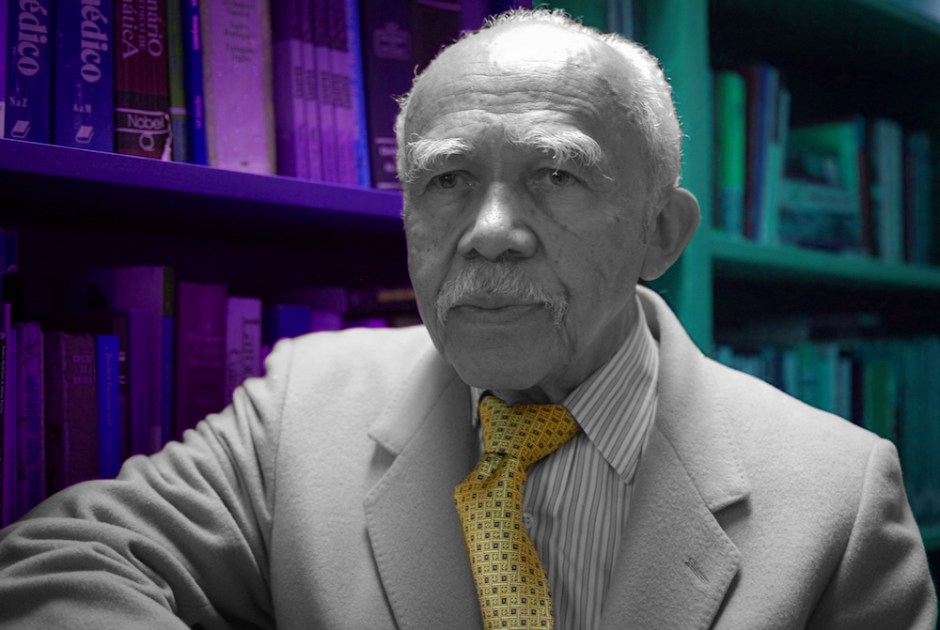
George Salis: In 2024, Incríveis Revelações de uma Minhoca was finally translated into English and published by Tough Poets Press as Incredible Revelations of an Earthworm. What do you hope English-speaking audiences will take away from the book?
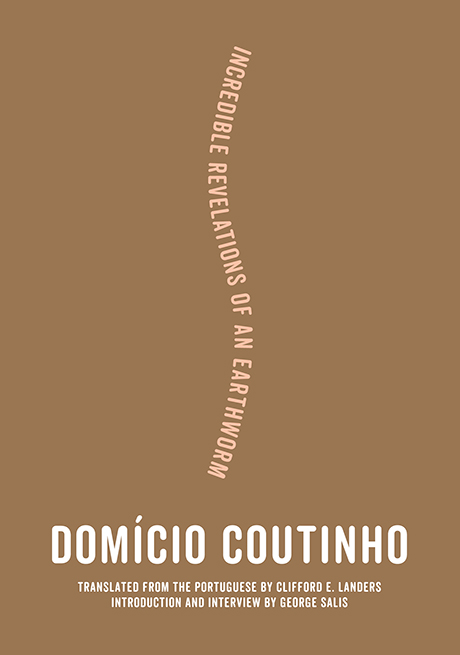
Domício Coutinho: I am hoping that the English language reader will be able to take away from Incredible Revelations some of my ideas concerning man, his place here on earth, and the universe.
GS: Salomônica, your poetry collection from 1975, remains untranslated into English. Do you remember what themes you explored in that poetry collection, and would you want to see that work translated into English next?
DC: Salomônica is, I would say, viewing it from far afield, the work of a young or youngish man. You have to remember that ideas explored in the collection were the remnants of the sixties. I should say the American sixties. Something that I, as an emigre with a family, viewed from a distance. Albeit, being a husband and a father, I could not participate in what was going on. I should say I viewed with some sympathy what young people were doing at that time.
GS: The Brazilian/American and Latin American communities have greatly benefited from your efforts to preserve and promote Brazilian arts and literature. How do you see the future of Brazilian cultural heritage evolving in the diaspora?
DC: This is a difficult question to answer as I am not a fortune teller. However, I do remember what the great Polish emigre poet Milosz said about the Polish diaspora here in America: Philistine, almost completely uninterested in contemporary high culture, either Polish, European, or American. For Milosz, trying to get across what great literature was was an exercise in banging one’s head against the wall. Well, I can tell you that this has most definitely not been my experience here in the USA and, in particular, New York. Here there is an openness among Brazilians to the commanding heights of Brazilian culture. Which is not to say that all is ultra-well with the community here. Indeed, If I could close my eyes, I could readily give in to Milosz-type complaints as to the type of culture that is devoured by Brazilians here in New York. I suppose the most problematic aspect would be the failure of Brazilians, both here in the diaspora and back in Brazil, to come up with a Portuguese-language version of the Boom literature in Spanish-speaking Latin America. It is conspicuous by its absence in the Portuguese-speaking world. Clarice Lispector, while a great writer, cannot be compared to the giants of the Boom period.
GS: As someone who has been involved in both literature and real estate, how do you see the intersection between the arts and business? Have you found any parallels or lessons from one field that apply to the other?
DC: I am tempted to state that there should be a “Chinese Wall” separating these two categories. But that is the wrong way of looking at this matter. After all, we have too many examples of great Poets who were in business, like Eliot or Stevens. In my own case, I only began my writing career when I had already retired from business. How Eliot managed to work at the Foreign Exchange desk of Lloyds of London while at the same time working on The Waste Land, editing The Criterion, writing the most brilliant literary criticism of the 20th century, et cetera, who knows?
GS: The Brazilian Writers Association of New York (UBENY) provides a platform for Brazilian authors to connect and collaborate. Can you share some success stories or memorable moments from your experiences with UBENY?
DC: There are too many to name. And I would not wish to upset friends by mentioning one person and not another.
GS: The Machado de Assis Medal of Merit honors individuals who excel in Brazilian cultural traditions. Could you discuss the significance of Machado de Assis’s legacy and how it informs the criteria for this prestigious award?
DC: Machado (please forgive me the Brazilian habit of calling great personages by their Christian names) is the Alpha and the Omega of Brazilian literature. That is the simple fact of the matter, which cannot be gainsaid. It is extremely unfortunate that Machado is not better known in both the US and the Anglophone world in general. My son Charles tells me that it is, for example, extremely rare to read in, say, the TLS or the London Review of Books, an article about Brazilian literature.
GS: Your contributions to the Brazilian literary scene extend beyond your own writing, including the founding of the Brazilian Library of New York. How do you envision the role of libraries in fostering cultural exchange and education in today’s digital age?
DC: I am afraid that your question assumes a much greater degree of knowledge of things “digital.” With that being said, I encourage everyone to go regularly to a library: public or private. Try to read as many books as you can. There is nothing more wholesome and enlightening than reading a good book.
GS: Looking back on your career, what do you consider to be your proudest achievement? What do you hope your legacy in Brazilian literature will be?
DC: My proudest achievement? I would say the following: the publication of my first novel, Duke, the Dog Priest. The awarding of the rank of Commander in the Order of Rio Branco (the Brazilian equivalent of the Legion of Honor) for my services to Brazilian literature and culture. The translation into English of my first and second novels.
RIP José Domício Coutinho (1931-2024)
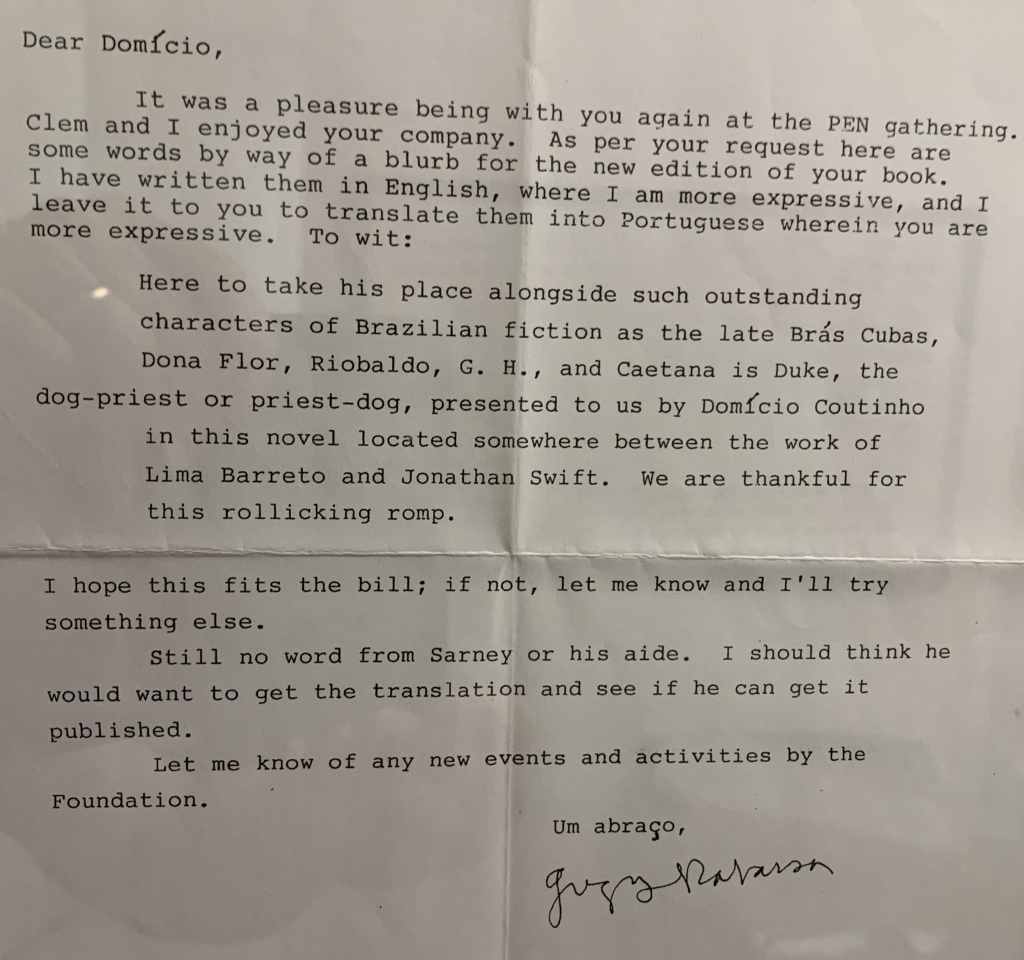
“…Duke was swept into the air by that tremendous whirlwind, spinning, spinning, his paws raised, his expression proud. Many people saw it, and went dashing through the streets with [Lourdes] in the hope of finding him fallen to earth somewhere. Futile. […] An astronomer at Mount Palomar had detected a brilliant object moving at the speed of light in the direction of Sirius in the constellation of Canis Major, the Great Dog.” – from Duke, the Dog Priest by Domício Coutinho

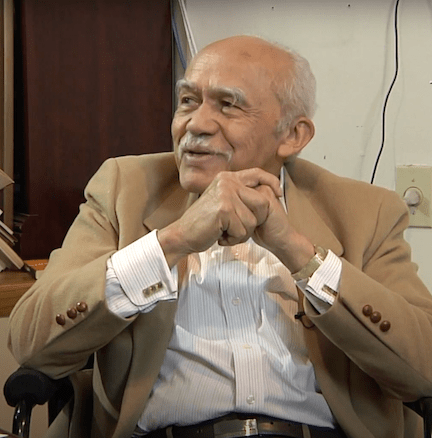
Born in João Pessoa, Brazil in 1931, Domício Coutinho emigrated to the United States in 1959, eventually earning a Master’s and Ph.D. in Comparative Literature from the City University of New York (CUNY) in addition to his bachelor’s degree in Aristotelian Thomistic theology from the Gregorian University of Rome. In 1986, Coutinho, with his wife and two sons, began a business in real estate appropriation and management of properties. In 1999, Coutinho founded The Brazilian Writers Association of New York (UBENY). In 2002, he was admitted as Commander into the Order of Rio Branco, a Brazilian Institution honoring those who have distinguished themselves in cultural and patriotic achievements. In 2004, Coutinho founded the Brazilian Endowment for the Arts (BEA), a non-profit organization dedicated to preserving and promoting the Brazilian Arts, Literature, and Cultural Traditions for the Brazilian/American and Latin American Communities. That same year, he created The Machado de Assis Medal of Merit to honor those who distinguish themselves in Brazilian Cultural Traditions. In 2006, Coutinho founded The Brazilian Library of New York, which houses 7,000 titles, with an auditorium for events, conferences, literary gatherings, films, and dramatic performances. The library has been visited by prominent representatives from government, diplomacy, and academia.
Aside from an untranslated poetry collection titled Salomônica and a recently translated novel titled Incredible Revelations of an Earthworm, Coutinho published a novel in 1998 titled Duke, the Dog Priest, which was translated from the Portuguese by Clifford E. Landers and brought out by Green Integer in 2009.
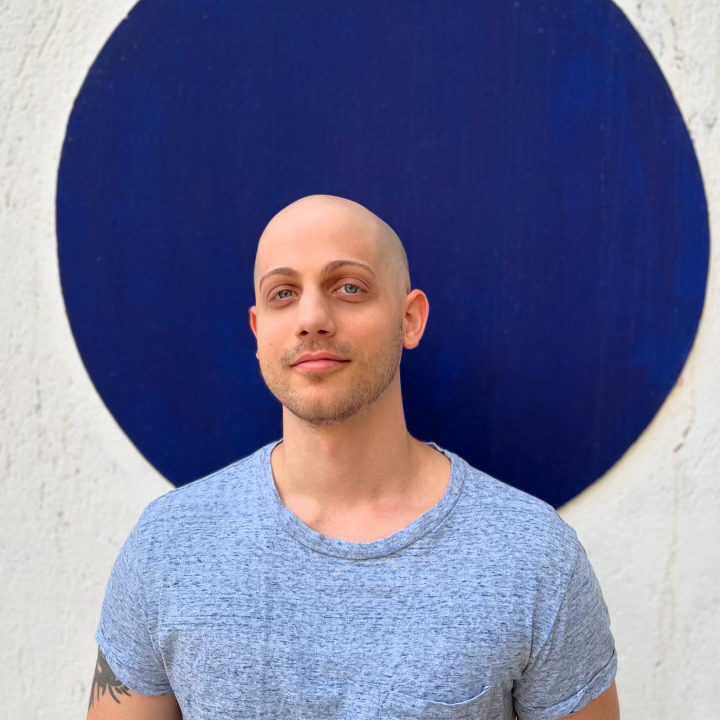
George Salis is the author of Sea Above, Sun Below. His fiction is featured in The Dark, Black Dandy, Zizzle Literary Magazine, House of Zolo, Three Crows Magazine, and elsewhere. His criticism has appeared in Isacoustic, Atticus Review, and The Tishman Review, and his science article on the mechanics of natural evil was featured in Skeptic. After a decade, he has recently finished working on a maximalist novel titled Morphological Echoes. He has taught in Bulgaria, China, and Poland. He’s the winner of the Tom La Farge Award for Innovative Writing. Find him on Facebook, Goodreads, Instagram, Twitter, and at www.GeorgeSalis.com.
For early access to literary content like this and other awesome benefits, such as editorial services, consider supporting The Collidescope on Patreon.
The Collidescope is an affiliate of Bookshop.org and will earn a small commission if you click through those specific links and make a purchase.
 The Collidescope