

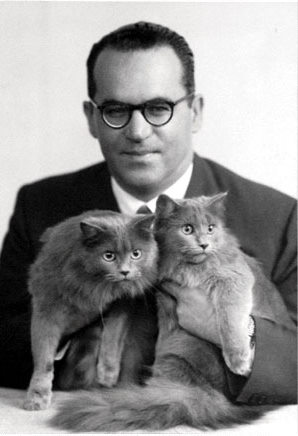
About João Guimarães Rosa: “Born in 1908 in Cordisburgo, Brazil, Rosa was a novelist and short-story writer whose innovative prose style, drawn from Brazil’s hinterlands’ oral tradition, revitalized Brazilian fiction in the mid-20th century. His portrayal of the conflicts of the Brazilian backlanders in Minas Gerais reflects the challenges of an isolated rural society adapting to a modern urban world.
Initially studying medicine in Belo Horizonte, Guimarães Rosa later pursued a diplomatic career, attaining ambassadorial rank in 1963. Sagarana (1946), a collection of short stories, marked his literary breakthrough. Despite diplomatic duties, he published Corpo de Baile (1956), a collection of novellas, and his monumental epic novel Grande Sertão: Veredas(1956), solidifying his international reputation. Transitioning to short stories, he released Primeiras Estórias (1962) before his death in 1967, leaving a legacy as one of Brazil’s and the world’s greatest writers.”
“Don’t you doubt it, sir, there are people in this hateful world who kill others just to see the faces they make as they die. You can foresee the rest: comes the bat, comes the rat, comes the cat, comes the trap.”
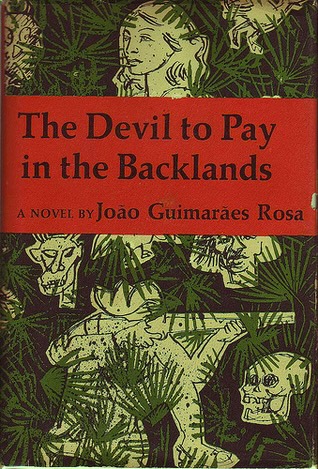
Grande Sertão: Veredas by João Guimarães Rosa is the epitome of Brazilian fiction, emphasis on tome. The only full English translation, clunkily dubbed The Devil to Pay in the Backlands by James L. Taylor and Harriet de Onís, has been out of print for over 60 years. No Ulysses this, despite claims made by Joshua Cohen and others. The original Portuguese does seem to be somewhat Wakean in nature, what with its neologisms, puns, and archaic lingo. Either way, as it has been wrought in English, Rosa’s book is closer in spirit to Cormac McCarthy’s Blood Meridian—McCarthy’s evening redness in the West transmuted into the greenness of the Brazilian Northeast, a forest as wild and weird as any jungle this side of the heart of darkness, said greenness depleting into an apocalyptic grayness during the fall. In place of the kid and the Glanton gang, The Devil to Pay in the Backlands follows Riobaldo’s exploits among the jagunços (bandits or “armed ruffians,” according to the book’s sparse glossary). No, the multiplicity of forms that make up the essence of Joyce’s Irish tour de force isn’t to be found within these pages. Rather, Rosa’s novel unfolds via a single form, that of an epic confessional, a lengthy campfire tale, as narrated by Riobaldo, Baldo for short, who warns, “The sertão. You know, sir, the sertão is where the strong and the shrewd call the tune. God himself, when he comes here, had better come armed!”
The protagonist is now old, ailing, retired, and lives on a plot of land alongside fellow ex-bandits who are always ready to take up arms if need be. Aside from occasional yet welcome digressions (for what is a Story if not stories within/beside stories?), the main thread involves how Baldo fell in with these bandit types and their thirst for revenge against the “Judases,” two rogues who go rogue and murder Joca Ramiro, a beloved chief of the jagunços. One of the two Judases, Hermógenes, is rumored to have made a pact with the devil, thus making that betrayer well-nigh immortal.
Baldo frequently tries to make sense of the spiritual economy of good and evil, bravery and cowardice, prayers and punishment, god and the devil, the latter personage’s existence he refuses to believe in if for no other reason than to ease his fear, a fear that has its origin in a turning point much later in the novel, in which Baldo sneaks out at night and ventures to the crossroads at Veredas-Mortas. There, he tries to make his own pact with the devil (to fight hellfire with hellfire?—the motivation is never fully explained). While no horned and hoofed hoodlum manifests, Baldo’s personality becomes, if not outright Hyde-ish, certainly more hostile, domineering, and capricious, qualities that soon lead to his becoming leader, the newly named Urutú-Branco, or White Rattler. He’s aware of this change, “It was as if my self-assurance came from the Dark One,” but does little to stop the Faustian momentum.
For all this mangy masculinity, I was surprised that one of the main inner struggles and mutual tensions in this book is Baldo’s love for a bandit he first met as a teenager and only reunited with later, Diadorim, the son of the late Joca Ramiro (the French translation is simply named after Baldo’s beau). It’s as fascinating to read about this struggle as it is frustrating (shut up and kiss him already, Baldo!). At times, he believes his feelings are the work of the devil himself, “the Dirty One—the one who takes our evil words and thoughts, and brings them all to pass; the one who can be seen in a black mirror, the Hider.” As it happens, we learn near the end of the novel, after Diadorim dies in the final fight (not before exacting revenge), that he is in fact a she, disguised as a man all this time for reasons unknown, aside from fitting in with her fellow bandits, but even when little Baldo first meets her, he takes her for a boy. Believability aside, this reader felt the gender twist undermined the importance of the homosexual narrative (reminding me of the dubious incest plot in Miyazaki-san Junior’s From Up on Poppy Hill), or bisexual, to be more accurate, for Baldo lusts after women throughout, and even yearns to settle down with one in particular, the beautiful Otacíla. Still, Diadorim’s reveal does stay true to the mutability of identity and personality found bookwide. Diadorim is the ostensibly real name of Reinaldo. His kinship to his murdered father doesn’t seem to be a known fact, and he may be an uncle instead. Even the White Rattler, née Riobaldo, had to be raised by his own uncle after his mother died, only to later hear from the grapevine that his uncle is his father, the cause of Baldo’s running away in the first place. And let’s not forget the cognitive dissonance that Baldo suffers from, being a man of learning who then turns into a jagunço, something the protagonist can’t quite accept in full. As early as page 47, amid this cognitive dissonance, Baldo dreams of a possible utopia in the wasteland, a “mighty ranch” where “brave, healthy people” seek “Heaven,” perhaps one in which they can be their truest selves.
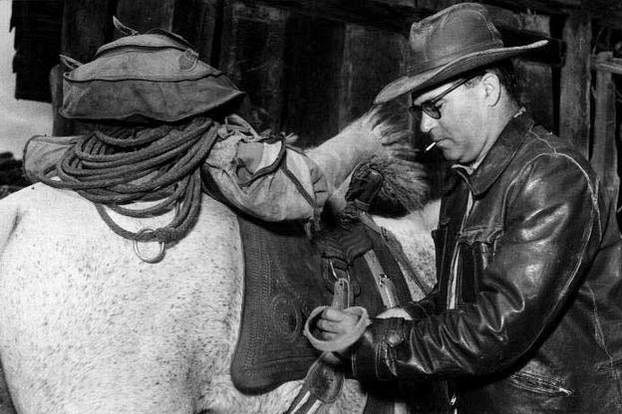
Even Rosa himself was a man of many hats—first a doctor, soldier, and then a diplomat, not to mention an autodidactic polyglot. While Rosa never lived as a jagunço, he was no stranger to the sertão. Novelist Jorge Amado, in his introduction to the original English translation, wrote that “this distinguished diplomat—nobody could be a greater gentleman or more refined—went invisibly shod in rope sandals, wearing the leather jerkin of the backlander over his soul, and armed with blunderbuss and violence.”[1] Backlands is a testament to that duality, that paradox.
As it happens, Rosa was born in 1908, several months before the death of another giant of Brazilian letters, Machado de Assis, a writer who could be considered a progenitor of magical realism. Despite this delayed exchange of souls, Rosa’s 1956 novel merely flirts with that grand Latin American tradition via lepers in guava trees who lick fruits to spread their disease, the killing and eating of a man who was mistaken for a “big monkey,” the labyrinthine infinity of the sertão (“you think you have left it behind you, and suddenly it surrounds you again on all sides.”), or when the bandits stumble onto the backlands of the backlands inhabited by motley primitives who partly echo McCarthy’s death-hilarious legion of horribles:
Those men had big ears, they were governed by the phases of the moon, and they sniffed in their sleep. And they had great powers of evil. I learned about it from old-timers. They could blow hot hatred on the leaves of a tree and dry it up; or mutter words into a hole which they made in the ground and then covered up: the road would then wait for someone to come by and do him harm. Or they would hold a handful of dirt in their closed fist three days and nights, without opening the hand or losing any of the dirt; then, when they threw the dirt down somewhere, three months later there would be a grave on that spot.
Still, such surreal flirtations are enough to augment the wonder of those backlands as seen through Baldo’s attentive eyes, even if a full embrace could have contributed to a total totem as much as tome.
The dust jacket warns that this is a “rather difficult” read, yet, aside from a few chronological jumps, it’s as about as straightforward as it gets, with fairly plain prose to boot. And while Taylor-de Onís’ execution has its moments, don’t expect McCarthy’s sentences in all their ouroboric splendor, their biblical staccato. Occasionally, unique details do come to the surface, such as, “he walked toward the edge of the creek naked, naked as the leg of a stork,” and the feeling of grasshoppers like “prankish stars letting their little droppings fall on my back.” Alas, grammarians would balk if not bark at the book’s comma splices, dangling modifiers, and other mistakes, but I found them easy enough to overlook.
As it is, Riobaldo’s monologue has plenty of sections on the backlands’ unforgiving nature, the proliferative flora and fauna, more infernal than supernal. What Werner Herzog said about his Fitzcarraldo jungle applies, “It’s a land that God, if He exists, has created in anger. It’s the only land where creation is unfinished, yet, taking a close look at what’s around us, there is some sort of a harmony; it is the harmony of overwhelming and collective murder. […] I love it against my better judgment.” Earlier in that documentary, Burden of Dreams, Herzog says that the only thing missing from that unfinished, prehistoric land is the dinosaurs. In an evolutionary sense, they’re almost omnipresent in Backlands, in the form of diverse avifauna, to say nothing of the saurian, what Carl Sagan called the dragons of Eden.
Aside from the borderline bestiary, Rosa’s sole and soulful novel is also punctuated by amateur philosophizing, all of it sincere even if the depth and application tend to vary. For example: “I think that sometimes hatred of one person serves to strengthen your love for another. The heart grows in all directions. The heart is like a brook winding through hills and lowlands, through woods and meadows. The heart combines loves. Everything fits in it.”
The question remains: why has this acknowledged masterpiece been out of print in the English-speaking world for the better part of a century? At some point, the renowned translator Gregory Rabassa had been tasked with tackling a new translation but eventually bowed out due to the sheer difficulty of it all. In his memoir, If This Be Treason: Translation and its Dyscontents, Rabassa explains, “…Rosa would have to be rewritten, not translated, unless by the likes of James Joyce. His translator is immediately faced with an impossibility: Rosa’s epigraph reads O diabo na rua no meio do redemoinho (The devil in the street in the middle of the whirlwind). Take a good look at the word for whirlwind: redemoinho. There sandwiched in is the word demo, so that the devil is not only in the middle of the whirlwind but is in the middle of the word for it. The novel had already been translated but a lot had been slurred over and a lot had been left out.” You read that last bit correctly: the original English translation is, to one degree or another, abridged. For instance, the novel ends with “Travessia. O homem humano,” (“Crossing. The human human-being.”) and then an infinity symbol (riverrun, anyone?). All we’re given in English is “The passage.”
Fast forward to 2016 and it was announced that Alison Entrekin would be embarking on that long-overdue translation. I emailed Entrekin about the project and she said, “I have finished the translation and it will be published in 2026 by Simon & Schuster in North America and Bloomsbury in the UK and ANZ. The new title is Vastlands: The Crossing.” It took her three weeks to translate the first three pages, and I asked her if she ever got into a groove in which she could expedite the process without sacrificing quality. She said, “Nope, the rhythm was pretty much a snail’s pace from beginning to end.” About the original translation, she was kinder in her estimation than most, “In many ways, it is actually quite accomplished.” Perhaps her Australian background will help heighten the outback atmosphere of the novel. If the excerpt published in Words Without Borders is anything to go by, a heightening seems to be the case indeed. First, take a gander at the opening to the first English translation by Taylor and Onís:
It’s nothing. Those shots you heard were not men fighting, God be praised. It was just me there in the back yard, target-shooting down by the creek, to keep in practice. I do it every day, because I enjoy it; have ever since I was a boy. Afterwards, they came to me about a calf, a stray white one, with the queerest eyes, and a muzzle like a dog. They told me about it but I didn’t want to see it. On account of the deformity it was born with, with lips drawn back, it looked like somebody laughing. Man-face or dog-face: that settled it for them; it was the devil. Foolish folk. They killed it. Don’t know who it belonged to. They came to borrow my gun and I let them have it.
You are smiling, amused-like. Listen, when it is a real gun-fight, all the dogs start barking, immediately—then when it’s over you go to see if anybody got killed. You will have to excuse it, sir, but this is the sertão. Some say it’s not—that the real sertão is way out yonder, on the high plains, beyond the Urucúia River. Nonsense. For those of Corinto and Curvelo, then, isn’t right here the sertão? Ah, but there’s more to it than that! The sertão describes itself: it is where the grazing lands have no fences; where you can keep going ten, fifteen leagues without coming upon a single house; where a criminal can safely hide out, beyond the reach of the authorities.
Now, behold the denser and truer opening, as translated by Entrekin:
Nonought. Shots you heard weren’t a shootout, God be. I was training sights on trees in the backyard, at the bottom of the creek. Keeps my aim good. Do it every day, I enjoy it; have since the tendrest age. Anyhow, folks came a calling. Bout a calf: white one, strayling, eyes like no thing ever seen and a dog’s mask. They told me; I didn’t want to see. Seems it was defective from birth, lips curled back, and looked to be laughing, person-like. Human face, hound face: they decided—it was the devil. Oafenine bunch. They killed it. Nought a clue bout the owner. They came to beg my guns, I let em. I’m not superstitious. You got a way of laughing, sir . . . Look: when shots are for real, first the dogs set up barking that instant—then you go see if anyone’s dead. Don’t mind, sir, this is the sertão. Some reckon it in’t: the backlands are further off, they say, the campos-gerais inside and out, back-o-beyond, high plains, far side of the Urucúia. Lottarot. To folks in Corinto and Curvelo, in’t this here the sertão? Ah, and that’s not all! The sertão makes itself known: it’s where pastures have no fences, they say; where a man can go fifteen, twenty miles without coming to a single house; where outlaws live out their hallelujah, in the yonder beyond the law.
If not for the leftover Portuguese, readers could be forgiven for thinking they’ve ended up in some backwater of Yoknapatawpha County. Such Faulknerian spitoonin’ further fuels this bonfire yarn at the edge of Nowhere, and I can’t wait to read the iteration in full. As the moralizing Dr. Hilário warns in Backlands, “‘Another can take our place, but we should never take the place of another…’” Regardless, I’m eager for Alison Entrekin to take her place in the pantheon of translators who have made the impossible possible, the godhead of such literary miracles being the late John E. Woods who gifted us Arno Schmidt’s Bottom’s Dream.
[1] In an email, translator Alison Entrenkin writes that Rosa “actually didn’t spend as much time in the sertão as people believe. I think Amado’s comment is a little misleading, or meant metaphorically. Rosa was born and spent his early childhood in Cordisburgo, which is considered by some to be in the sertão, but he didn’t crisscross it as Riobaldo did. He did go on a ten-day trip accompanying cowboys as they took cattle from one place to another, and took copious notes while he was at it. But most of what seems like intimate knowledge of the deep sertão actually came from studying and reading.”
Editor’s note: The aim of Invisible Books is to shine a light on wrongly neglected and forgotten books and their authors. To help bring more attention to these works of art, please share this article on social media. For early access to literary content like this and other awesome benefits, consider supporting The Collidescope on Patreon.
The Collidescope is an affiliate of Bookshop.org and will earn a small commission if you click through those specific links and make a purchase.

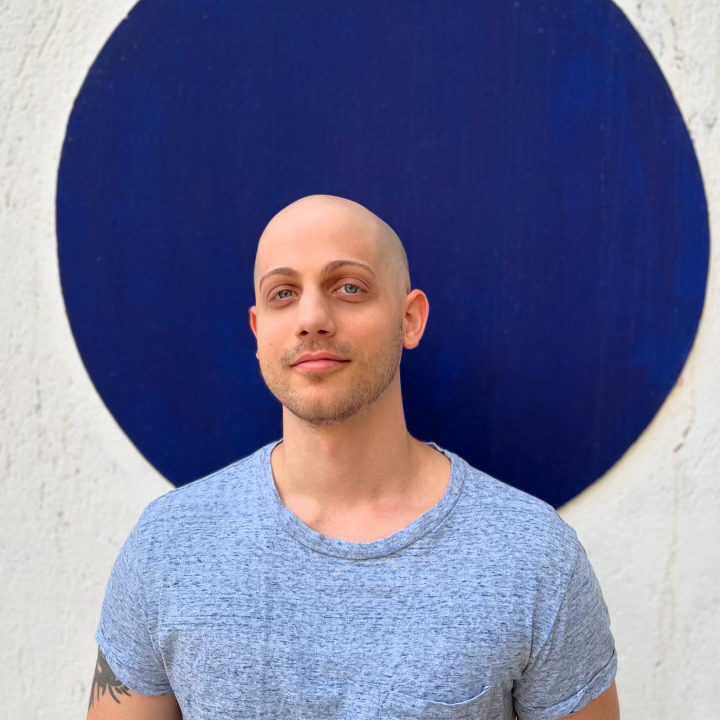
George Salis is the author of Sea Above, Sun Below. His fiction is featured in The Dark, Black Dandy, Zizzle Literary Magazine, House of Zolo, Three Crows Magazine, and elsewhere. His criticism has appeared in Isacoustic, Atticus Review, and The Tishman Review, and his science article on the mechanics of natural evil was featured in Skeptic. After a decade, he has recently finished working on a maximalist novel titled Morphological Echoes. He has taught in Bulgaria, China, and Poland. He’s the winner of the Tom La Farge Award for Innovative Writing. Find him on Facebook, Goodreads, Instagram, Twitter, and at www.GeorgeSalis.com.
 The Collidescope