
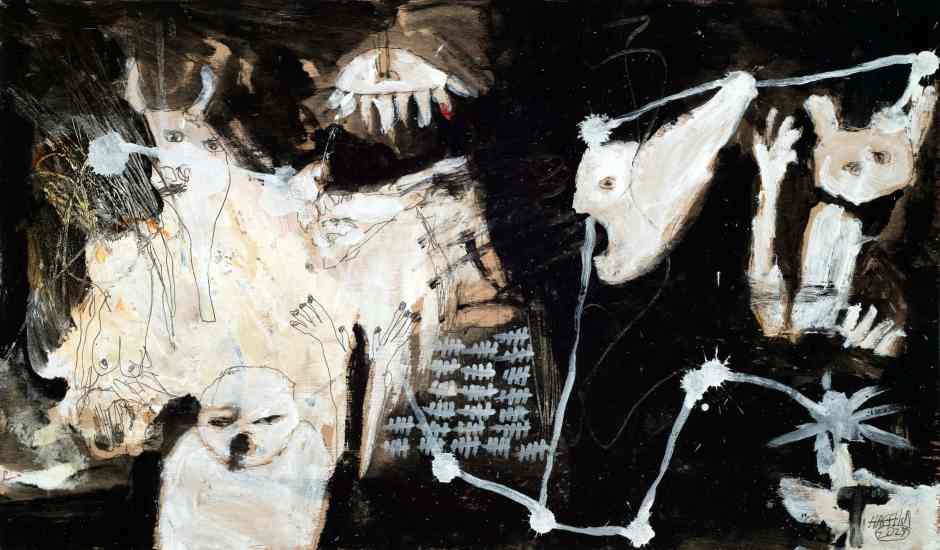
The feature image is Homage to Picasso & Goya by Michael Hafftka, used with kind permission
…this man was made incorruptible by his enormous vanity, that finest form of egoism which can take on the aspect of every virtue.
Joseph Conrad, Nostromo, Part Second (The Isabels), chapter 8
To his knowledge at least, nobody woke up in the womb or before and decided that if he was to have the misfortune of getting himself born then he must insist it be as this, that or the other. Specifically, nobody—nobody—wakes up in the womb revived (after a heady day’s drowse engineered through transmission of the usual toxins from mother to fetus) only to discover that the doom he craved is to end up as nothing less—and nothing more—than a whistle-blower (at which point he goes back to sleep secure in the knowledge that he’s fixed for life and that he’ll be sailing safely through her birth pangs and the ejection process unfazed, his destiny having already been formally entered into the rolls). So, this being the case, nobody could have been more surprised than he to discover—or better yet, nothing could have surprised him more than to discover—that this was the very vocation he’d been seeking all his life. On a woefully less interesting level and compliments of the hindsight he’d thriftly put aside for just such a rainy day he was willing to grant that, with things having grown so intolerable so fast (since his return from active duty), he had no choice but to become one—a whistle-blower, that is—and not just any old whistle-blower but the rarest kind: a whistle-blower masquerading as a civil servant with a hefty grudge. Thing is, too many competing scams—mimicking each other—pumping up each other’s volumes—had come home to roost in this, his hometown, confusing aspiring muckrakers about exactly where one ended and another began. Only later, though not much later, did it become obvious that the Moguloid affair—awaiting him on his own doorstep, so to speak—outshone all the others hands down.
At first it was hard to determine on what to the exclusion of all else the focus should be, since his concentration would have to be nothing less than exclusive. Which is not to say he’d ever intended to disable the spigots of stress-generating uncertainty by stooping to convert the first innocent bystander he laid eyes on into a person of interest—the person of interest. No, he would never let impatience which invariably mushroomed into desperation mar his rectitude. So, given this long overdue awakening, compounded with learning through the grapevine that the town’s most powerful (though, admittedly, the sole) muckraker was in the market for hiring an underling extraordinaire, with possible room for advancement through secondment (voluntary, of course) to, of all places and yet oh so predictably, New York—given all this, how could he not jump at the chance (even if deployments to Afghanistan [two] and Iraq [three] made even the mere envisagement of such a jump soul-shattering)? Not that the spectre of NY had anything to do with his hesitation: he’d been there too many times to count and as far as intimidation per square meter went it paled shockingly compared with the hellish hotspots that had made obligingly short work of his youth.
This is to be their very last supper together, although Moguloid father-in-law, wife and grandson (bruised fruit of her previous stab at matrimony whom WB takes the liberty of referring to under cover of darkness as the Get of a Thousand Faces) are not aware of the fact. Nor are the contingent of hangers-on and favored employees. It’s also dad’s birthday, which is being celebrated, as every year, in what the birthday boy tediously insists is his favorite hangout although he never gets anywhere near finishing off whatever specialty of the house is ritualistically served up to him by the owner. (WB thinks it’s just another uninteresting case of over-ordering to make waste more conspicuous.) WB’s dutiful wife is dutifully up to her old tricks by sacrificing the carcass of hapless hubby on the altar of dad’s effortless greatness—but when, I ask you, is she ever not up to ’em once (to quote her unfoolable uncle, Elliott Templeton) “the inevitable inevitably happens” and said greatness, as shameless as the day is long, sees fit to get up on its hind legs uninvited to bellow forth to assorted flunkeys proof of his latest breakthrough. There’s of course the obligatory late arrival (by the look of him a newcomer to the group) who notes, in a tone hard to dismantle, that the boy very much resembles his father. She’s taken aback: the guest has assumed without warrant that the Get is WB’s offspring. “No, no, no,” she condescendingly, i.e. forgivingly, stage-whispers. And into the whisper she squeezes as much forbearing sanctimoniousness as can fit (the more uncomfortably the better). She’s clearly a daddy’s girl and a shrew. He knows the type.
Come to think of it, something in her “no, no, no” reminds this newcomer of his sole surviving relative, an idiopathically incontinent female stashed away in an assisted living facility somewhere on the Florida Panhandle—the kind where even fool alligators fear to tread. Whenever he kindly suggested, for example, that said relative crawl to the bathroom (in response to the unassailably routine plaint that she could never reach it in her currently malfunctioning wheelchair in time to pee and poop her way to salvation) rather than go the incontinence route and wait hours for the reliably disgusted night aide to change her fetid diaper, the newcomer got fed a megadose of the same smug, exalted dismissiveness, encapsulated in the same three (identical) syllables. But it’s only now, thanks to the antics of daddy’s girl (even if she and the coz have little in common besides those Three Little Maids from School), that he’s beginning to: (a) appreciate on its own terms the coz’s modus operandi as a persister cell, which has been to set any two courses of remedial action she’s been saddled with at loggerheads and generate from the conveniently unresolvable tension between them a pathway to liberation-as-paralysis; and (b) recognize that she was comfortable only in their nowhere zone, conducive to obsessionality and the know-it-all defiance that rises proud and tall above all craved (in order to be summarily spurned) interventions? So why is he left with the chilly feeling that he’s somehow betrayed not just the idiopath but the entire Panhandle culture even if he doesn’t know it from Adam.
“I’d be insane to consider” (implied shrug) “having a kid with my current husband. To quote the psychopharmacologist over in the next county, ‘Constitutionally, he’s all stretto and no fugue.’” The newcomer (through the auspices of a connection made between two very disparate occasions of humiliation, now very much an ex-newcomer) concedes that a schadenfreude-driven twinkle does soulful wonders for both her eyes if not her disposition, dispelling any remaining doubt that they’re definitively not of the same color. But more to the point and by the same token, why shouldn’t they—she and the idiopath—be unregenerately dismissive of meddlers like him? After all, each of them, like billions of others, is the planet’s reigning expert authority on her own particular predicament—her own particular doom—and its arcana. In fact, he finds that he’s actually starting to like the role of hapless helper forever getting caught in the act of…obtuseness and deems himself worthy of a lashing or two.
“Five tours of duty have done him more harm than good. He shouldn’t have trusted the recruiters who said a change of scene, with lots of sunshine thrown in for good measure, was just what he needed. But as one of the last of the professionally unprivileged he thinks it’s his duty to be in character 24/7 and to be in character means to pretend to be gullible every chance he gets so as not to…offend (funny, because I don’t know anybody who has less of an affinity for playacting). Not to offend! He’s an almighty coward! My little son said so from the start and he can’t be fooled.” Her claws are still stuck in the stage whisper’s neck. On cue, WB grits his teeth and looks deep into his plate as if it were a mirror through which he’s about to ram his hematoma-smeared fist. “Maybe I am gullible,” he hisses, inaudibly, wondering if the hiss is authentic or just more unplayable playacting.
“You’re talking about PTSD, I guess,” says the ex-newcomer, trying to be helpful or to imitate somebody trying his hand at being helpful. Wife (mock-wistfully): “No, what I guess I’m talking about is blast wave interface astroglial scarring.” She explains that the Army simply hasn’t gotten around to diagnosing the damage visited on gunners by repeated exposure to routine blast waves from their own weapons (like long-range cannons, mortars and shoulder-fired rockets) crashing through the brain at the speed of sound—simply hasn’t gotten around to diagnosing it not as depression, attention deficit disorder, chronic encephalopathy, anxiety or (in deference to the newcomer, who doesn’t deserve it) post-traumatic stress disorder (all kid stuff) but rather as what it is: traumatic brain injury. She’s a neurologist (the ex- turns skeptical and quickly reproves himself before she can sequence his brain waves) and if she knows anything it’s that no blood test or scan or urine sample can reveal the maelstrom of microscopic tears that repeated blast exposure gives rise to in a living brain. In this case only dead brains are diagnosable and those brains must, to bolster their claims, come to the lab prepared to provide (in accordance with the Army’s irrelevant criteria) both evidence of having survived a pinpointable traumatic incident and proof of engagement in active combat. “He gave the Army everything he had to give and they showed him the back door and kicked him out with nothing. Nothing but grief, nothing but agony, nothing but access denied: to disability benefits, medication and psychotherapy, all compliments of a less-than-honorable discharge for (imagine!) taking marijuana in the vain hope of putting his hallucinations (all stretto and no fugue) to sleep.” (She’s turned the tables on him—his writing her off as a shrew was smug—premature. More power to her.) “Just so you know: it’s dad here who’s been paying through the nose for his so-called son-in-law’s useless treatment.” (Through an adroit contortion, the Moguloid [never out of earshot when high praise is in the offing] delivers himself of an implied bow without moving a muscle.) “A son-in-law he still doesn’t know from a hole in the wall.”
WB’s has had enough of listening to her talk about him as if he weren’t quite there. He wants to lash out. Thing is, to lash out is to grant father and daughter and assorted cronies a free run of the premises of his inner life so just in the nick of time he restrains himself, hoping that some revelatory tic hasn’t already seen fit to give him away. What saves him, as always, is, well, to imagine how surrender to the spiderish allure of self-immolation on the altar of their enmity (real or imagined?) would play itself out this time. Such abasement of course being understand (by whom?) as perversely alluring only within the confines of the granitic impossibility of self-betrayal (given his make-up, that is, his penchant for heroism very much in spite of itself)—impossible even with such alluring goodies as conformity, normality, time off for bad behavior, an acquired appetite for greed, the fringe benefits of razor-sharp blandness and ski trips and après-skittish shenanigans being dangled before him. His identity has been too hard-won, especially over the last few years, to merit the abject sacrifice of even a sliver. So what is the appeal of this ploy, this game? Might it have anything to do with his discovery way back when (sickeningly—i.e. euphemistically—a “work in progress”) of the all too dreary future stretched out before him and that what at first seemed a straight downward path to unwisdom—and greater and greater feats of isolation—was in fact a starkly vertical purchaseless trek rife with endlessly fractalizable coves and danger lurking at the entrance to each. More specifically and less operatically, does it just maybe have something to do, he wonders, with a tyke’s hunger for distraction—smothering his consciousness of the imminence of departure for a place where he’ll have to deploy his mettle as never before and not just for show since nothing less than the health of his own lifespan is at stake—a place where (as far as he or anyone knows) the boss won’t be around to liberate him from the messiness of a genesis, an evolution, specific to him alone. Since starting now, or pretty soon, his trajectory will be all about lapses, delays, self-protective descents into hopelessness—everything but instantaneous completion. But by the same token and on the other hand and when push comes to shove doesn’t the messiness to come render the precursory dread of a dreary future obsolete?
But getting back to weighty matters of spiderish allure, what if he were to, say, announce to father and daughter (forget the assembled cronies for the moment) that he’s finally made up his mind to undertake a long-overdue reform—to burn all the notebooks—all the files (which they were probably smart enough (or were they?) to have suspected would end up, under his boss’s aegis or auspices—or both—going to the FBI or some subsidiary thereof. What if he swore out of the blue that, sort of like Rocky Graziano as caught in that photo taken by pre-Fear and Desire Stanley Kubrick (which the boss kept in a frame on his desk and from which he maintained that he drew exhaustingly inexhaustible strength), he was going to be “a good boy now” in and out of the shower stall? Which meant no more of the following: paranoia, crying in their ungracious lap, push-ups on whatever machete-encrusted mat happened to be at hand, vertigo, insistence that death threats directed at him had been secreted in street signs—and, most important, no more palling around with the similarly afflicted losers he was still in contact with from his years of soldiering. Not that self-immolation as he’s practiced it has been limited to invocation of the same tired old father-daughter act. Fact is, he’s also developed a stage manager’s fondness for inclusion of gargoyles like mom and dad in his fantasy troupe. Nobody’s fault, after all, if they hated his guts and if the fact that he didn’t cotton to their hatred as planned gave them an even better reason for perfecting it. But any wonder, then, that from a very early age he wanted nothing so much as to know what it was like to nip one’s selfhood in the bud—shed one’s selfhood lock, stock and barrel, so to speak—to transcend it by sending a shameless proxy into the fray.
Under one scenario (too bad that the same Kubrick would have snottily rejected it out of hand) he could be seen introducing mom and pop to his real life spouse and her son (the actors impersonating the latter were ordered from the temperamental director’s chair to radiate a savagely joyous uncouthness) and proclaiming with ostensibly invincible pride—an imbecile pride which refused to see reason—that he was currently working three or four (he’d lost count) menial jobs (and in the most crime-ridden sections of the county no less) to support them in high style (no sacrifice too great inasmuch as the bride had married very much beneath her and dragged her own parents, still noisily—some might say lavishly—overdressedly—in shock, down with her). The same mock-imbecile joyousness Stavrogin (giving perversity a good name at last) must have felt when introducing Mlle. Lebyadkina, his crippled bride, to the stodgy old folks at home. And all this brouhaha—all this Russified stage business—just to induce mom and pop’s signature look—a look almost vocal in its intensity—of unspeakable outrage—a look on a par with the Money Shot in a pornographic film begging for classic status without quite knowing how to get it. Not that they’d been jealous guardians of his welfare (and maybe, just maybe, he enlisted not, as rumor would have it, to escape working at the town’s only drive-thru but rather to do their unspoken bidding by getting himself blown up)—not because for them he was always just what the benevolent stork doctor had ordered in the way of a flawless chip off the old block—but, rather, because (as laid out, ladies and gents, in the playbill available on your way out of his inner theater, which I agree is in desperate need of a centuries-long fumigation regimen) the revelation was the best up yours! challenge—to their self-serving logic—he could come up with on such (always) short notice—but rather because this stunt, like his very being, was the defiant insult to their very being to end all defiant insults so-called. But he always came back from his theater-going experience—his inner theatergoing—immeasurably unenriched, i.e. grossly relieved and…disappointed—both! that it had turned out, by design, to be just another run-of-the-mill bad dream.
But still with all its drawbacks nothing beats this suffocating fascination exerted by the notion cum envisionment of adopting the plumed persona of an anti-self solely to please the despising wife and the unadopted son, not to mention the Moguloid, which, as refracted through the lens of the wife’s contempt, will only reinforce that contempt. So it’s the ever-expanding reinforcement of contempt that fascinates, dangling before him what he craves most: liberation from the straitjacketing—deadening—hunger to realize himself (and, come to think of it, why bother at this stage of the game though he’s only thirty-three?). But while staging this kind of mess for an audience of one is always worth a try when times, as now, are tough, suddenly he’s no longer interested. The assemblage here of so many worthies has killed both urge and urgency—killed them but good. However, remembering that he now bears the very privileged status of double victim—victim of both the military’s feckless medical bigwigs and the Moguloid himself with his toxic tanneries, farms fertilized with sewage sludge, carpet manufacturing empire etc. and, in particular and at the root of it all, his cherished killer per- and polyfluoroalkyl substances (PFAS) indentured as they are and always will be to their carbon-fluorine (C-F) bonds—remembering his status encumbers him with hope and strength and, better yet (but only on occasion and only after a hard day’s relentless labor masquerading as suburban lassitude), a never less than manful case of the giggles over the import cum importlessness of it all. And he mustn’t forget the Moguloid’s latest Big (albeit peripheral) Idea: construction of a fleet of the world’s biggest (or, if you’re an authentic Mogue, why bother?) gob (garbage of bituminous) burning plants. Though no businessman—no operator (and how the wife hates it when little WB uses the word [always with juicy contempt] since he thereby becomes powerful enough [through riding pillion on the sheer will of the word itself] to disable the very core of nisus itself—powerful enough to enjoin the foreclosure of all hope for her future and the Get’s)—though no businessman, it seems to WB that this gob (hobgoblin) project exists for the sole purpose of being forever in the works, thereby serving as a smokescreen—a distraction. But (since the nefariousness of all of Big Daddy’s operations has always been faithfully broadcast, especially to the unfaithful who, predictably, went away schadenfreude-starved) a distraction from precisely what?
However, the self-shredding star turn (quasi una fantasia) and its tributaries (all stretto, stretto, stretto—as in her phrase of minutes ago—and no fugue) have kept him so busy that he is only now realizing the wife’s patter has constituted merely the puny opening act of, as already noted, this, their “last supper together on earth” (an epithet that must be music to the ears of all amateur Aggrandizers of the Moment). But even if the real star of the show is of course the Moguloid or rather his Project 2026-and-Beyond and even if the battle to the death that the world unbeknownst to itself has been waiting for without necessarily knowing it must be waged between—could only be waged between—him, victim of traumatic brain injury and PFAS-induced testicular and kidney cancers (both currently in remission), and the Moguloid, apostolic conservator of the slumbering spirit of that brutalist monument to inertness-as-indestructability, the (accursed because mythic) C-F bond (which he feels absolutely no shame about invoking in and out of context)—even if that fight’s between a heavy- and a welterweight with no sideshows in the works for small fry, the whistle-blower takes altogether seriously the self-imposed obligation as hapless hubby extraordinaire to ensure that, since he owes the wife more than just a nod of thanks for disservices duly rendered, she somehow gets to reap her share of the spotlight. After all, the kind of soul-shattering apprehension—dread—rage—anxiety—she’s been dutifully triggering over what seem like decades—especially tonight, on the eve of flight—doesn’t come cheap at today’s market prices. He can only hope that where triggering torment is concerned he gave as good as he got, for both their sakes, may they rest in peace. Any way you slice it, he’s forever in her debt since torment lays bare this particular victim’s unsuspected appetite for self-construction through countervailing analysis of his tormentor’s addiction to inflicting pain. Or, put differently, state-of-the-art yet oddly run-of-the-mill torment such as she dishes out is the mother of despair and despair the father of vigilance and vigilance, ultimately, the great galvanizer of the not quite universal urge to generate improbable tensions and even more improbable connections between and among starkly disparate things, which would otherwise be condemned, through want of ungovernable impulse and affinity, to waste their rot on the desert air. And generating those tensions and connections wherever one happens to find oneself is a way to keep busy staying alive. At least that’s what his boss has been telling him all along and will probably tell him yet again when they meet later tonight. WB’s tempted to add “for the last time” but refrains since becoming a fifth-rate aggrandizer of the moment holds no appeal to one of his humble beginnings. And he’s sure the boss will append the usual coda (for the boss is first, last and always a father figure, a role he both loves and hates in unequal measure) which is that every situation worth its salt that WB gets to be involved in down there—or anywhere else for that matter—will inevitably unfold within a context of high tension (if the stakes are high, the tension will be even higher) and that as a whistle-blower he needs to be aware of such things because the Feds will expect him to be, though, granted, not necessarily right off the bat (yet even so he must never get taken in by their apparent laxity—their seeming eagerness to make allowances for slow learners).
In fact, the boss hasn’t just told WB that tension is the measure of all things but on one unforgettable occasion went ahead and proved it through covert action (admitting subsequently that underhandedness had never felt so liberating, especially to somebody of his advanced age)—proved through covert action that a victory lap lay at the heart of every failure and that nothing could be as exhilarating as being caught between two entities—things—thugs—unnecessarily—improbably—superfetatorily—illogically—at cross-purposes and licensed to kill. It was that time of year when building passes for staff were or were not renewed (depending on performance and productivity). Although the boss had given him every reason to believe that in his case renewal would be automatic, true to his fatherly code he saw fit to inject a dose of uncertainty into the rite, just massive enough to enable the whistle-blower to experience mythic tension in its pure—its purest—state (a privilege given to very few). And while he waited for the verdict not a minute went by when he wasn’t busy calculating how best to remove all of his belongings in record time since uncertainty writ large as he lived it spelled eviction and eviction meant opprobrium. In fact by the time the good news reared its ugly head, he’d already invested so much sweat (measured in units of despair) in the upkeep and education of its evil twin that he could react only with severe distaste. For the tables had turned and his overriding concern was no longer to get himself renewed (kid stuff) but rather how to outsmart the good news should it prove relentless in its efforts to block his exit. Inasmuch as evacuation of the premises had now become so conjunctive to his life and soul that he just had to find a way to ensure that the new—and uninteresting—villain of the piece, that is, the divine right to stay on with a legitimate pass in tow, did not stand in its way. For as that dyed-in-the-wool totalitarian, his buddy Murray G-M (who died in Germany and was buried in, of all places, Vichy France) used to say: any undesired and fiercely resisted opportunity (in this case, eviction) immediately became necessary, just as what was officially prohibited out in the world immediately became mandatory and would eventually find a way to realize itself.
To create some distance between himself and what he dreads, which, tonight, is pretty much everything in sight (however much he’s invigorated by the prospect of a train journey in the company of a chaperon cum old army buddy), WB struggles to take the lay of the land outside from his seat near the window before she launches into the obligatory paean—but fails, though not miserably. There she goes again plying her intensifiers, as if this exaltation of the old fart had nothing to do with lobbing an invidious comparison (the stuff that shrewish dreams are made on) at his budding nemesis right smack between the eyes.
“But we’re here to enjoy ourselves. Let’s not get all tied up in knots about sad things. Things we can’t—and shouldn’t!—combat, at least not single-handed.” Surprisingly, a doctrinal tone suits his father-in-law to a t. And he must admit that the simplicity of this pre-prologue (if pre-prologue it is) to the speech he’s about to deliver on the occasion of his (what’s the magic number?) seventieth birthday makes WB almost proud to have as his opponent so unflappably upbeat a self-made visionary. “You look like you’re deep in thought,” the Moguloid says (not unkindly) to WB or rather to the shadow cast by his fleetingly swelled head (in response to this jab of not-unkindness) on the seat of the adjacent chair. “Not really. I was just observing how much our little shindig resembles one of those circus maximus Cabinet meetings down DC way. And how much it…doesn’t!” Before making it to the next sentence he’s interrupted by somebody a few lower-level tables away who protests. “Won’t listen to another word. Sense what’s coming. So just a warning, friend, meant kindly of course, mate. If you can’t get past your own smugness to recognize the greatness in people you don’t agree with, you have no business being in this business. So let the heads roll where they may!” Before WB can ask (with every intention of avoiding even the appearance of impropriety, that is, arrogance), “What business?”, he overrules himself, between his (now trademark) gritted teeth, with another, much better utterance to the effect that, as a matter of fact, the body of rage he feels for the greats doesn’t leave him much wiggle room for smugness, much less sanctimoniousness. And for that he’s forever in its—the mammoth rage’s—debt. Though come to think of it, WB doesn’t think allotting himself a millisecond or two of smugness from time to time would qualify as excessive compensation, considering all he’s been through. “Chicken feed,” chirps the No Business Being in This Business dude, “compared with what the Oval Administrator down in DC’s been through. And you may remember OA was almost assassinated over the summer but somehow managed to come through the ordeal with flying colors.” “Stronger than ever,” adds the ex-newcomer, who’s started to look at life more forgivingly—even through rose-colored glasses—now that compliments of his unreciprocated infatuation with the chatelaine of the manor (and a certified neurologist to boot, imagine!) he’s almost a member of the family. And is even being talked about as a possible replacement for the feckless incumbent son-in-law and getting rave reviews among the hoi polloi for propping up the illusion that this pretentious hole in the wall is a hotbed of gallic flair.
WB has lots more to say: it’s his last night in these precincts, after all, and he almost regrets that nobody could ever imagine connecting his boldness with impending flight. “When I suggest that everybody at this table has and yet doesn’t have his counterpart in—is and isn’t the…avatar” (is he using the right word?) “of—some OA Cabinet flunkey I’m not being snarky. Far from it.” (Though he’s willing to grant that his kind of hypertensive rage might sometimes get out of hand enough to breed (at least from their warped perspective)…well, the sickness known technically as self-congratulation.) He’s just minding his own business, so to speak, by taking the temperatures of two bigger-than-life in-groups and discovering how uncannily the members of one set off the corresponding members of the other to their best advantage. “It’s a little hobby of mine.” As he drums his fingers on the tabletop, he dares them to surmise what he’s thinking at this very moment (nothing and everything to do with what’s come just before). They can’t so he’ll do the hard work for them without any expectation of a note of thanks. In the best Beltway tradition, whatever that is, those before him manage to demonstrate, though they’re members of a mere subsidiary (albeit run by none other than His Honor the Mogul) of the in-group to end all in-groups, namely, the ovular one down there—manage to demonstrate just how easy it is once you set your mind to it—merely by living and breathing in fact—to wear your soul armor—your borrowed self-importance—lightly. And in so doing and whether they know it or not they bestow glory on their betters down there (who can use all the glory they can get, borrowed or not, to populate those nasty null spaces within), thereby serving as nothing less—and nothing more—than universalizing validators (in a more palatable minor key) of the infectious authoritarian temperament wherever it sees fit to blossom. (“So what’s the secret of our success?” asks some impatiently forthright dunderhead, who may turn out [WB can’t tell: the lighting, by virtue of crying out to be read as atmospheric, is too poor] to be none other than the No Business dude. As for his fellow [and in fact much bigger] dunderheads, no facial contortion is too extreme if it can be made to signify dissociation from the antics of this joker. They don’t realize it’s precisely by asking such a question whether answerable or not that he, the dunderhead laureate, catapults himself into another dimension entirely and gets to cultivate something not necessarily better than but surely way way different from…muted self-importance. Imagine! that holiest of grails, a painless evolution—handed to him on a silver platter no less—through the mere asking of a stupid question. And, for once, an evolution that’s not some obese prima donna refusing to be rushed. Some flunkeys of fate get all the breaks.)
Preaching to the converted, he’ll have them know that they, the members of the Moguloid’s cabinet, demonstrate through their every gesture that the capacity to stay self-importantly fit hence worthy of the big time hinges on a well-oiled cultivation of disbelief (as devoted psycho-, sicko- or just plain good old-fashioned sycophants) in their staggeringly good fortune. Disbelief must never be allowed to flag, as it tends to do among the Ovaloids owing to their nauseating complacency, bred partially but not entirely by the bug known as safety in numbers. Unlike the Oves, the Ove-nots get everything the hard way (it’s the secret of their success). And deep down they all hope things will stay that way for they know (even deeper down) the easy way out is ultimately only a shortcut to recrudescence of some kind of same old stalemate but on a more massive scale. The hardest thing you can demand of an Ove-not is to take the easy way out (okay, maybe not the hardest but since the Ove-nots are only human they’re understandably no strangers to verbal self-inflation in mini doses). On the other hand, at anything that poses a challenge—anything perceivable as an unpleasant duty—anything that cries out for what to the Ove-not is mother’s milk, namely, resistance—he’s sure to excel! (Suddenly he has them right where he wants them, in the palm of his hand—nodding as if entranced and as if to say, Right on, brother!: at last somebody who gets me right and gets where I’m coming from.) When they’re sitting round the conference table (the Promised Land) and even when they’re not WB’s willing to bet that they instinctively—relentlessly—admirably—routinely—cut themselves down to size by breathing hard (in the style of, say, that incorrigibly well-meaning MacWitskopf character down in DC, eminently suited for deployment of abject incompetence in the course of serving as one of the Ovaloid-in-Chief’s special envoys to some “good guy” across the sea—a good guy-style mass murderer like the Putin…Thing—that is to say, a good guy vile, insidious, nefarious enough to qualify for protected status as blameless “force of nature,” since according to the Law of Plotinus when perpetration attains a certain magnitude the perpetrator is immediately x’d out and that old horse chestnut, the “not in ourselves but in our stars” card, is played to the hilt)—breathing hard in nervously smiling anticipation cum adoration of the OA’s next groundbreakingly nasty Delphic crack. In fact some of them, also like MacWitskopf, are so massively repressed in every dimension of their stupid little lives, a term coined (independently) by Slavoj Žižek and Dolores Kirk (a co-worker), that being granted license to laugh—to be shellshocked into psychic release—constitutes the only liberation they’ll ever know on this overheated earth’s flat surface. They’ve mastered—or rather, they’re still mastering—the applied art of shamelessness by proxy. The Moguloid and OA are routinely bold, shameless, for them. “You just lost me,” confesses somebody (almost protectively) who this time around is indubitably (pace the lighting) ex-newcomer himself. “Are you referring here to the Oves or the Ove-nots?” Pause. “Not quite sure,” WB replies (and humble honesty never tasted so refreshing). “In the course of this evening they’ve become indistinguishable.” Before leaving this accursed town, should he, the whistle-blower wonders, ask the boss whether these lapses (for there have been more than one) into an inability to distinguish A from B or B from A might be due to the conjoint effects of brain damage and PFAS antics. And if so…
But infinitely more precious to both masters (all right, maybe not infinitely more) than the massively repressed true-believers-from-the-start (expendable for their stupidity though tolerated, if pretty enough, with something like affection)—infinitely more precious are what WB calls the late bloomers by dark design (pity he can’t assign ownership of the term publicly to its progenitor, his father figure boss, but a rule is a rule is a rule). Since, as they already know, or at least must sense, for entities like the Moguloid and OA (WB tenders a grudging nod of congratulation to the father-in-law which, as bespeaking the rankest fawning, he immediately regrets) the malign totalitarian thrill like no other is to be luridly denounced (as, say, the American Quisling) by some future lackey who after a plausible hiatus of presumable soul-searching goes on to stage the inevitable snakeskin-deep “disavowal of denunciation-cum-exaltation of capitulation” charade, thereby acknowledging that there’s no advancement without borderline-credible abasement. (Think: morbidly schoolmarmish convert JDV, whose smile invokes, to the practiced eye, something akin to extrusion of an unwieldy turd compliments of the interplay of his blubbery cheeks, joyless squint and conformist beard [too timid to be unweededly rank and gross in nature].) And the more nakedly pietistic the opportunism, the more gluttonishly do the masters lick their ulcerous chops in anticipation of all the short-order asslicking to come.
“Well,” says the Moguloid father-in-law, “you certainly ain’t as dumb—as gullible—as my daughter claims you try to look. (With all due respect, darlin’, you wouldn’t know gullibility if it swooped down like an Andean condor and carried you off forever. But that’s OK. You’re just a woman after all.) But though I give you a world of credit, my boy, for enlisting and getting your head not quite blown off, I just can’t buy all this fancy talk about mapping my people onto OA’s and back again. I don’t get it—don’t take to it—and, most important, don’t buy into it. At the same time I don’t believe you’re just indulging without due cause in some puny amateur exercise in applied abstract algebra. In fact, I’ve had a detective on your case for the last few weeks. He also moonlights as an amateur psychologist so his credentials are obviously top-notch. Turns out he’s unearthed some pretty relevant—some might say incriminating—information in your medical history. Did you know, for example, that when you were around 5, your left hand succeeded in getting caught in the folding joint of a beach chair belonging to your favorite aunt (favorite because she was the sole blood relation who loved you [unstintingly]—who liked loving you—who got a big kick out of it, with no strings attached except the pleasure of watching you pretend to be uppity and ungrateful around her precisely because you loved her back in spades), resulting in the partial amputation of the distal phalanx of the fourth finger. But that’s not exactly my point. Every time the surgeon got too close (in the amphitheater: yes, in the amphitheater!: after all, you were deemed awestruckedly a case for the books) it seems you cried out (and I quote), “This and that’s all. This and that’s all. This and that’s all.” (Some might call it a stroke of genius—at least, for a five-year-old on life support.) Based on the evidence, Harry Stack (my detective pal and fearless champion of the lust dynamism and other psychosexual booby traps) had no choice but to deduce that what drives you and your kind is not— But, here, let me read what he that doggone hyperliterate wrote out in longhand.” Whereupon the Moguloid whips out a torn and tattered sheet of paper—roughed up, WB suspects, solely to give the impression of its having (barely) survived too many impassioned perusals. Clearing of the throat followed by: “—what drives your son-in-law is not the desire to come up with the most improbable premise—a premise whose rejection by the present context would certify both its lonely power and its pathos. What’s been driving him all along is Grade A fear—in particular fear of self-styled master class/master race types who huddle in corridors of power no darker than they need to be, mimicking the monsters of dismantlement they’re about to become. And the construction of what he calls his mappings (at which he’s a master, even if an unacknowledged one) is just his folksy way of saying all over again, only now as an adult, ‘This and that’s all.’ ‘This and that’s all.’ ‘This and that’s all.’” In spite of himself, WB takes the bait that’s offered. “I didn’t use the term mappings. You just did.” “Touché. A palpable hit, my youngish friend.” WB’s surprised the Moguloid can do British so effortlessly and on second thought he’s ashamed of his surprise. “Kidding aside, putting our heads together Harry and I ultimately determined that you’d indeed managed to do the impossible, to map—that is, glue—every member of my team without exception onto a member of OA’s in order that, so glued, they could do no further harm (according to your vision of the world, that is)—could not go roaming in search of convertibles—could (maybe best of all) be studied as a single being since it’s only when there’s more than one of a kind that that kind becomes analyzable, i.e. real.” And hearing all this, how could the ex-newcomer not invoke his relative down alligator way together with the Moguloid’s daughter (fused as they were thanks to the C-F bond of help rejecting complainerliness) and still hold his head high. “In Harry’s words: ‘Each member hobbles—impedes—spays—incapacitates—castrates—his strange bedfellow—gobbles up the corresponding member from the other team and spits him out cold—as cold as revenge when taken right.’ In other words, as you see it, mapping a member of my team onto a member of OA’s renders both parties to the cataclysm inoperative. And in a funny sort of way, the tension—that old devil tension (it’s a battle to the death, after all)—renders (again in Harry’s words) ‘unto each a muscularity—better yet, an animal cunning—impossible when they’re just standing on their own two feet.’ And you’re smart or desperate enough to be reassured (since in your own eyes you’re the ultimate culprit), knowing it could take years to trace the damage done to any member of my team back to the perpetrator on the OA team and vice versa. Sort of like trying to trace, say, any one of millions of reported deaths abroad, resulting from the cynical and vicious dissolution of USAID, all the way back to some specific pseudoideologically driven act committed under the umbrella of that dissolution. But getting back to you, son (’cause I do think of you as something like a son—even if way too warped to be mainline prodigal), there’s a dark side here. It’s as if what’s going on in your head—and remember that what you’ve concocted, though quite a feat, is going on only in your own head—is capable of happening simultaneously out in the world. But it isn’t—capable, I mean. Yet, in a funny sort of way your hallucinations are contagious and the contagion—or rather the fear of contagion—is driving me, like a sort of presidential pardon machine, to promote everybody at this table as fast as I can (given all of the hard work ahead of us) before they’re rendered inoperative thanks to your machinations. I rest my case.” WB again wrestles with the thought of asking for the boss’s opinion—this time about whether he had any talent for madness—for the Mogul’s words have frightened him. What a way to start a train journey, after all! Though the boss might end up asserting (a bit too doctrinally for WB’s taste and with too facile a flair)—and this in fact would, counterintuitively, give the whistle-blower no pleasure whatsoever—that the madness lay not in WB’s mappings and associated creations but rather in the temerity of his daring to question the legitimacy—the resplendent pseudosanity—of those creations—the temerity of his daring to make feeble-minded sanity the head of that pin upon which dark angels of shameless invention must be obliged to pivot or otherwise forfeit their union card.
WB could swear that the pungent phrase promotion is near has just been smeared like one great big cowpat across the collective brow of these last-supping celebrants. But getting back to the matter of contagion, or poison as remedy: as every cloud has a silver lining and as good news travels fast—and great news even faster—faster in fact than it can be made—let WB be the first to congratulate his nemesis the whistle-blower on the latter’s entry into the realm of science fiction (where mapping in the head gets to be indistinguishable from mapping out in the world), not from affinity though he certainly has no bone to pick with this hallowed genre but rather from what many would call (though not the boss) a pathological aversion to telling his story (even if that’s what the boss and his affiliates down in NY will be paying him to do).
“But tell me,” WB immodestly self-interrupts (seeming in the process to dismiss his recently deployed powers of analysis as third- or maybe even fourth-rate), “what bloated OA flunkey quip are you aspirants most fond of these days? Could it be the one about the 94-year-old mother-in-law who cried wolf once too often over the unconscionable delay in getting her monthly Social Security check?” A quorum of assenting hands shoot up simultaneously (the kids are in clover now that promotion is on the horizon): The 94-year-old quip has won hands down since as everybody knows it’s not the falsely accused fraudsters but the felonious gramps and grannies dead for hundreds of years (so inept is the doddering SSA and its sister agencies currently being torn limb from limb with true Grim Reaper élan by an army of soulless creeps and their water boys) who bellyache loudest when the Government doesn’t pay up. (Creep will—must—surely turn out to be of the utmost importance for WB if he can only manage to associate the term with as many likely specimens as possible so as to extract through the fusion of their comparative anatomies a comprehensive definition. Hard work ahead.)
Disappointingly, the No Business dude doesn’t glare back murderously given all that’s been said by the whistle-blower in contravention of his brotherly advice but looks oddly respectful—even cowed, apparently by WB’s unwarranted access of self-assurance. The wife’s expression aspires (uncharacteristically) to be hard to read. That the Moguloid looks pleased (as if from his words it were clear that at last the whistle-blower, a newly minted diehard adoring fan, has decided to throw in his lot with the great man) leaves WB no choice but to remark or rather to want to remark (impelled by valorous discretion), “By calling our overgrown birthday boy the Moguloid I’m not being disrespectful though he sure enough deserves disrespect—handsomely. I hereby invoke the nickname as just the kind of detritus—just the kind of sewage sludge—that erupts out of an inner battle royal with no turning point in sight.” Valorous or not, the whistle-blower concedes that the Moguloid is not in the least overgrown but in fact quite svelte.
But what WB hasn’t just remarked seems to have gotten somebody’s epic dander up. It’s the ex-newcomer, whom he’s secretly taken to calling (in grand Shakespearean style) Sidekick to the Dude. No more Mr. Nice Guy since here he is asserting, with the savage relish of a true Panhandler just released from Alligator Alcatraz, that mapping is like a bone or a piece of lint picked up on the road to purgatory which the wretched madman whistle-blower simply can’t let go of, no doubt mistaking it for the price of admission. But WB fights back in record time: Did it never occur to his opponent the lint just might be crucial to an analysis of the crisis at hand and that introduction of this wisp of seeming ineptitude and incoherence into the process would be a small price to pay for clarity. While the twinkle in his eye makes clear that his thoughts remain competitively fixed on his lady love, he manages to summon up enough rancor to inform everybody that this (pointing at WB’s skull) is what happens when dynamite gets into the wrong hands. Should WB tell the ex- that what he takes for dismemberment is in fact pure suture, so thank you very much? Hm, maybe next time.
The whistle-blower would like to inhale deeply and, as a first step in the right direction, pledge formally, if privately, to take his investigation into the dynamics of creephood as far as it needed to go. Only there simply isn’t time for mere formalities: The honoree is getting ready to launch officially into the birthday lecture. While delivering a post-prologue preambular flourish to the effect that it’s only right and proper that he unveil his secret here and now—release it from the shadows at long last—the Moguloid does his best to look bashful but the simulation of bashfulness doesn’t take, doesn’t pass muster, doesn’t jell. A Madonna-like silence transcending such ploys (though itself a ploy) works much better.
He shouldn’t be shy about spilling the beans. What’s at stake after all is his latest project, the achievement of a lifetime, already emitting the odor of a mammoth swan song. Intent as he is on ingesting every last ego-boosting sign of enthrallment, admiration or better yet intimidation it’s hard for him to get on with the show. “Spoiler alert” (stupid prissy phrase: it doesn’t suit him): “this isn’t a hobby I’m talking about. No, not by a long shot.” The daughter is busy ingesting as well but in her case is it to avoid looking at the whistle-blower? since he’s convinced (though for no more than a split second) that she knows he’s leaving and can barely muzzle her contempt for his failure to conceal the evidence—contempt for his hunger to be caught and punished. Since for somebody like him there’s nothing more unnerving—and more damning—than to be caught in the act. Though allowing himself to be caught in the act…of innocence—the act of simply minding his own business—by somebody as suspicious as she is always exalting.
“So, as you must already know, my obsession of a lifetime is the category of creatures along the Great Chain of Being known as PFAS (the clumsiest acronym imaginable for a divine thing) or as forever chemicals or per- and polyfluoroalkyl substances. Or just plain Perf and Polly to plain and, in some cases, faux plain folks like you. A delightful couple—too cute for words but don’t let their cuteness lead you astray. I stand in awe of them but that’s no surprise since I’ve always had a soft spot for contaminants (through no fault of their own) that refuse to knuckle under and biodegrade upon entering our foul environment or the even more foul human body. They’re the stable geniuses among synthetic chemicals thanks to their—their—” The celebrants mark time with looks of dutiful befuddlement. They’ve been made to understand that according to his own set of rules, as bequeathed by, say, a tyrannical but loving grandmother, the Moguloid is duty-bound to play fast and loose with his audience, in particular with its tolerance for lumbering coyness. “But before I get into that, you should know there’s a plan—worse, a movement—afoot to destroy them, my beloved Perf and Polly, by getting at their—their—” But even a fake oaf like him can tell that his slaves are hungering for what only they themselves can self-deliver: the freedom to let their master know they’re fed up with his ten-ton disingenuousness. “—to destroy them by getting at their very core, their very soul: their carbon-fluorine bonds. By now PFAS are in all of our bodies so we should get to know them, be grateful for them, oppress them with our awe, since nothing is more iconic (a word I eschew since it’s been groomed to refer to everything and nothing—the nothingness of everything). Like those six wondrous wretches in the Supreme Court, they don’t evolve: they persist. Which accounts for the fact that they’ve been passed over by journalist talent scouts in favor of the nakedly carcinogenic or mutagenic blowhard chemicals. The scouts are deluded and should have their licenses revoked. Theater audiences by the truckload have been lulled into thinking that just because PFAS are persistent they’re benignly inert and have no interest in tampering heroically and (when divinely required) viciously with an organism’s genome. You might as well get used to the idea that their brand of persistence shares no boundary with the “They also serve who only stand and wait” variety.
As the whistle-blower will be skedaddling any second now, he has nothing to lose by noting coyly that the Moguloid was not always a registered Polyfluoroalkylite. “In fact you were a pretty vocal opponent of all the glamorizing, weren’t you, dad-in-law?” Surprisingly, the Moguloid replies, “That’s right—and I’m equally proud to be a bolter.” Having gotten the desired looks of astonishment, he explains that there’s nothing less exhilarating—and more mesmerizing—than to watch somebody—especially oneself and in real time no less—convince himself he now believes what he’s disavowed all throughout his previous incarnations. Nothing more sobering than to watch that somebody throw off the caul of selfhood just because it has a rancid smell and assume the mantle of…an unbreakable bond—a C-F bond, you might say—with none other than the four horsemen of perversity.
Listen to an in-depth discussion between George Salis and Michael Brodsky on The Collidescope Podcast:

Michael Brodsky, born in New York City on August 2, 1948, is a novelist, playwright, and short-story writer. He is best known for his novels, including Detour (1977) (for which he received the Ernest Hemingway Foundation Citation from PEN); Xman (1987); and *** (1994), as well as for his translation of Samuel Beckett’s Eleuthéria. He lives in Manhattan, on Roosevelt Island. His latest novel is Invidicum.
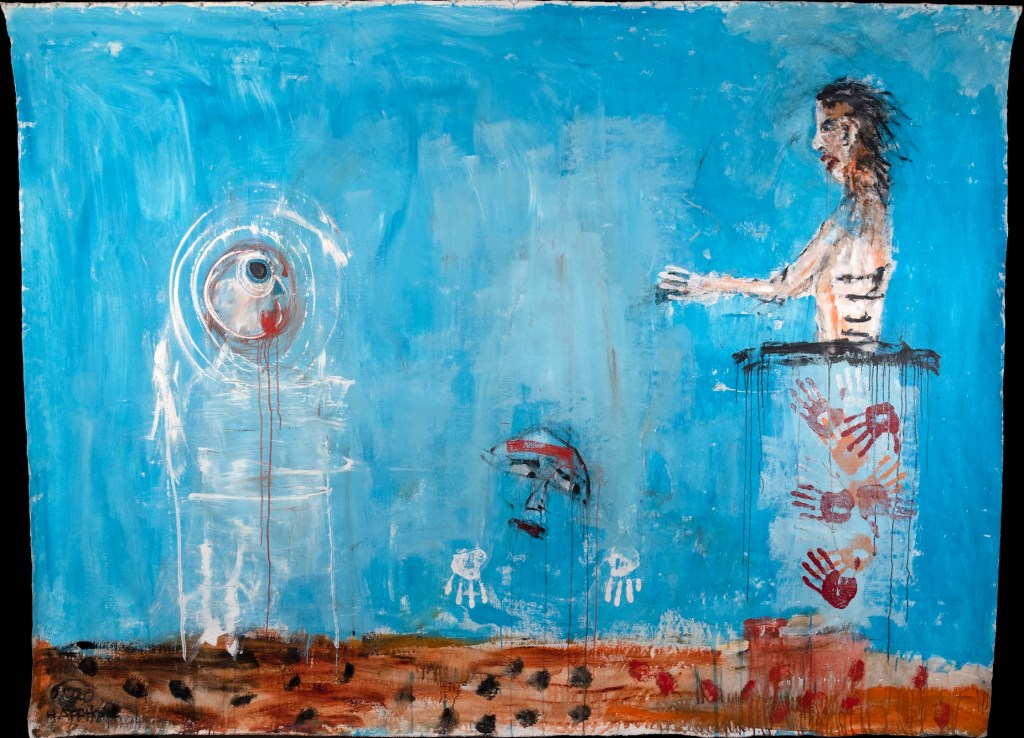
About the illustrator: Michael Hafftka is represented in the permanent collections of The Metropolitan Museum of Art, Museum of Modern Art, Brooklyn Museum of Art, San Francisco Museum of Modern Art, The British Museum, Carnegie Museum of Art, Museum of Fine Arts Houston, New York Public Library, Housatonic Museum of Art, National Gallery of Art, Yeshiva University Museum and other museums. He is currently a leading artist in the crypto art community. Learn more here.
 The Collidescope