
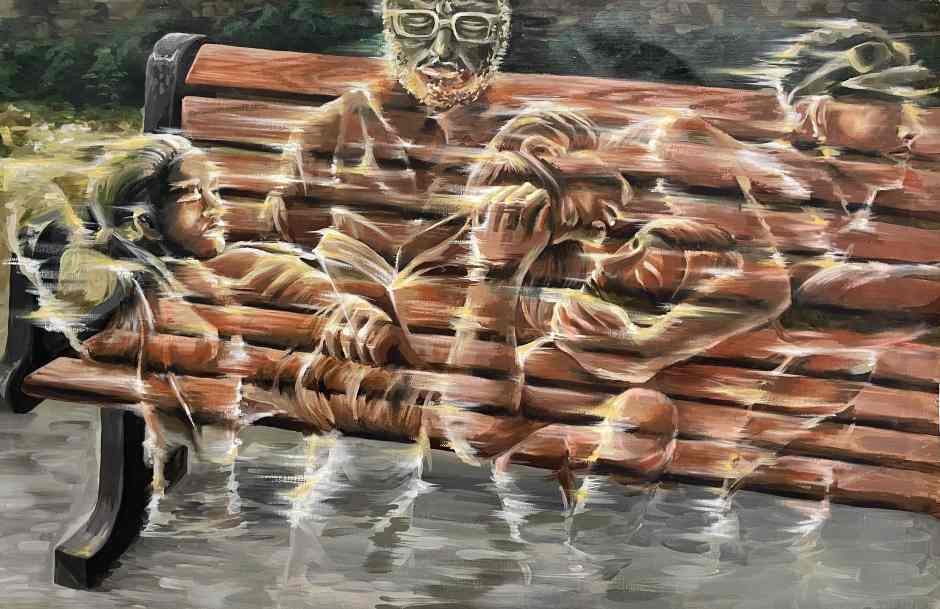
I am driving through Vermont and the leaves are changing. We have just moved back to the northeast and it has been two decades since I have lived somewhere with fall foliage; it is more beautiful than I remember. The leaves swirl around the car and the distant hills are lit with color, the red barns and white farmhouses nestled in yellows and oranges and reds. I am taking my children on a road trip to see my sister in Canada. My daughter is almost nine and she listens to music through pink headphones. My son is almost four and he turns the pages of a book that makes noise when you turn the gears or press the horn on the truck. Someone is missing: my second child would be five, and she should be squeezed between the other two, in the middle seat that now holds a stuffed dinosaur, buckled securely in.
But there is a problem, because how can it be that she has survived and my son is also alive? It’s the butterfly effect—the sensitive dependence on initial conditions in which a small change in one state of a deterministic nonlinear system can result in large differences in a later state, or so the internet tells me. In short: too many things have to have happened for them to both be alive. A small change; large differences. Her/him. My son’s existence is contingent on so many little moments that happened after I held my daughter in my arms for the first and only time. The moments my husband held me as I shook, crying as quietly as I could so as not to wake our then four-year-old. The moments we considered moving away, and the moment we decided; then the packing of boxes, the dragging of a couch out to the sidewalk, the lugging of a washer and dryer to the Salvation Army. Each step we took moved us further from her, closer to him. I better understand “the miracle of life” now.
How do I give him up in order to keep her? I can’t, and I wouldn’t. But the alternative is to accept her as a memory, while he gets to live and breathe. It is not a fair trade, not because I don’t love him, but because I love her too, and I want them both. I want them both.
People call them rainbow babies, the babies who are born in the wake of a pregnancy loss. But when we think of rainbows we so often think of their end, of the pot of gold, and that, too, feels unfair—why is he gold, and if he is gold, then what is she? My towheaded son, my dark-haired daughter. Are they light vs darkness, day vs eternal night?
I need help, and I wish there were a number I could call. A help desk, of sorts.
Help desk, what can I do for you? the operator would say.
Yes hi, quick question, I would say. How am I supposed to live with the knowledge that my daughter is dead so that I can have my son, or that my son wouldn’t be here if my daughter were, or that, to put it succinctly, I am not allowed to live in a world where my three children are seated side by side on a road trip through Vermont with the red leaves swirling around us as we tumble up the highway through the autumn wind? Can you help me?
Absolutely, the operator would say. Please hold while I transfer you to the right extension.
~
The Help Desk isn’t a desk, of course. It’s a sprawling complex—not one of those 1980s office parks off a highway, but a series of renovated buildings in the downtown of a small northeastern city. The compound might have been a mill at one time, or a warehouse. All brick and glass from the outside, inside the buildings are bright and airy; the sound of shoes clacking on the granite floors echoes, except in the places where there are cozy scatter rugs spread between comfortable arm chairs and midcentury coffee tables. The coffee is good there—people who work at the Help Desk are proud of that.
Have you tried the coffee? they ask new hires. It’s really good. Here, I’ll grab you one.
People like working there, because they know they’re making a difference. But if you say that to them, they roll their eyes—“making a difference” sounds so hokey and lame. It’s a feeling—an idea even—not something that’s openly discussed. Those new hires? They’re onboarded with language like “grief counseling,” and “growth mindset.” It’s not corporate speak, though; no one is holding long marketing meetings. It’s all pure. Again, they wouldn’t say that. They’d laugh. They like a good laugh, the folks there.
There are maps and charts hanging on walls in conference rooms in hallways, but there are also little alcoves with Zen gardens; it feels like a hybrid place, like a cross between the headquarters of a multinational corporation and an acupuncturist’s office. They’re familiar with the butterfly effect at the Help Desk, and you might see a few employees deep in conversation about it, poring over arrow-heavy graphics, parsing the idea of a deterministic nonlinear system, considering what is and isn’t possible—how to go back in time to just that very moment where everything, both outcomes, are possible. It’s algorithmic, in a way, but it’s also spiritual; it’s not just about numbers, but something more than that. It’s about fate, and whether we believe in it or not. It’s about kindness, and whether that matters—if I do x things right, will y become possible for me? It’s about honoring the past, without risking the future.
It was discussed, at one time, that there could be a room filled with toys and tea and baby blankets. It was Myron who brought up the idea, actually—what about a room, some nice things we can send people when they’ve suffered? The idea was dismissed. “Consolation prizes,” the employees called them. Cheryl actually cried.
I don’t want a box of tea, Cheryl said. It’s not enough.
Myron gave her a hug. No one was mad at him; it’s always nice to try something new, but really, the Help Desk doesn’t need much innovating.
Dante works there too, which is a running joke: Feels hot in here. Is Dante working late? He’s not related to the Inferno writer, this particular Dante. His parents were literature professors, one at Georgetown, one at Howard. Dante (the guy from Foggy Bottom, not the Italian writer), may have been the reason Help Desk workers stopped answering the phone with their names.
Help Desk, this is Myron. That was fine.
Help Desk, this is Dante. That scared people.
Dante, though, Dante gets something that not every employee gets, at least not right away—he’s worked there for a while. Dante gets that sometimes people call just because they want to hear a voice on the other end of the line. Yes, the goal of everyone at the Help Desk is to make things better, and sometimes that’s possible. But sometimes it’s not. In fact, most people aren’t calling because they expect an answer: they’ve been asking answerless questions for a long time, and they often know it. They’ve been negotiating with God for years, but God generally doesn’t talk back. People are looking for someone who can talk back, and make them feel normal again.
What is normal, at a certain point? Is it normal to cry every night? Every other night? Once a week? At what point does the full-body grieving end and the incremental, sneak-up-on-you-while-waiting-in-line-at-the-post-office grieving begin—the kind of grieving that asks for a trigger warning? What do you do when life itself is a series of trigger warnings? These aren’t necessarily questions that are asked of Help Desk employees when the phones start to ring, but they’re the questions they ask themselves, when they wake in the middle of the night and can’t go back to sleep. Dante wonders, How much are we really helping? Myron wonders, Isn’t there anything else we can do? Cheryl wonders, Why is all this shit happening in the first place?
~
In the car, among the swirling leaves, I look in my rearview mirror. My son has drifted off, book in hand, his head lolling slightly from side to side. My daughter is still listening to music, her eyes on the autumn landscape, meditative. The stuffed dinosaur sits in the middle seat, leaning to the right. This is the only possible outcome; this is the way it must be.

Elizabeth Bolton holds an MFA in creative writing from the University of Alaska Fairbanks. She was a winner of the AWP Intro Journals Project, and her essays have been published in Puerto del Sol, River Styx, The Forge, West Branch, The Dodge, and wildness, among others. Her work has been nominated for the Pushcart Prize, Best of the Net, and The Best American Science and Nature Writing anthology.
About the illustrator: Brian Ji is a seventeen-year-old writer who goes to Seoul International School in South Korea. His works have been published in Lullwater Literary Magazine, SCOPE Magazine, and VOICES Literary Journal. Besides creative writing, Brian loves to play racket sports.
 The Collidescope