
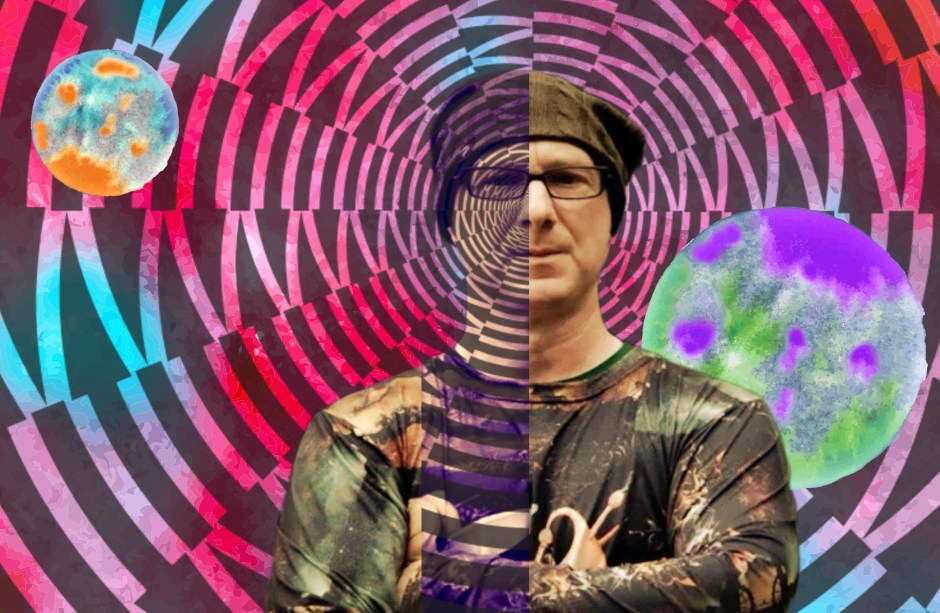
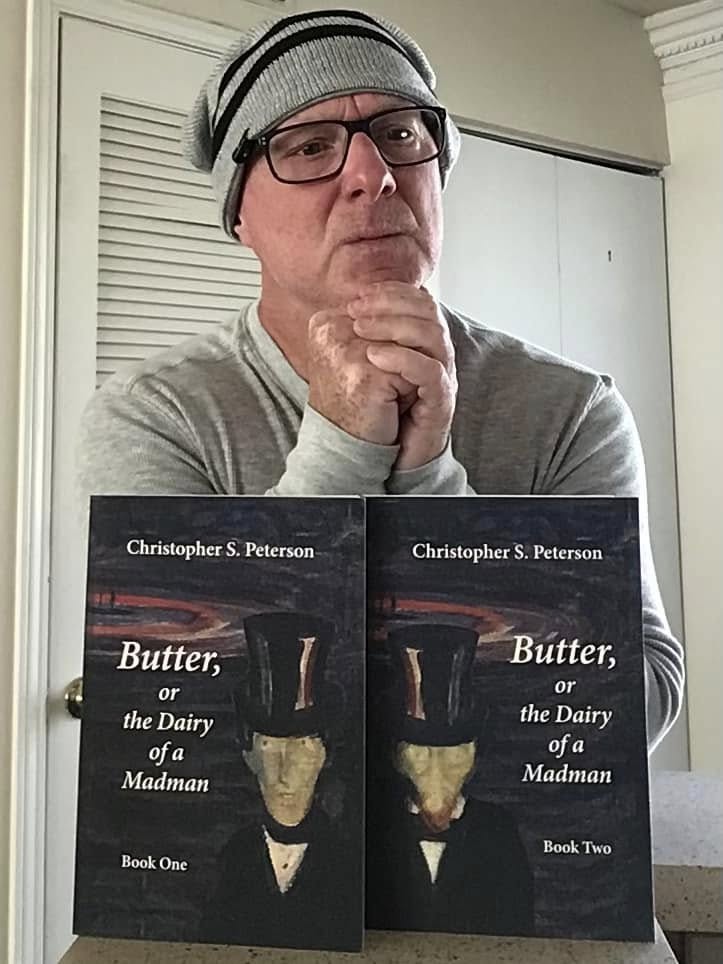
George Salis: Your two-volume, 1,000-plus-page novel, Butter, or the Dairy of a Madman, was recently published. What spurred such a mammoth project? What sustained it?
Christopher S. Peterson: I was initially going to write a historical novel about Manuel Blanco Romasanta, also known as The Tallow Man, who in 1800s Spain killed numerous people and used their fat to make soap. Intimidated by the amount of research required to do the thing justice, I abandoned the project. Within days I came up with the idea of the freakazoid protagonist, Peki Zambrano, and his world. I had sustained interest in composing it because I found it thoroughgoingly compelling.
GS: The title Butter, or the Dairy of a Madman is a play on Gogol’s Diary of a Madman. What other literary allusions are woven into the book’s DNA that you expect only some readers to pick up on?
CSP: At the risk of sounding/reading lame, I chose the subtitle because it’s catchy and cool. Plus, I dig Gogol to no end—the surreal aspects of his work, and how he deftly (and daftly) incorporated these outlandish elements into realistic depictions of everyday life, and lest I forget the wild-ass satire that exposed the flaws of society and corruption of Russian bureaucracy. His short story, “The Nose,” is the shit.
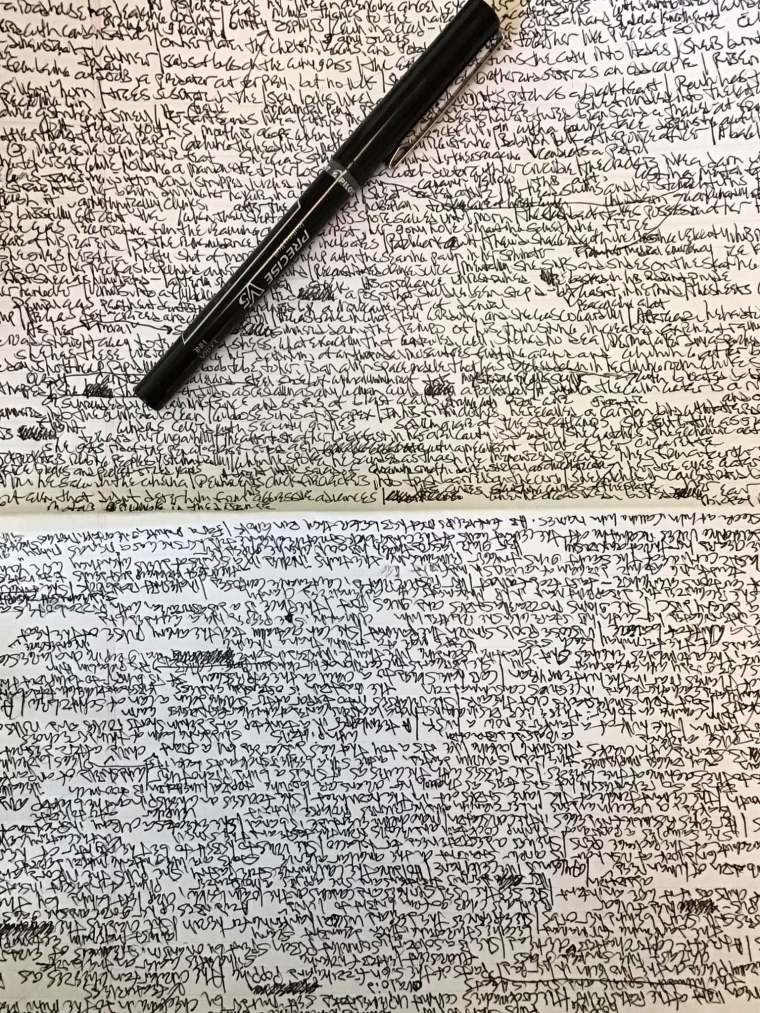
GS: You often post ekphrastic writing on Facebook. I also noticed some of that writing appearing in the novel itself, such as the introduction to Abby Domen, a character based on a sculpture of an obese, hairy, limbless torso plopped in a lawn chair. Can you talk about the ekphrastic process and how it informed this novel and your work in general?
CSP: I only do it on Facebook. It’s more of a creative exercise than anything else. Sometimes I’ll see an illustration and feel the need to compose something. What’s wild is that many of the posts you’re referring to changed the work, at least to a certain degree, for the better. On a whim, during a writing session, I copied and pasted into the work one of my posts that I wrote specifically for Facebook. That was the impetus to include many others. I wanted to use these characters as the victims, to provide some semblance of depth and substance. I didn’t want them to be nameless and, well, lifeless.
GS: What type of art or imagery strikes you as the most fecund? Do you find beauty in the grotesque?
CSP: Only when the grotesque is rendered with beautiful skill. Francisco Goya, one of my major influences, is a prime example. Peter Greenaway is another. What a brilliant filmmaker. And I shan’t forget the Brothers Quay, the stop-motion animators.
GS: I know you’re something of a cinephile. What film would you, in a sense, novelize via ekphrastic writing if given the chance?
CSP: Lordy, it would have to be Jeunet & Caro’s The City of Lost Children. I’m a sucker for the cartoonishly surreal.
GS: Butter is chiefly comprised of a sheer accumulation of sensory details, many of which are similes. What does it really mean to compare one thing to another? What exactly is being accomplished? I’m asking not from a practical standpoint as much as from a spiritual or metaphysical one.
CSP: This is a toughie. I’m a simile slut, plain and simple. It opens many doors, creates vivid imagery, enhances descriptions, and, you know, makes comparisons way more engaging for the audience. “The giantess ran after the pygmy like a cheetah chasing its prey.” I mean, come on. Similes, I believe, help readers visualize, understand, and remember information more effectively by connecting it to something familiar to them. At least that is how I look at it. And I love metaphors, which offer limitless possibilities for linguistic poetics and pyrotechnics.
GS: Speaking of sheer accumulation, does that term accurately describe the book’s structure, or did you have something more precise or geometrical in mind? For instance, David Foster Wallace somewhat famously referred to Infinite Jest as a “lopsided Sierpinski gasket,” lopsided because of the intensive editing that the manuscript underwent.
CSP: It would be a sexy answer to say that the work has a trigonal pyramidal structure or something, but that would be a load of horse-twaddle. The bottom line is, the fucker is a “large, loose, baggy monster,” to quote Henry James.
GS: What was the editing process of Butter like? Did you change or add much after the fact?
CSP: Darlings were killed. About 20,000 words were deleted. There were flashback chapters in which Peki wound up in a relationship with a Japanese woman named Fumi, the two of them living in a bunker during wartime. It was a little too schmaltzy and didn’t jibe with the rest of the novel. Also, there were diary entries by Marisa, Peki’s mother, who wrote prose like Samuel Beckett on steroids. The text had to go.
GS: There’s an obsessive emphasis on sex in Butter, almost more so than the murders that follow the sex. Not to mention the exhaustion of every position and orificial penetrative possibility, in fact. What does sex in literature mean to you in general, and how would you defend or justify the detailed quantity of it in Butter?
CSP: Shit, if it works, use it. No question. I would justify the coitus in Butter because Peki is a sex fiend. He digs the nasty big-time. Was it overdone? Mayhaps. He went to extremes in every facet of his existence. It was incumbent upon me to be true to the character. I was all in.
GS: What is it about maximalism that speaks to you more than, say, minimalism? Do you see maximalism as a philosophical stance as much as a stylistic one?
CSP: Absolutely. Maximalism is freedom. Minimalism is imprisonment, in my book.
GS: Did you study fiction writing in any formal way or are you, like me, more of an autodidact? What has proved most useful for honing your craft?
CSP: I’m completely self-taught. I learned by doing. For me, reading, writing, and revising a lot is of paramount importance. Commitment is the key. I’m dedicated to experimentation, tinkering with plot arcs and character development, and all that jazz. I love the process and the challenge, putting the pieces of the puzzle together.
GS: Tell me about how you first discovered and responded to the work of David Foster Wallace. I recall that you met him during his Infinite Jest book tour. Give me all the juicy details.
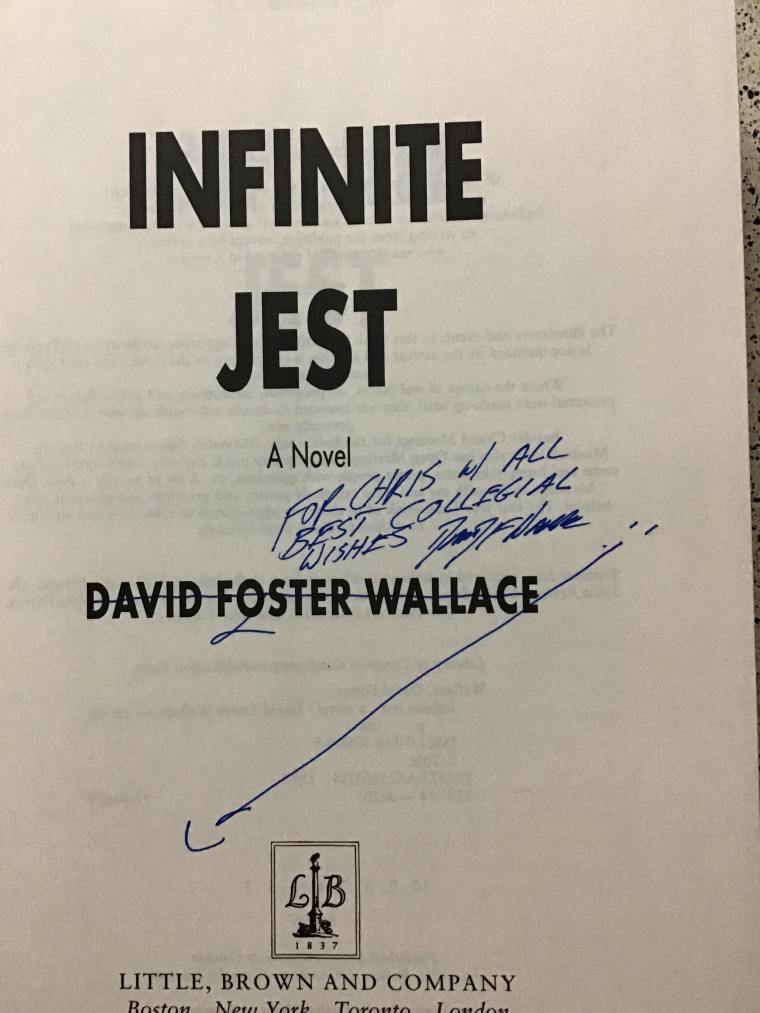
CSP: Actually, it was for the Brief Interviews trade back tour. I think it was in 2000, at the Boston Public Library. The place was packed. You would not believe the groupies. Before the reading started, I went looking for the restroom, and when I walked around the corner, there was The Man, wearing a polo shirt and blue jeans tucked into semi-laced work boots. He was sitting in one of those folding chairs, and spitting chewing tobacco into a Styrofoam cup. He was linebackerishly huge. I said, “Hey, man,” and he waved sort of nervously. Later, when he signed my copy of IJ, he drew a little doodle on one of the pages. He sarcastically apologized to this snooty woman who was handling the gig; he was only supposed to sign his name. The lady gave me the stink eye and that was that. I don’t think I slept for days afterward. What an unreal experience. As far as how I discovered him, I remember working at the Waterstones store in Boston, and when I was sitting in front of my computer in the stockroom, I heard this thud. There was a copy of Infinite Jest on my desk. The assistant manager of the store said, “This is right up your alley.” She was right. Thanks, Ellen, wherever you are.
GS: What’s the weirdest thing you like to put butter on, and please don’t say your asshole.
CSP: That would be a Pop-Tart. An ex-girlfriend recommended that I try it. I did, and was hooked.
GS: What’s a novel you’ve read and think deserves more readers?
CSP: David Madsen’s gorgeous and nutty Confessions of a Flesh-Eater. Check it out.
GS: What have you been working on since Butter?
CSP: After recently finishing the edits on my massive psychedelic noir, Sea No Evil, I’m letting it rip on an intricate novel, The Air You Breathe Turns Blue, which is a book structured like a paper doll chain, with each story exploring one of the five senses. It’s progressing nicely, despite the tricky-as-heck narrative.
GS: You dive from one epic-sized book project to another. How do you maintain both your inspiration and ambition in the face of a dwindling, if not outright microscopic, literati? Is there an element of madness there, much like Peki Zambrano, who is dedicated to the art of butter despite everything else, even dedicated at the expense of everything else?
CSP: It’s easy-peasy to maintain inspiration. I’m currently reading Parallel Stories by Péter Nádas. Jaysus, if that doesn’t get it up, nothing will. Top-shelf stuff. I live for writing. When I’m doing it, I get the same feeling I got as a kid when playing video games. At the risk of sounding immodest, it’s as natural to me as breathing. Is there an element of madness? Hell, yeah.
For early access to literary content like this and other awesome benefits, such as editorial services, consider supporting The Collidescope on Patreon.

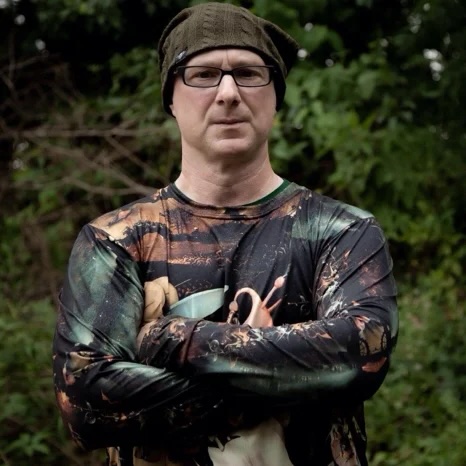
Christopher S. Peterson has been seriously dreaming since he was a bambino, immersing himself in Icarusian flights of fancy. He enjoys reading, film, music, animals, working out, football, hockey, and living in nerdvana. He has been published in several lit mags few people have read. He was properly educated at Wildwood Elementary School in Burlington, Massachusetts, and currently lives in Atlanta, Georgia with his black cats. His most recent novel is Butter, or the Dairy of a Madman (published by Fomite Press via volume one and volume two).
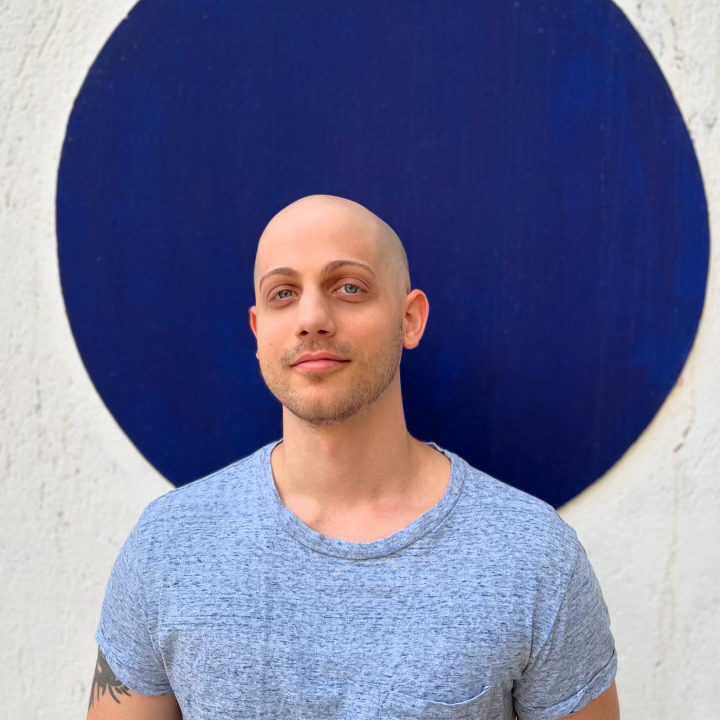
George Salis is the author of Sea Above, Sun Below. His fiction is featured in The Dark, Black Dandy, Zizzle Literary Magazine, House of Zolo, Three Crows Magazine, and elsewhere. His criticism has appeared in Isacoustic, Atticus Review, and The Tishman Review, and his science article on the mechanics of natural evil was featured in Skeptic. After a decade, he has recently finished working on a maximalist novel titled Morphological Echoes. He has taught in Bulgaria, China, and Poland. He’s the winner of the Tom La Farge Award for Innovative Writing. Find him on Facebook, Goodreads, Instagram, Twitter, and at www.GeorgeSalis.com.
The Collidescope is an affiliate of Bookshop.org and will earn a small commission if you click through those specific links and make a purchase.
 The Collidescope