
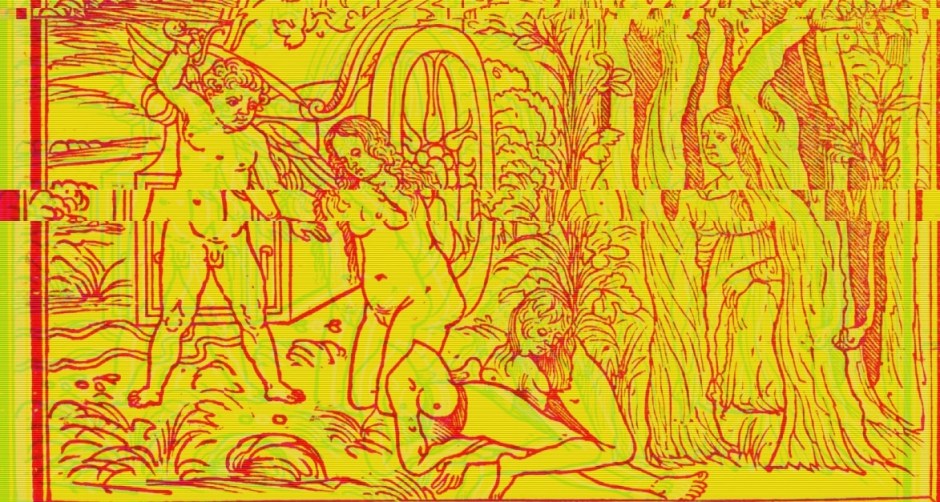
“‘If we got rid of all the margarine, the world would be a butter place….’”
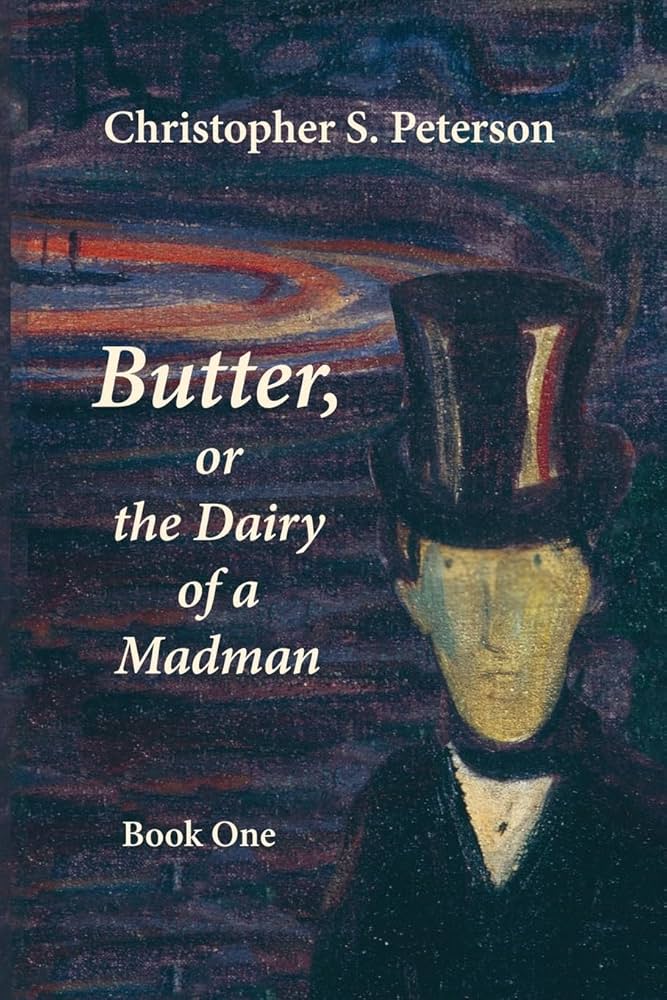
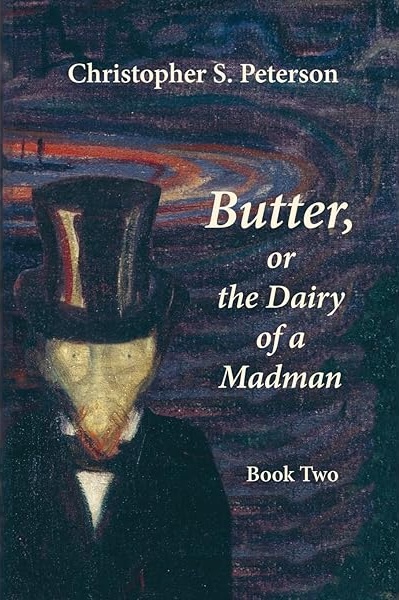
Christopher S. Peterson’s two-volume, 1,000-plus-page sophomore novel, Butter, or The Dairy of a Madman (Fomite Press), is closer to a cornucopian collection, an exploded encyclopedia even, of similes rather than a novel proper. As such, it reads more like a textual painting that morphs and writhes before one’s eyes, a Dalí, a Bosch, a Brueghel, as well as Rodin’s The Gates of Hell sculpture, all cumming together in a grotesque orgy of unrelenting proportion. Peterson often posts on social media ekphrastic prose responses to classic art and then some, so perhaps this is just the way his mind works.
This anti-novel is unabashedly, uninhibitedly, and inflexibly itself. As an author’s pure vision, a work like this is in some ways a callback to a time before the omnipresent MFA novel assembly lines, before the virulent vogue of minimalism masquerading as verbal humility, before the demographic quotas that are ostensibly there to give voice to the voiceless but only if that voice is sanitized or anesthetized for marketability. Without so-called qualifications, Peterson, a self-professed “simile slut” and “sucker for the cartoonishly surreal,” is simply a writer with a love for words and images who has used nothing more than the sheer power of his imagination to breed those elements into a monsterpiece all its own. If anything, Peterson might be the heir to Marguerite Young, whose Miss MacIntosh, My Darling also dispenses with motion, narrative or otherwise, for the sheer accumulation of sensorial similes, kaleidoscopic depictions, and trippy hijinks over a thousand dense pages. Both novels have somewhat pastoral preoccupations, evoking the sky and stars and sea, but Butter also throws into the mix urban filth, anatomical nightmares, and more. Think also of Sylvia Plath’s early poetry, before Ted Hughes got to her.
As it happens, Butter’s strength, its singularity, is also its weakness, for a book of this length can’t be carried by purpureal prose alone. There isn’t much plot to speak of, except for the foundation that gives a reason to keep on accumulating details upon details within details. Our protagonist is Peki Zambrano, a homicidal and nymphomaniac dwarf who turns his victims into hallucination-inducing tubs of butter that sell like hot cakes, a situation inspired by the 19th-century Spanish serial killer Manuel Blanco Romasanta, otherwise known as The Tallow Man, who used the fat of his victims to make top-tier soap. What would the reptilian brain be without a generous dose of sex to balance out the violence? Peki gets more pussy than a toilet seat, almost always seducing or raping his victims before killing them, sometimes after killing them too (he even penetrates the belly button of a male, sentient torso). The fucked-up lust and “high-intensity coital theatricals” don’t end there, because he also yearns for his mother in chapter after chapter after chapter. In other words, he has the pussy that had him. Between those chapters are super-Pynchonian character sketches followed by a sex rape murder scene or some combination thereof. It doesn’t take very long in this very long book for the ennui to set in à la “The Part About the Crimes” in Bolaño’s 2666. In essence, Butter could almost be considered a fantastical expansion of that catalogue of corpses. Equally exhausting, equally inhuman.
Peterson does attempt to break up the maniacal monotony with chapters on the history and science of butter: “Butter, it seems, was the fat of choice for the tribes of northern Europe—so much so that Anaxandrides, the Greek poet, derisively referred to barbarians from the north as ‘butter-eaters.’” While Peterson doesn’t do for butter what Melville did for whales, he is wading in similar waters. The major divergence is that, whereas the digressions are both the meat and blubber of Melville’s masterpiece, Peterson’s short and sparsely scattered chapters are the exception to the overruling rule. The same is true for the excerpts from Peki’s diary and sections of Peki’s time in a war that seems to occur in a vacuum. Peterson told me that he cut out Beckettian diary excerpts written from the point of view of Peki’s mother, Marisa, but that still would not have provided a necessary polyphony to the overall structure. The marketing lingo promoting the book describes it as part “cat-and-mouse psychological thriller,” which is far from accurate, yet would have helped with the butyraceous novel’s severe lack of narrative trajectory.
Peki, that perverse Oskar Matzerath, does have some amount of psychological depth, even if that psyche and its history have intentional discrepancies and contradictions, and is spread window-thin across the millenary folii. “He feels as though he is the Devil’s miracle or God’s mistake.” He experiences grief and guilt about his actions, although he refuses to listen to his conscience, such that it is. There’s an alleged reason for his dairy fixation, which could easily have come from Dalí’s unhinged autobiography:
A prison psychiatrist once told him, with clinical dispassion and ethical confidentiality, that he is obsessed with margarine because, as a child, he, Peki, used Marisa’s diarrhea and vomit on a bran muffin, for they couldn’t afford butter, and nowadays he’s trying to connect himself to that source of “nourishment.” Butter captures the true flavor of many foods, and he lavishes every iota of inventive skill upon its making.
Regardless, all we ultimately have is Peterson’s dam-burst-of-dreams prose, so let’s unpack it further: the details that portray Picasso-esque features and feelings not only accrue but overlap, cancel each other out, and create a microcosm of endless paradoxes: “Remembrances are like a kaleidoscope—reshaped, reordered.” Peterson uses an extremely expansive vocabulary comprised of the formal and Latin and scientific and archaic, including megrim, endue, vizard, boutade, zoftig, caducity, pinguid, harridan, crinigerous, and appetency. In addition, there’s a slacker-slang reminiscent of Thomas Pynchon and David Foster Wallace, in which Peterson flings out words like “pies” for eyes, “phizog” and “fizog” for physiognomy, etc.
The fact that this massive novel has almost no dialogue contributes to an experience akin to reading the rapid celluloid paintings of experimental filmmaker Stan Brakhage—the flitting of excess color and sensation goes by almost before you register it, unless you read slowly or stop altogether to savor a choice phrase or sentence, of which there are, by design, more than plenty, such as “His bodily tingles make him feel as if he swam into a school of stinging jellyfish,” “She has a saint-in-a-painting eminence,” “He was sweat-sodden in an erotic swamp,” “Her feet look like dying leaves,” and “Humectation is as tumescent as a globose-gravid labonza,” that last one an example of the hyperbole gone hyper-bubbly.
While his sentences are often much simpler in their construction than Marguerite Young’s, Peterson frees his writing of anything like sequential logic on the level of the paragraph, “cause and effect are lost in limbo,” much like the work of short story virtuosa Garielle Lutz. As a matter of general example, one sentence in Butter will describe the clogged-drain pong of a woman’s feet, the next sentence will evoke a hemorrhaging welkin, and the one after that will encapsulate the ghost-gasp of an AC unit before returning to the number of quivering wrinkles in Peki’s stink-star. Despite the mega-multiplicity of descriptions, the narrow focus on Peki’s desire for his mother and the characters who exist just to be promptly de-existed makes the book, like Young’s own monsterpiece, smaller on the inside than on the outside, giving a claustrophobic feeling similar to a swallowing by avaricious avalanche, by coughing sarcophagus, by solipsistic purgatory.
Make no mistake, I admire and respect Peterson’s imagination, but I also found it difficult to follow him all the way to the boundaryless edges of this weird and wet dreamscape. William T. Vollmann, in his 20s, proved his creative powers with his 1987 debut novel, You Bright and Risen Angels, a 700-page book that shares Peterson’s cartoonish sensibility (the former actually gave it the subtitle: “A Cartoon”), except Vollmann disavowed that chunk of juvenilia as too easy an exercise. It’s much harder, he later claimed, to research deeply and write novels based on a far more realistic framework. I wouldn’t necessarily want Peterson to flip the channel on his Ren & Stimpy marathon, as it were, but I will say it’s also much harder to write a surreal novel based on any realistic framework at all, and its narrative in its most primordial and mythic form that can elude even the fecundest mind. Having said that, I look forward to seeing how Peterson uses his skills in future novels.
“He brags, with her blowing him, that, when it concerns butter, it’s like he’s ‘spinning straw into silk.’”


George Salis is the author of Sea Above, Sun Below and Morphological Echoes. His fiction is featured in The Dark, Black Dandy, Zizzle Literary Magazine, House of Zolo, Three Crows Magazine, and elsewhere. His criticism has appeared in Isacoustic, Atticus Review, and The Tishman Review, and his science article on the mechanics of natural evil was featured in Skeptic. He has taught in Bulgaria, China, and Poland. He’s the winner of the Tom La Farge Award for Innovative Writing. Find him on Facebook, Goodreads, Instagram, Twitter, and at www.GeorgeSalis.com.
The Collidescope is an affiliate of Bookshop.org and will earn a small commission if you click through those specific links and make a purchase.
 The Collidescope