
Neighbors (1980)
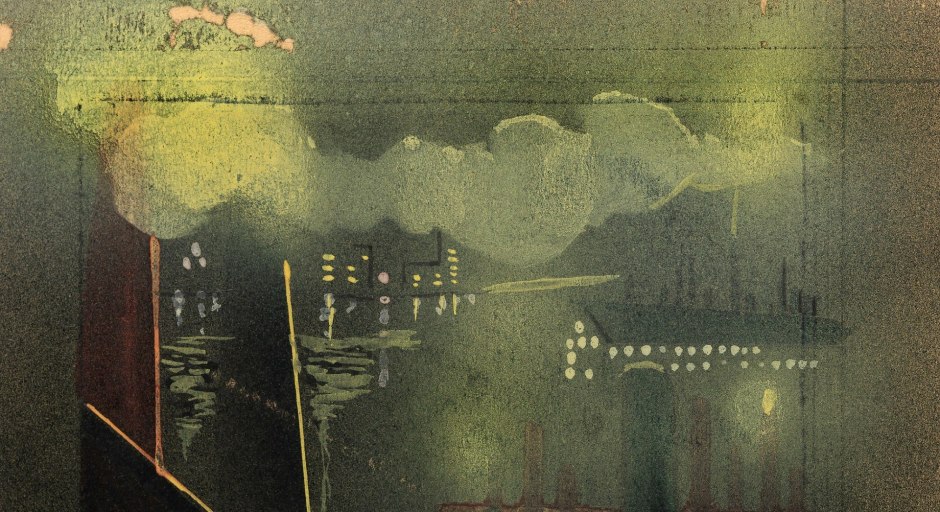
Here the oddities do not coincide and so multiply – feral cats everywhere, women with tarnished children crowding around under strychnine streetlights, and the moon, its every movement a rehearsal for a departure, an escape.
X
The pain cannot let itself out.
X
Figures stare from behind cracked glass – Remember when sunlight opened doors and we spoke? Remember when night was a game we played?
X
Corpses of busted-up cars line the street, the spirituality of their coming and going withered from the spaces they wrinkle. In walls, vacancies grow and the people become thin as night falls. I am forced, I suppose to the nebulous auditorium of daylight after drink where the parallel lines of night remain a chaos of bourbon, slow to absorb either warmth or sun.
Sparks Are the Only Light
The dog whining in her sleep hears moonlight,
a guitar, and from off in another part of the city, the warm and still concerto of maples and a motorcycle ripping a hole in the night, yet the man, asleep on the couch, does not wake, inexplicably the woman continues to gather laundry, and children play far, far past their bedtime beneath a battered wooden table where food from some other day is dried out on paper plates on which flies have landed.
A wren departs later than the sun, its wings trembling as it darts toward the darkening sky and the sea falls away from the decadence of light and ice because the sea’s waves have scraped away their melodies and sprayed them onto the lost choirs.
When night collapses it contains dusk, rain, and a thick chill which circles the house stealing a shadow, a drop of water, a leaf, and one child.
It places these things on the shoulders of the storm which has darkened everything, and the child will grow to love the night and sow the spaces between the leaves with sparks, a fiction of light.
But someone has broken into the story and approaches me, insisting I am not finished to which I reply, “But it ends here.”
The intruder, coated with static and impatience, sneers, “Well, not to me it doesn’t,” just as I raise my pinkie into a wind of black paint and weep. “It ends, I tell you. It ends here with sparks!”


John L. Stanizzi is the author of fifteen collections, including his soon-to-be-released Entra La Notte. Other titles are Sundowning, POND, Feathers and Bones, and SEE.
Besides The Collidescope, Stanizzi’s work has been widely published in Rattle, Prairie Schooner, American Life in Poetry, Tar River, The New York Quarterly, and many others.
His poems have appeared widely in Italy—with profound gratitude to his translator and dear friend, Angela D’ambra.
His creative nonfiction has been published in Literature and Belief, Southern Florida Poetry Review, and many others.
Stanizzi has read at venues all over New England, including the Mystic Arts Café, Mystic Art Gallery, Hartford Stage, and many others. Johnnie is a former Wesleyan University Etherington Scholar and New England Poet of the Year. In 2021, John was the recipient of a Fellowship in Creative Writing (nonfiction), granted by the Connecticut Office of the Arts, Culture, and Diversity. Learn more here.
 The Collidescope