


About Arno Schmidt: “Schmidt (born January 18, 1914, Hamburg-Hamm, Germany—died June 3, 1979, Celle) was a novelist, translator, and critic, whose experimental prose established him as the preeminent Modernist of 20th-century German literature. With roots in both German Romanticism and Expressionism, he attempted to develop modern prose forms that correspond more closely to the workings of the conscious and subconscious mind and to revitalize a literary language that he considered debased by Nazism and war.
In 1958 Schmidt moved to the village of Bargfeld near Celle in the Lüneburg Heath. Over the next 20 years, until his death in 1979, he wrote some of the landmarks of postwar German literature. In Kaff auch Mare Crisium (1960; Boondocks/Moondocks), a novel set on the German heath and on the Moon in the wake of nuclear war, he began to push the limits of experimentation with orthography and punctuation. The influence of James Joyce and Sigmund Freud is apparent in both a collection of short stories, Kühe in Halbtrauer (1964; Country Matters), and, most especially, in Zettels Traum (1970; Bottom’s Dream)—a three-columned, more than 1,300-page, photo-offset typescript, centering on the mind and works of Poe. It was then that Schmidt developed his theory of “etyms,” the morphemes of language that betray subconscious desires. Two further works on the same grand scale are the “novella-comedy” Die Schule der Atheisten (1972; School for Atheists) and Abend mit Goldrand (1975; Evening Edged in Gold), a dream-scape that has as its focal point Hiëronymus Bosch’s Garden of Earthly Delights and that has come to be regarded as his finest and most mature work.
Schmidt was a man of vast autodidactic learning and Rabelaisian humour. Though complex and sometimes daunting, his works are enriched by inventive language and imbued with a profound commitment to humanity’s intellectual achievements.” – John E. Woods

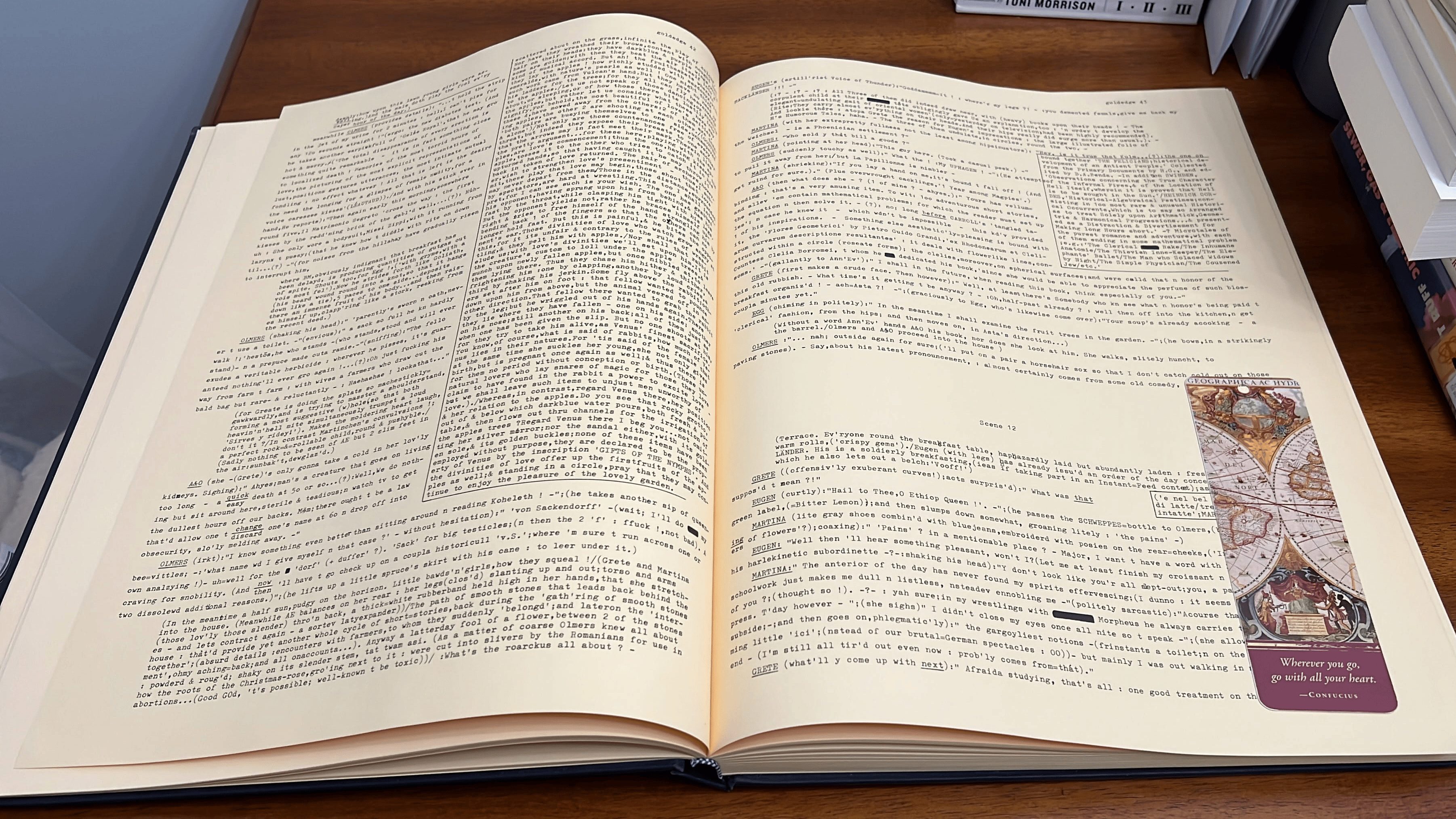
Evening Edged in Gold by Arno Schmidt is over 17 inches tall and nearly 13 inches across. While reading this rarest of tomes, I felt like a monk hunched over an illuminated manuscript. It’s truly an objet d’art nonpareil, impossibly and majestically rendered into English from the German by the late, great John E. Woods, who described it to me in the latter half of 2022 as “the crown work, a world without borders or limits, it flows from heaven to haystack and back with a mighty, delicate roar,” a novel filled with “elementary spirits and arcane literary nooks and crannies.” His translation won the National Book Award and the PEN Prize in 1981.
Almost 50 years after the book’s publication, precious few copies can be found for sale online, and they tend to go for around $700 or more. I bought mine in March 2021 from the literary critic Steven Moore, who said, “I purchased that book in Denver in the summer of 1980, and it has accompanied me from Colorado to New Jersey to Illinois back to Colorado and then to Michigan. Now it gets to see Florida. A well-traveled novel.” The journey didn’t end there, for the tome accompanied me to Charlotte, North Carolina for a few years before eventually making its way to a new owner in Salt Lake City, Utah.
Schmidt’s nearly 1,500-page Bottom’s Dream preceded Evening Edged in Gold’s original publication by five years, and although the latter may not be as thick as the former, its 215 pages are far larger, and no less stuffed to the gills, if not armed to the teeth, because the reading experience can at times feel like a battle between book and reader, a textual carpet bombing, in which any empty space persists as a no man’s land.
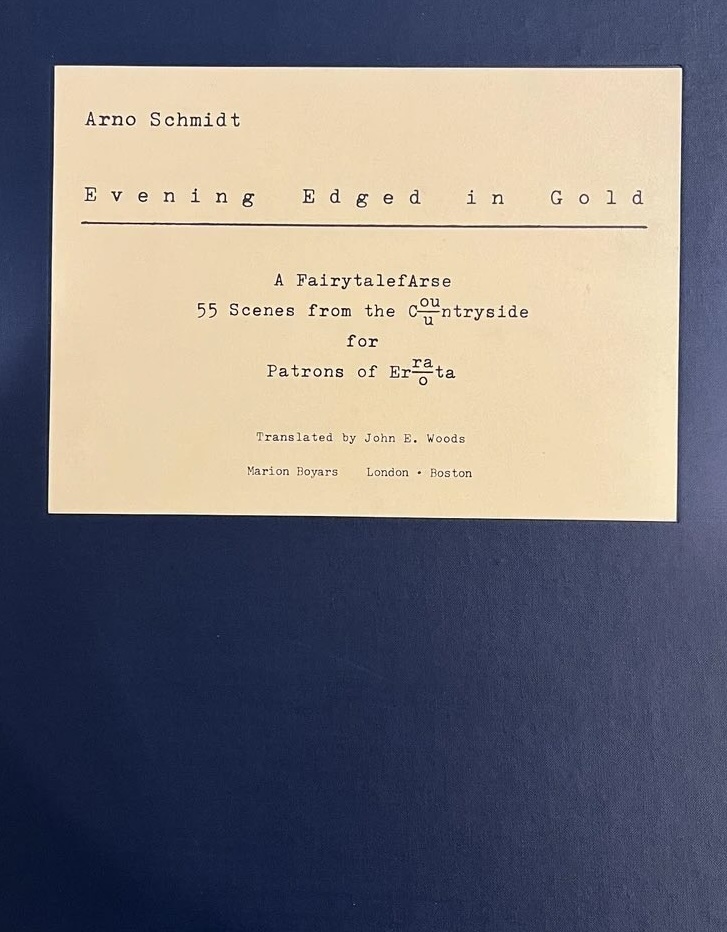
The novel is structured as the manuscript of a play—a FairytalefArse with 55 scenes from the cuntryside for patrons of errata/erota—with penciled in corrections, hence the large pages, dull yellow like the hay-strewn microcosm they describe, the color in contrast to the deep, twilit blue of the book’s covering. Rather than any stripped-down Beckettian drama or other, this “play” is an assemblage of not just dialogue but botanical facts, songs, photos, literary quotes (from the Koran to Jules Verne), blueprints, multiple languages (German, Spanish, French, Italian, Latin, Old English, etc.), historical quotes, product ads, maps professional and amateur, endless typographical shenanigans (years before Mark Z. Danielewski lost his virginity, let alone wrote House of Leaves), and instructions on how to shower that are paired with several photos of a beautiful, sudsy woman demonstrating the technique: back then pits and tits, asscheeks then feet. If anything, the book’s closer in spirit to the everything-and-the-kitchen-sink mindset that drives Joyce’s Ulysses, specifically the “Circe” chapter, except Schmidt and Woods’ prose goes further by incorporating words sandwiched on top of each other to alter the meaning within a single word and/or the meaning of a sentence as a whole. For instance, “into the valley” becomes “into the vulvey,” but depicted so that the a is over the u and the l is over the v as in an equation. And what is being equated? The banal with the anal, perhaps, the common with the cum-in, for Schmidt is a Freudian who believes that within literature’s descriptions of landscapes one finds, in actuality, erotic descriptions of women, or that any phrase really, say, “Where is my pen’s ink?” could, in fact, disguise the sexual, “Wear my penis’ stink.” Schmidt calls such wishes and longings, in their most rudimentary form, etyms, and if anything, Schmidt’s work is an excuse to create or unearth as many etyms as possible, most of which are quite delightful, some beautiful, almost all lecherous. A handful/glandful of my favorites include: “aluminumb,” “clairvoyeurant,” “twivilization,” “vigilantease,” “silkrament,” “breastidigitator,” “syruptitious,” “perspeckertive,” “convulvsions,” “hyenacinth,” “balustrayd,” “barefut” (fut in German means twat), “God, that ol’ creatortoise,” “vagility,” “messiasses,” “formalititties,” “anallytickle method,” and “adildolescing toward maidenhood.” However, not every one of the etyms in this novel is as clever as all that. Still, if you’re a wet noodle and write/jack them off as im[mate]ture, as low-hanging fruit/fut, then you won’t have the capissatitty to appreciate this work of f/art.
Aside from being lascivious as all hell, the novel often involves discussions of old German writers, Friedrich Wilhelm Hackländer chief among them, and a general sense of bibliophilia, as well as politics, misogyny (as a virtue), religion (as an intellectual sin), philosophy, and psychology (usually as it pertains to the school/skull of Freud).
Schmidt could also be considered the grandfather of the emoji, except, instead of simplistic facial expressions, his use of characters is much more abstract, as a way of suggesting movement, emotion, and the like, with no discernible internal logic to the practice—the parentheses and periods and colons stamped on the manuscript in a manner comparable to Pollock’s paint-drips upon the canvas:
OLMERS (astonisht=indignant) :” Could-I=ever ! “; (what kinda men are you, you other-guys ?! – But just a sec : have you ever notic’t thát before ? (He sites, tward the North, (but not at the fisher’s house; but rather, t judge by the sharp angle …)-)-):” Take a peek for yourself.
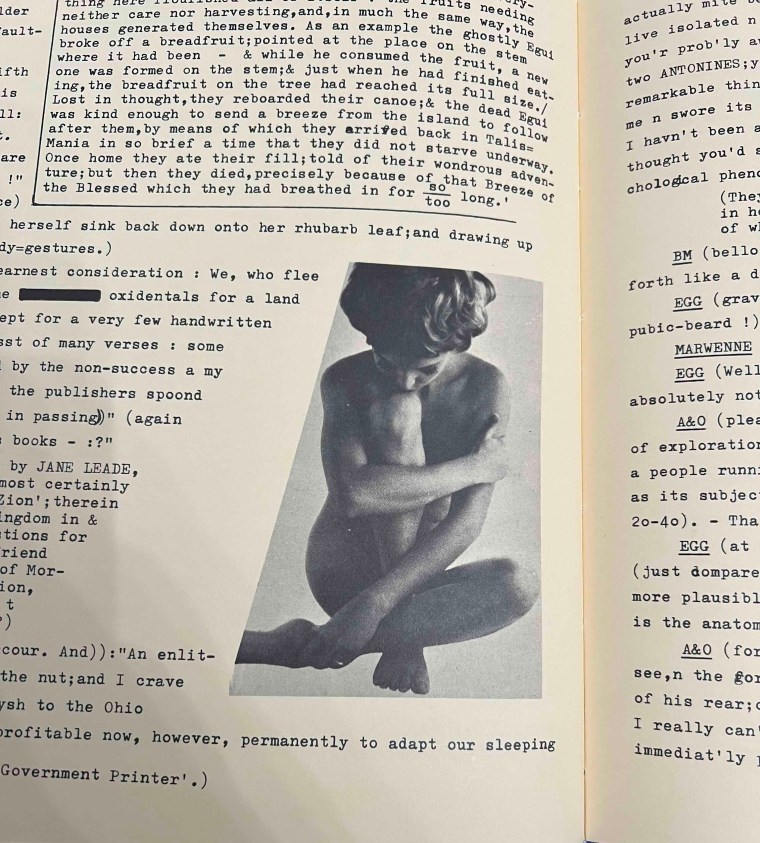
As for the plot, there exists the bones/boners of one: Our heroine is the lovely and lewd Martina Forbach, a 15-year-old whose name rhymes with Lolita, that other nymphet, yet Martina’s the cuntry bumpkin who is also part Sinderella because her mother Grete often berates her and forces her to do chores. Instead, Martina would rather lounge around with the ever-nude Ann’Ev’ (listed as “just 20” on the personae page but, as Steven Moore corrects in pencil, described as 21 on the ninth page) and fawn over a boy she admires from a distance, a boy whose virginity Martina often imagines taking. Martina gets along far better with her father Eugen, also known as the “Major,” a war veteran and double-amputee from the thighs down. Other characters include Egon Olmers (Grete’s brother and a retired head-librarian), Asta (a housekeeper in alliance with Grete), the licentiate and literary Egg, the barbarous Bastard Marwenne (who often brandishes a caveman-club-sized hard-on), and Babilonia (an 11-year-old who is already a widow several times over). Ann’Ev’, Egg, Marwenne, and Babilonia comprise the “group,” essentially a band of bohemian vagrants who both inspire and antagonize the residents of the Forbach home.
The “play” takes place in Klappendorf over the course of a few days in early October 1974. The “events” are listed on the final page, and mostly involve the characters strolling around, discussing specific topics, and so on: “moonlite with girls bathing,” “conversation about ‘Religions and Sects,’” “shooting contest Augen,” “the 4 girls comment on the scenes around the hillahay,” “A&O tells about his childhood years in Hamburg,” “M & AE taking a shower,” etc.
Of course, none of this is made as simple as it may sound, juxtaposed and spliced as it is with the sweet spicy bitter ingredients mentioned above. There are also brief digressions into the fantastic, putting the fairy into the tale: people who have woken to find their bodies marked by their dreams, for instance, and Chinese floating villages on the water, digressions I would have preferred to see more of. They’re part of the many partitioned quotes from sundry manuscripts as discussed or hinted at in the main text, some that might be Borges-style fabrications altogether. Of the writers who are verifiable at first glance, there’s Bunyan, Rückert, Shakespeare, Kant, Swedenborg, etc.
The partitions can be porous, despite rarely being so, as when Ann’Ev’ enters a Bosch painting that the group is discussing, specifically the center of his famed triptych, and interacts with the inhabitants, a naked woman among the naked, then returns with a red seed-ball, much to the group’s astonishment. Later in the novel, we witness prognostication in a puddle of Coca-Cola. Such are some of the most intriguing titbits, which do get weighed down, gagged and bound even, by an excess of talk about esoteric and banal matters, and the plot, such that it is, more or less peters out by the end instead of raging with an erection to the heavens.
Either way, the characters dissolve, the curtain drops, and if it’s an experience that lasted maybe two times longer than it should have, I’d much rather chew on too much than starve on too little. I’m grateful to Woods for gifting us this slab of literary magic, a tome that demands every iota of its physicality in a world now dying digitally. Yes, Evening Edged in Gold (Abend mit Goldrand) is an undeniably impressive swan song from a titan of German letters who passed away some four years later in 1979, leaving behind an unfinished novel titled Julia, oder die Gemälde (Julia, or The Paintings).
Editor’s note: The aim of Invisible Books is to shine a light on wrongly neglected and forgotten books and their authors. To help bring more attention to these works of art, please share this article on social media. For early access to literary content like this, consider supporting The Collidescope on Patreon.
The Collidescope is an affiliate of Bookshop.org and will earn a small commission if you click through those specific links and make a purchase.


George Salis is the author of Sea Above, Sun Below and Morphological Echoes. His fiction is featured in The Dark, Black Dandy, Zizzle Literary Magazine, House of Zolo, Three Crows Magazine, and elsewhere. His criticism has appeared in Isacoustic, Atticus Review, and The Tishman Review, and his science article on the mechanics of natural evil was featured in Skeptic. He has taught in Bulgaria, China, and Poland. He’s the winner of the Tom La Farge Award for Innovative Writing. Find him on Facebook, Goodreads, Instagram, Twitter, and at www.GeorgeSalis.com.
 The Collidescope