
George Salis: You’ve done plenty of admirable work to shine a light on obscure writers, an endeavor close to my heart. What’s one novel that’s obscure-squared and deserves more readers? The “crème of the under-read. The stuff flattened under fat fashionista arses, forgotten in the waft of mainstream farts,” to quote you to yourself.
M.J. Nicholls: Tom Mallin’s Erowina or L’Eternelle Blessee, first published by Allison & Busby in 1972. Mallin worked as an artist until the last ten years of his life, when he produced a flurry of plays and novels, each marked by a restless stylistic experimentation that left him isolated by the British literati, which has always been predictably sniffy about the avant-garde. (Kingsley Amis once waged a one-man war to ride the avant-garde out of town). Erowina remains one of the most unique, thrilling, and challenging novels I’ve read—a homage to Ulysses that properly honours the scope and dexterity of Joyce’s language in a way that is fresh and underivative. I reissued the novel for Verbivoracious Press in 2015 with the help of fellow buried book enthusiast Nate Dorr.
GS: While it’s defunct now, Verbivoracious Press started about a decade ago and reprinted many notable works, including books by Marvin Cohen, Chris Scott, and Michael Westlake. Can you talk about the history behind this press and your involvement in it?
MJN: In 2013, I read Christine Brooke-Rose’s exceptional novels Textermination and Amalgamemnon alongside Goodreads member G.N. Forester. She suggested setting up a small press to reissue Brooke-Rose’s earlier works, and after several shonky reissues, we expanded into making festschrifts of unsung supremos à la Raymond Federman and Rikki Ducornet, and reissues of other classics unearthed through my own reading. The production of the books improved as we progressed—Forester was pumping her own money into the press so we relied on the generosity of contributors to assist for free—however, her time was needed elsewhere, and I ended up having to run the press solo with nothing more than my rickety laptop and flair for penning begging letters, which was untenable, making the press chaotic, unprofessional, and unfair to the authors and artists. I’m deeply sorry to everyone involved. I hope they’ve recovered. I love the reissues we produced of Steve Katz’s The Exagggerations of Peter Prince and Marvin Cohen’s collected stories in How to Outthink a Wall: An Anthology. All our books were published as print-on-demand, so everything’s still available.
GS: Speaking of verbivoracity, what are some of your favorite uncommon words and why?
MJN: I’m inordinately fond of clishmaclaver (Scots word for idle talk), have a strange attraction to growtnoul (Middle English for blockhead), and a lust for quinquennial (recurring every five years). Any word that frolics and gambols in your mouth and makes a sentence even sexier is a winner for me.
GS: There’s a truism that states, “You can have too much of a good thing.” Even if it’s not necessarily bad, what’s a book you’d torture someone with by forcing them to read it day and night?
MJN: I’ve been responding Mulligan Stew to that question for years, and my ardor for Gilbert Sorrentino’s novel hasn’t cooled since a strange man turned me on to his work many yonks ago. It’s an entire university seminar in creative writing in itself, with its uproarious parodies of bad writing and thickets of sizzling prose performing boundless imaginative cartwheels across the page. It’s a carnival of sheer readerly bliss, as are most of Sorrentino’s singularly distinctive and unappreciated novels.
GS: On the whole, how do you view your relationship with readers in theory and in practice? Is it with indifference, hostility, or what? Also, who is your ideal reader?
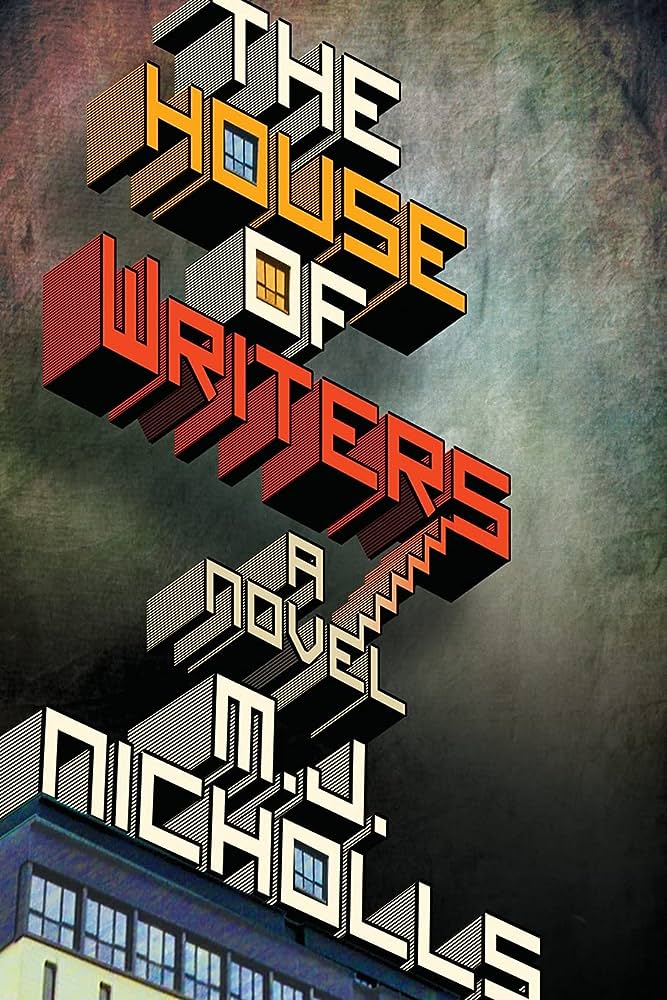
MJN: When I launched my novel The House of Writers in an artisan café frequented by the literary poseurs of Edinburgh, a friend of mine ill-advisedly went around trying to interest the eaters in my novel and was uniformly brushed off. This cemented my belief that the reader is a treacherous, disloyal bastard…or merely people who take umbrage at having weird comedic novels thrust at them when trying to wrap their mandibles around kimchi and bean veggie smash burgers. This queasy launch experience is detailed in 1002nd Book. My ideal readers are almost certainly creatures like yourself, George, those with an unquenchable lust for the written word. As a writer, having an imagined reader of that calibre makes it impossible for me to slouch when crafting a sentence—a robust method of quality control, if daunting when laying that stink of a first draft.
GS: “Those who can’t do, teach,” the adage goes. One could also say: “Those who can’t write, critique.” Yet a certain species of online troll can’t write or critique. Instead, they lob ad hominems and excoriate in an attempt to fill the talentless void in their skulls. What are your thoughts on this troll, and what have you found is the best method of pest control?
MJN: The troll is no longer a fiendish firestarter on the internet’s fringes, lurking with their jerricans of kerosene awaiting the perfect moment to crisp up the orphanage. The troll is now a mainstream banality—as much an establishment no-mark as the besuited corporate politicians of yore. In America, you made a third-rate troll the president, and in Britain, we are governed by a party who repeatedly troll the electorate by out-icking themselves with every phony policy announcement. My hope is that the troll, stripped of the ability to startle and appall, will merely lapse into the shadows, leaving only the talented and sane people to lead us into a less moronic age. But I’ve made the mistake of hoping for things before, so I should probably put the kibosh on such reckless behaviour.
GS: If the literary system and landscape are as broken and ass-backward as we seem to agree it is, why write? As your protagonist in The 1002nd Book to Read Before You Die suggests, is it a way to worship at the altar of literary gods and perhaps futilely fight against the deluge of dross? Is it the revenge of producing a work that nano-brained readers could never tackle, sweating and shivering anytime they see it judging them from the highest ledge of their bookshelves?
MJN: I’ve striven to write the sort of books I would pounce upon if written by another bespectacled Scottish author completely at odds with his country’s prevailing cultural landscape. In the realm of offbeat, low-reader literary fiction, there’s no purpose in writing for any reason except to amuse yourself, or to purge yourself of various hiccups of despair and inchoate rage. In my new story collection, there’s a story where a writer tries to tailor his writing to one specific woman named Carol by imagining the sort of prose she may appreciate based on his own assumptions, having never even met her. It’s a comment on the futility of imagining an audience, and the closest thing to a rom-com I’ve ever written.
GS: Speaking in general, the label “postmodern” tends to be used amorphously by readers and writers. Obviously, there’s a strong element of self-awareness, of knowing a story is being told, or at least attempted, by a storyteller (even though this can be traced back to very premodern works, such as Don Quixote and the One Thousand and One Nights). How would you define postmodernism in literary terms?
MJN: I’ve heard the self-referential elements of those texts being described as “postmodern before postmodernism existed”—attributing prescience of a cultural label in the 20th century to classic texts is a head-scratcher, a form of backtracking by writers unaware of the rich history of the meta moments of yore. As for postmodernism, you either accept that any text knowingly weaving elements of other genres or older texts into its fabric (i.e. everything now being published) will have the label “postmodern” appended, and concede that postmodernism is a form of cultural endgame from which no one can escape, or you can choose to untether all contemporary art from that trap and view the sum of all art being produced today as part of one long cultural tapestry. The latter is more appealing to me.
GS: Speaking of postmodernism, your first novel is titled A Postmodern Belch. It’s something of a cliché for writers to loathe their debut novels. Looking back, how do you feel about it, and in what way does it fit with your oeuvre?
MJN: I wrote A Postmodern Belch before I’d really explored metafiction, so I thought I was being highly amusing and original. I also hadn’t learned to discipline myself to write properly by paying attention to the rhythm of the sentence, I was merely having a blast sending up my own crippling self-awareness, which had kept me from experiencing any basic pleasure up until that point. It’s a hoot of angst in the form of a frolic from a young man yearning to leap into life’s bazaar and continually butting heads with failure. I dreamt up an imaginary carnival into which I could insert myself as I worked to overcome my social anxiety and shyness issues. And yes, it’s shit.
GS: Fast forward to today and your publisher, Sagging Meniscus Press, tells me you have a new book coming out in March of next year, a short story collection titled Violent Solutions to Popular Problems. What can you tell me about it? Are these all relatively new stories, or have they been collected after a long period of time? Which of the stories is your favorite and why?
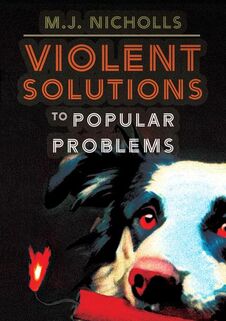
MJN: Half new, half older. I’m quietly fond of the story “man/woman” [subscript sic]—here I managed to compose a dystopian yarn with a straight face. I’m perpetually exasperated by my own stylistic tics, so whenever I have the stamina to override my tendency to lapse into freewheeling punny comic prose, I always pat myself on the head. The last story, ‘The Bardo of Abandoned Characters,’ is the cowardly version of a very long, very indulgent, very unfinished novel consisting of a maddening cycle of stories from unloved, undeveloped characters at war with themselves and the author. In The Dirty Dust by Irish modernist Mártin Ó Cadhain, the residents of a cemetery spend the afterlife kvetching at one another from their coffins. I’ve always wanted to compose a similar novel where the world’s discarded characters commingle in a Battle Royale-style limbo, furiously competing for page-space. It’s precisely the sort of unreadable, overindulgent novel I’d write if I had the patience and the infatuation with my own hilarity, both of which I lack.
GS: Going back to postmodernism and metafiction, here are the words of your character Marcus Schott: “For me, composing a postmodern novel about a writer composing a postmodern novel is a more sincere form of emotional expression than the I-love-you.” Is this true for you? Either way, do you think there’s a limit to this style, a point at which any ounce of sincerity disappears or is revealed as shallow, another smokescreen, as it were? This seems to be one of the main theses in Gerald Murnane’s novel A Million Windows, for instance, particularly when he criticizes Italo Calvino’s If on a winter’s night a traveler. To be more specific, Murnane writes: “I admit that I was dazzled at first by If on a winter’s night a traveler, by Italo Calvino, but I did not fail to note soon afterward how little I could recall of its intricate contrivances or of the seeming-qualities of its glib narrator, not to mention its stock characters, and if I think of the book nowadays I think of its author as someone for whom writer and reader are opposed to one another as the players on either side of a chessboard are opposed. Even the undiscerning reader of this fiction of mine should have understood by now that I, the narrator, would dread to feel that we were separated even by these sentences.” For the record, Calvino’s novel is one of my favorites.
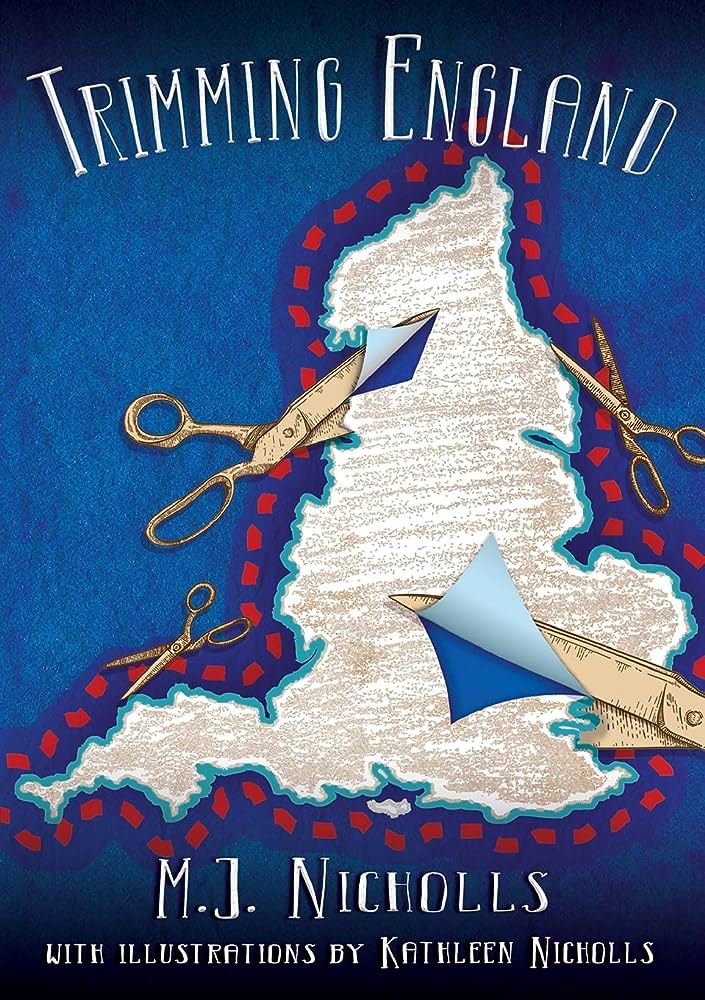
MJN: I’m fully in agreement with Marcus. Metafiction has been a necessary (and arguably safe) tool with which to limn the various lamentations of my own personal difficulty as a writer seeking a way to accurately represent my difficulties as a writer. In my novel Trimming England there’s a section, ‘The Novel Inside You,’ which moves away from overt metafiction to try and more witheringly poke away at that canker of self that has increasingly restricted my creativity over the years. It’s inspired by Calvino’s second-person address in that metafictional milestone, which was the first OuLiPo text I read and still the most definitive. As for Murnane’s remarks, as I move away from writing metafictional prose, I’m more inclined to agree with him, although I lack his ability to feel any emotional fusion between my sentences and a hypothetical reader. This, I expect, is because Murnane has readers, whereas I’m still groping blindly for some of those.
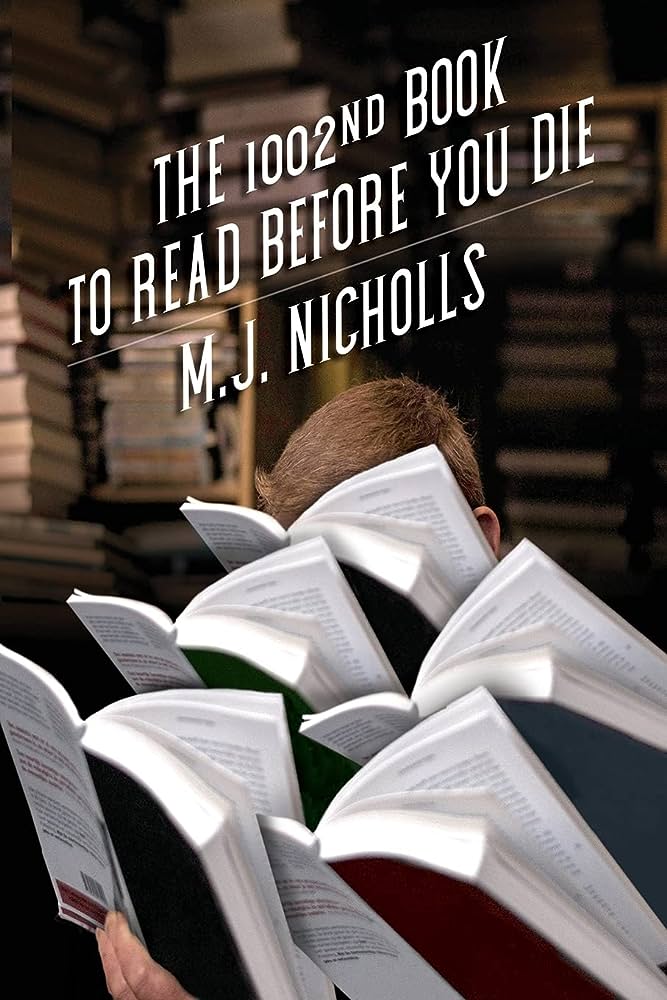
GS: Among other things, The 1002nd Book to Read Before You Die raises this vital set of questions: “Should a reader have a ‘conscience’ about what is read in their lifetimes? Does someone serious about literature have an obligation to read the books less conscientious readers will never think to pick up? Or is the reader, regardless of their powers, allowed to read whatever takes their fancy, neglecting lesser-known books in favour of franchise sci-fi or other popular brands?” What are your answers?
MJN: Why not immerse yourself in the warm caramel of every conceivable art form at the very pinnacle of its possibilities? Why settle for Bob Ross on YouTube when there’s a pre-Raphaelite exhibition one bus-hop away? I conducted my cultural life thusly for a long squirt, but over time, I’m less averse to such an arch and arrogant stance, mainly as I’m not listening to Mozart on Spotify, I’m listening to The Fiery Furnaces. I’m not watching Robert Bresson, I’m watching Bob Byington. I’m not reading Vasily Grossman, I’m reading Irvine Welsh. I would politely encourage any consumer of culture to periodically dip their wick into the unknown, the uncomfortable, and the unconventional, as they will almost certainly unlock new kunstkammers of artistic wonder that will allow them, to paraphrase Michael Silverblatt, to endure greater degrees of suffering.
For early access to literary content like this and other awesome benefits, consider supporting The Collidescope on Patreon.
The Collidescope is an affiliate of Bookshop.org and will earn a small commission if you click through those specific links and make a purchase.


M.J. Nicholls writes comedic fiction with surreal, satirical, and metafictional elements, including The 1002nd Book to Read Before You Die, Scotland Before the Bomb, Trimming England, and Condemned to Cymru. He was raised in the small town of Armadale, studied English & Scottish Literature at Edinburgh University, Creative Writing MA at Napier University, and co-founded the micro-publisher Verbivoracious Press. He works as a web developer and lives in Glasgow. His most recent book is the story collection Violent Solutions to Popular Problems. His website is here.

George Salis is the author of Sea Above, Sun Below. His fiction is featured in The Dark, Black Dandy, Zizzle Literary Magazine, House of Zolo, Three Crows Magazine, and elsewhere. His criticism has appeared in Isacoustic, Atticus Review, and The Tishman Review, and his science article on the mechanics of natural evil was featured in Skeptic. He is currently working on an encyclopedic novel titled Morphological Echoes. He has taught in Bulgaria, China, and Poland. He’s the winner of the Tom La Farge Award for Innovative Writing. Find him on Facebook, Goodreads, Instagram, Twitter, and at www.GeorgeSalis.com.
 The Collidescope