
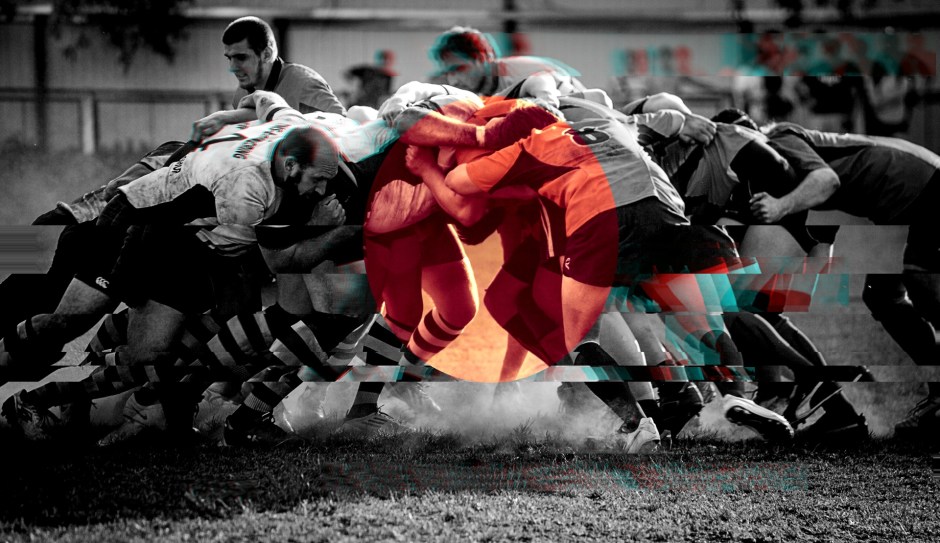
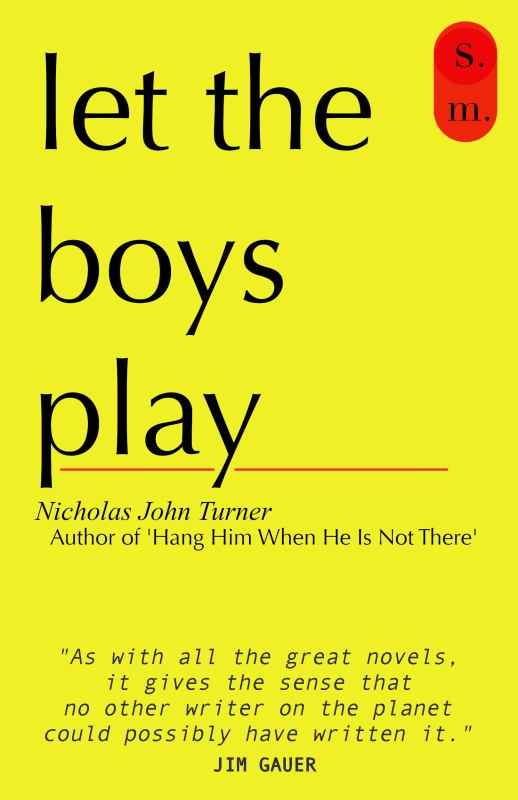
Let the Boys Play opens on a pair of cops (or double-o’s in this world’s parlance) investigating a strange crime scene. It plays with the trope of the overzealous rookie and the years-wisened vet, but with certain expected elements flipped on their heads, starting the long process of keeping you off-balance as you move through the next 393 pages. After this initial scene, one of the double-o’s will be trapped in a maelstrom of furtive narrative; the other will wither away to a faded palimpsest, creating the first of many negative spaces that yawn out before the reader, generating an intangible, yet powerful theme.
Aside from our intrepid copper, saddled with a gruesome and funny injury early on, we meet a young partyboy-cum-druggie working intently on scrubbing himself from existence or existence from himself. These are our two main woe-tagonists, whose stories oscillate between ear-splittingly melancholic mundanity and shockingly violent repulsiveness. The story’s tentacles weave out through these men to pull in a cast of tragic lives made comic and crushing in turn. Not a single character is left unblemished by savage scars across their bodies and/or psyches. It’s probably for the best that we are given a warning of sexual violence and more prototypical violence by way of an author’s preface.
The plot circles around two crimes: one sexual and made incomprehensible in its brutality, the other more symbolic in purpose. Both are related to rugby in very different but overlapping ways, connected to the violent implications of being involved in its facilitation. We get a number of philosophical meditations on this: “Perhaps what is really meant by this is that conflict is man’s impulse. Violence, even. And like all impulses, it comes and goes quickly, overwhelmed by impatience, or exhaustion, or fear of what it has stirred in others. And so this is the lot of the referee and perhaps those that [sic] organise war, to keep alive what would naturally dissolve…..To say; you must endure this impulse now, as though it were all of you, and of everyone. You must exist in conflict as I have arranged it for you. As, in fact, you have asked me to.”
These studies and others throughout the text reminded me of how Bolaño’s 2666 delved into the way violence can be threaded into societies. Though instead of picking a class of violence and running it back until you’re sick and unable to look away, Turner displays conflict in many forms: those in rugby; the unintended type perpetrated on lovers and friends, unintentional in the tight spaces we inhabit with them; the resting condition of violence after a lifetime of being forced to absorb it to a point of saturation; and even the quietly unobserved violence we inflict upon ourselves through repression, addiction, or pure unbridled and hopeless loneliness.
Besides the show of violence of all stripes, there is a bounty of analyses of people as individuals and as groups. The characters that are not eventually fully fleshed out are few, and that process unflaggingly produces delightful complexities and contradictions, the resolving of which is forced into your lap. We never get that full depth at any one time, but as we return to them again throughout the diffracted book, the details coalesce into something remade in each subsequent round, causing us to look at them anew. It can come unexpectedly amidst a spell of crass lunacy or sensual debauchery, but it always lands with a weighty thud, causing you to scuttle to try and regain your footing.
Counted among these wonderful glimpses deep into the souls of his characters are some profoundly moving moments (though not without a jolting shift in perspective):
Melanie Hodge had never quite freed herself from the verge of tears. All she really wanted to do was [bawl] her eyes out without thinking there’d be a bill waiting for her when it was over. To put her cheek on his thigh and be told with something in the broad spectrum of empathy that her pain was okay. And then maybe just maybe she could start to break down the molten-hard rock of self-loathing that was somewhere inside of her making it difficult even to stand up straight.
She wondered how difficult it would be to leave Richard Foley for good.
Richard Foley, looking at the top of her head, wondered how long the syrup would take to seep permanently into the couch’s material. And if, since she seemed preoccupied, he’d actually have to ask her to clean it before it came to that.
Turner is really innovative in this novel, in his unique descriptive language and in his style a la Ali’s “float like a butterfly, sting like a bee.” There are a number of connections to other writers: David Foster Wallace’s penchant for heavy contextualization, modifying ideas and thoughts while moving through them, something I’ve heard described as brain-voice; Dennis Cooper’s ability to describe acts of abject disgust in a way that somehow connotes ethereal beauty; and as I said, Roberto Bolaño’s ability to diagnose the weightier ills in a society by showing the factors that go into forming them. You can tell that Turner has learned valuable lessons from some giants and put a lot of his being into fusing them into an exciting new voice that is all his own.
Like with Turner’s first work, Hang Him When He is Not There, you get the feeling of working a puzzle where some of the pieces have been eroded. While some fit perfectly, others are maddening in their refusal to be fully understood, which seems fitting as an attempt to replicate the beautiful chaos of life and humanity.
“I suspect, Len, that we are what compels us to become. The crags by which we wriggle ourselves up out of incoherence. Whatever makes our tiny heads first turn to its light; that is the solar system to which we belong.”

Dylan Lackey works in IT by day and voraciously consumes literature by night…and by day. He graduated with a bachelor’s in finance but has always had a passion for reading and literature. He enjoys writing short stories and poems in his free time as well and has read some of his poems at various open-mic nights.
 The Collidescope
I think you’re on the money when you compare this novel with the way Bolaño’s 2666 delved into how violence can be threaded into societies. It seems to me that Turner’s concern is to show how violence — a term which he uses in a somewhat fluid way, at times — is threaded into the nature of organic life itself (hence, of course, the significant role “Organico” plays in this novel), and into the suite of processes we know broadly as “evolution”.
I strongly agree with you that reading the book does feel like working on a puzzle, and I am surprised others have taken up this idea and pushed it a little further. I have written a speculative piece myself about how some elements of this puzzle may possibly be decoded. I have not been able to find online any other essays taking this approach — but perhaps others have written along such lines in journals to which I do not have access.
If you would be interested to have a look at my own thoughts about this most intriguing novel, you can find them here.
LikeLiked by 1 person
Thanks for sharing, Peter!
LikeLike