
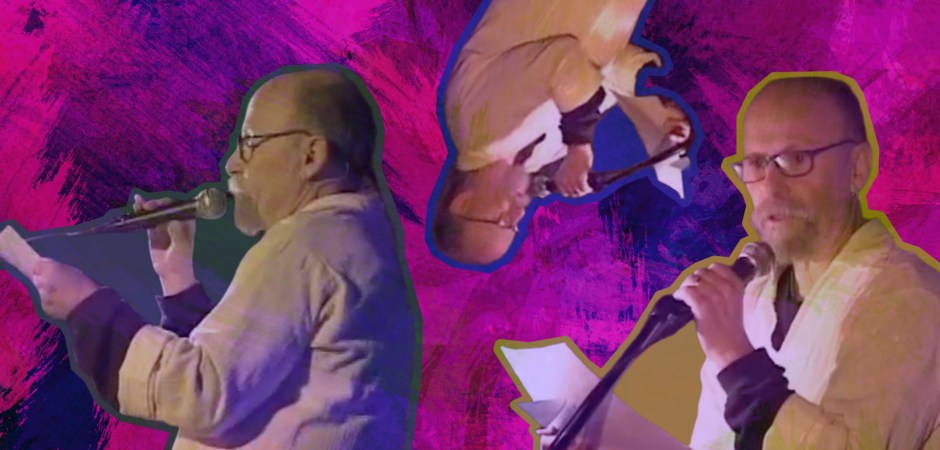
Everything butchers everything
— normal
Louis Bourgeois: I would like to begin by asking you to describe your background as a poet. In your poem “The Green Buses,” you refer to yourself as a jazz poet—please give the reader a biographical sketch of yourself.
normal: I have never taken a course in poesy. I was dyslexic when I entered kindergarten in 1948. No one knew what dyslexia was back then so they just concluded I had an oppositional personality disorder, which fortunately has always held true. So for the good of the community they put a dunce cap on my head and sat me down in the corner as the class fool—they did me a great favor for I adapted well and began to look at life from the outside in and play with a language that became unique to my own understanding—besides, good dyslexia has never hurt a bad poem.
I stole away from public school the better part of my high school sophomore year—observing life in Greenwich Village—observing life in Times Square—sitting next to old men with brown paper bags in the public library; reading Camus, Thoreau and Emerson; reading Lorca and Henry Miller when I could. I showed up the first day of plane geometry and not again until my final exam where I wrote my answer to Theorem 64:
Men say they know many things,
But lo’ they have taken wings,
The arts and sciences,
A thousand appliances;
The wind that blows
Is all anybody knows.
—H.D. Thoreau
I am a good listener. I learned to listen to the music of the street and the music in the trees. I have hunkered down in 47 different grubby and glorious digs in my life and held at least that many jobs and I have held no job at all—there are no regrets—each moment played its own special symphony, its own special spontaneous jazz—if I listen carefully, I can hear the music—if I wail soulfully; why then there is jazz to spare in the poetry.
LB: Explain your name normal—do you dare to tell our readers your real name?
n: My mother never named me normal (small case, please), though, but in her waning years she found opportunity to manage an affectionate “normala.” What she did name me was Norman (that’s all I’ll give). I would like to claim that the name normal had its origins by way of some sort of metaphysical enfant bathing accident, but it did not. Truth is that back in the real early 60s I was a caricature lad on the cartoon streets of ole Greenwich Village—we were barely out of the Eisenhower years (did you know he had the highest recorded IQ of any American president?)—one guess who has the lowest—and I was spotted on the street corner snapping my fingers, weighing 98lbs, pigtails, silverfish earrings, gold lame’ coat and all (see “Green Buses”) and there you have it. Names are no more than baby drool, they come back to claim you in the end.
LB: Judging by your poetry in your book Blood on the Floor, you seem to have come of age in the 1960s—for our younger readers, please give a description of what that was like—not only in life, but also what the literary and art scene was like during that time as you experienced it.
n: For a while I survived, loosely speaking, as an itinerant poet in the beat coffee houses of aforementioned Greenwich Village. It was early in the 1960s and in those years it was not unlike walking around in the first chapter of some great classic American novel that had not as yet been written. The legends to be floated in and out of my life on a daily basis. For instance, in his book, Chronicles, Dylan speaks of the shooting of The Dutchman—I know the incident well—I was there that day—The Dutchman owned the café that employed me. On one occasion I was busted with Sean O’Neill, Eugene’s mad son. Another time, I sat with Allen Ginsberg eating porridge in his kitchen while he crooned passages from “Howl” for my ears only. One midwinter’s snowy night, I wailed poesy to a house of one applauding Lenny Bruce. On yet another snowy Sunday morning, I rode the “A” train to Coney Island with Tiny Tim serenading me on his plastic ukulele—it surely sounds like I’m name-dropping, but life was simple and open back then. The latter part of the 60s I spent on Haight St and North Beach in San Francisco and the scene was much the same, only more so. I could write a book on that whole time space—perhaps someday I will. A lot of this comes out in my poetry.
LB: Although your poetry is often overtly political, there doesn’t seem to be a lack of poetic imagery that is usually absent in political poetry. Can you explain how you’re able to incorporate the personal and the political in your poems?
n: e.e. cummings once reflected “a politician is an arse upon which everyone has rode but a man.” To me, political is not exclusive nor it is inclusive to carrying on a poets’ war with some half-wit imbecile wannabe emperor charading about as a president—political is a worldview—it is, in my view, a sieging, palpable genuflecting energy that decrees my unwavering attention towards a well-greased host…of behemoth adversaries; those who would drain the earth-mother of her blood; those who would slave-ship children out to the wasteland of neglect; those who would shackle a soul in the good name of love; those who would sanction a lemming charge of overpopulation as holy work servitude to the interpretation of somebody’s version of a god; those who would fire god from a cannon—on upon on—history vomits and we remain nauseous. Emerson said—“If the whole of history is one man, it is all to be explained from individual experience.” Poetry is not a hobby, a contest, or a team sport. The poet needs to get beyond his ego-centered inner manicuring and expose some of the larger issues. The poet needs to leave the universities and join Tarzan in the trees. Simply, there are more urgent matters than our feeding frenzy of self-realization. It is our message, not us, that calls to be recognized. We gotta war, baby—the “masters of war” and the plentitude goblins of royal guardian are political whores and they deserved to get royally diddled by strange golems and utopian birds, rotorooted by whirring, whirling lizardly dervishes and furthermore shat upon by toothless, screeching hag mass furies. The great poets; Lorca, Whitman, Neruda, Vallejo, Ginsberg have all carried torches that I might see the light—I should do no less. I have seen the Big Boy’s greed and darkness and I want to run at it and I want to run away from it. In poetry I hide and in poetry I find; when I deny either, then hope, like a sly burger in my heart, begins to slide out the window. I have been torn most of my life between the journey of the recluse and the battle of the messianic.
LB: How factual is your wonderful poem “The Green Buses”? For that matter, how autobiographical are your poems in general?
n: Very factual. “Green Buses” is blow by blow me. I had been sentenced to a caricature faux military academy for the last two years of my secondary training, so I took some immense ironic pleasure playing in the fertile dung heap of “Green Buses.” I am not so sure that at the time this was a conscious political statement, but sometimes-right living speaks louder than bold signs. The bulk of my work is personal at some level. I have lived far more than I have written, so it is fair to say that my life conducts the orchestra of my pen. I believe it was Ezra Pound who said, “Poet is the antennae of the species.”
LB: Do you write poems to be read solely out loud? Do you spend a great deal of time with the presentation of the poem on the page?
n: Initially, I write quickly without much thought as to form or presentation. After the work first alights itself on paper, I stick it away for a while. Days, weeks, or years later I raise it from the dead and speak to it once again. Then I play with it, coggle it, tease it—slap it around a little—get it to yell at me. This goes on and on until it starts speaking back to me. Though I’ve lost more over the years than I’ve saved. I’ve got folders and boxes of percolating pieces going back decades. A lot of it is one big mold factory. In the final draw, I suspect most of my wingless gaggle will probably return from whence it came. Henry Miller once advised a young writer—“If you can’t make words fuck, don’t masturbate them.”
LB: Please describe the making of your performance poem “Throwing Tears at the Stones.” Has it made you famous yet?
n: “Throwing Tears at the Stones” exploded out of me during a fit of rage and sorrow. I did not go out looking for the words—the words found me. The work finds its roots beyond the Nazi gas ovens and beyond the agony of Arab or Jew—its tale is to be told before there were words to tell it—when two loin-clothed tribes of cave people picked up stones to claim the same cold darkness of the cave. Gods and technologies have only made it worse. It’s an old song but we still sing it well! The musicians who made possible the instrumental composition of “Throwing Tears at the Stones” have since gone their separate ways, but on one special night when the moon, the muses, the magic, and the mikes were in miraculous alignment—well, the results were heartening. A good piece is always there waiting for us to catch up to it. As for the famous part, well that’s not something I spend a lot of time looking for—I am sure it is a bigger pain in the ass than it’s worth.
LB: You make many references to apparent Judaism in your work—I was wondering if you would talk about this especially in the context of how it plays into the subject matter of your poems.
n: I was raised during the Great War Years in my grandparents’ house by grandparents who were ultra-orthodox European Jews and my mother who was Zionist, intellectual, and quite atheist. Yiddish was the first language I spoke. Some of my early memories stem back to the old temple my grandfather and his clansmen founded. I still see their faces; I still hear the litany of their chanting, the ageless tallis-covered bearded ones who had fled the burning shtetls and cassocks and blades of turn-of-the-century Eastern Europe. I remember them well, pounding their chests, bowing from the waist and wailing the song of their hearts, the black ghosts passing over their covered heads. It was during this time I could recall my grandfather rising long before the dawn, giving us both warm water and honey, holding me tight in his arms and singing Yahweh. These were the dark years, of course. Both sides of my family counted over 120 relatives gone to the Nazis. My grandfather alone lost two brothers and sisters. In 1970, I sat with my grandfather at his deathbed and I said, “Grandfather, how did you keep from going mad?” He said, “Little Nutta Chiam (tree of life, my Hebrew name), when life is full of sorrow, hold a small child close to your heart and pray to the East”. This, of course, had a tremendous influence on me in terms of the powers that lay beyond that which we can touch and see. That within my grasp there lay a mystical treasure trove of surprising and oftimes quirky answers well beyond the accepted shrouds of negativity trumpeting about as corpulent status quo. All I needed to do was to believe it was there. In time I saw that religion was the antichrist of god. In time I bore witness to the many clothed preachers that had channeled god into some kind of deranged corporate hypnotist to the masses who spoke babbled tongues of religious fervor. The heat is on and there is no shortage of fodder. There is a sardonic old Yiddish saying, “If god lived on earth, people would knock out his windows”. Though I have been granted miracles by way of angels, my car, nonetheless, sports a bumper sticker which reads—“God, protect me from your followers”. This all plays out in the bloodline of my poems.
LB: When composing works on the page, do you find yourself being particularly concerned with how the poem will sound on the stage or in the studio?
n: Not at present, but then again I have been afloat in my poetry tall ship (or leaky dingy) in the changing currents of river life for sixty years and the wind has never abandoned the sails, so to speak. The influence of sound has come by way of the old temple Jews, by corner doo-wop, by the bluesmen and the jazzmen—I have taken my lead from them all. The voice as jazz horn is indeed a kicky fit—Billy Holiday was good at that. I like to believe there is a holy trinity in the creation of the poem—the first part lays in keeping the creative portals to perception open enough to be able to pick up those electrical charges of life like a big lightning rod and move it through you and onto a piece of paper in a cunningly unconscious, uninhibited yet cohesive manner—and a rebirthing of the piece into another new life, again and again—like a jamming jazz musician horning it on—the piece is never the same twice over—and the third part of the holy trinity of poetry is perhaps the most important, that is how it is perceived in the unique language of our soul speak. It is here; in the ear of the receiver the poem finds its ultimate flowering.
LB: Please describe the process and/or techniques you use when choreographing your performance poems. Is it more or less difficult to perform than to write them down on the page?
n: Actually, I don’t use the word “performance,” it sounds too much like entertainer. But I do know what you mean. Ideally, I prefer blending music and poesy into a compositional whole—this presents great variations, great opportunity, and great joy—but it also presents a big pain in the tuchis. Because I am not a musician, it would suggest, of course, that I need to work with others, particularly with musicians, if you will, which can be profoundly problematic. A jousting of the egos. Honing everyone’s individual vision into one unified vision moves painfully slow as doing ballet in a vat of peanut butter. Of course musicians can be a pickled and peculiar package of peccadilloes and just the mere feat of corralling them together at once and focused is by itself no small wiggle of a mountain. To add, my expertise with technological equipment approaches the phenomenon of cromagnomism, so there again I become frustrated, diverted of purpose, and wind up trading away a valued measure of creative independence for the luxury of practical application. Through the years I’ve worked with a number of musicians but clicked with few. There’s that too. In the final draw, thus far, I have made very few recordings of my work that I feel worthwhile. With writing, all that is required is a pen, a sheet of paper, and a chair with no splinters. Simplicity, indeed, is the last resort of the complexed.
LB: Many of your poems have a certain dark humor to them, while others are rather serious with respect to a fairly grim depiction of American life. I was wondering if this is how you truly feel about life in America, or is this just a generalized attitude that comes out on the page despite how you may actually feel about the state of contemporary society?
n: My heroes would include Groucho Marx, George Carlin, and The Grim Reaper. I do view bleakly into the crystal ball and into the hourglass of early 21st-century America. One would have to be either a total dunce, a right-wing republican, or spend their days under a covered pot holding court with a kettle of boiling fish to think otherwise. But bleak is not necessarily the equivalent of hopeless. This spring I was in Crete. I spent a bit of time considering the self-styled epitaph of the gravestone of Nikos Kazantzakis. It read:
No hope
No fear
I am free
Kazantzakis spent his life fighting the oppressors of his people. Isn’t that what a poet is supposed to do? What a time we live in! Our oppressors are many, but this time our oppressors are mostly ourselves. We are like ogly-eyed children playing goo goo on a radioactive beach waiting for the punch line to roll in on a crest of an incoming tsunami. Is not 21st-century America a divinely dark and dysfunctional family comedy? The tragedies stampede like mad bulls through our streets and newsrooms. Our leaders are delusional. I look across America’s landscape and I see a strip mall of negative collective consciousness—I see no consciousness. Our children are being fattened for the kill. THIS SHIT I WILL NOT EAT! Life worn like tight underwear will surely strangle us where we really hurt. Kinky Friedman said, “Life is too important to take myself seriously.” The poet, like the comedian, is a very spiritual person, meaning he never takes anything at face value. Dark humor, to me, means looking into the darkness with a candle and a smile.
LB: I’m curious about your literary influences. Is reading still important to you in relation to writing poems?
n: I would, in the mostly imperfectly improbable world of my imagination, like to say that I stand uninfluenced to the point of originality, but that statement, I believe, is reserved for the domain of the truly deluded and those impoverished with a gluttonously ridiculous overappraisal of their creative self-worth. So I would say this: I am a child of the 20th century, and as such, my influences lie mostly there. Actually I find the 20th century most exciting and relatable to me. I read whenever I can and it would depend who I was reading at the time would probably be current to my passion. I grew up around a lot of the old beats; Kaufman, Micheline, Ginsberg, Kerouac, Ferlinghetti, so they imprinted early on me. Cummings and T.S. Eliot take me on an enormous ride through the curtains of poetic magic, as does W.C. Williams, who lived in the next town over from where I grew up. The Latins—Neruda, Lorca, Cesare Vallejo, Octavio Paz—I just can’t get around them. Both Dylan Thomas and Bob Dylan continue to affect me. Anne Sexton, Thomas Merton, and d.a. levy bring me to places where the air tastes different. Of course, there are those two magnificent 19th-century Americana bards, Emily Dickinson and Walt Whitman—life would not be the same without them.
LB: Do you write prose? Have you ever had any literary interest beyond writing and performing poetry?
n: I’ve written a number of short stories and several novellas, but little prose in the past 8 or 9 years—I’ve got the passion, but simply not the time. There is a lot of work stuffed away in boxes—I’ve forgotten much of what I’ve written. I do not recall that I have tried my prose on the plate of an editor/publisher but a few years ago I did manage a rather generous grant from a state art commission for a novella of mine. I have a lifetime of unwritten books running between my ears. I’ll face my prose muse when the clocks once again become my friends.
LB: Have you heard the performance poetry of John Giorno? If so, what are your impressions of his work?
n: I have. For a period of time I was close to the singer David Johanson, who for a while tried to get us together. I believe David mentioned him in the same breath as Lorie Anderson, Patti Smith, and William Burroughs. Dave said there “was a connection someplace in there.” For me, the connection never happened. Further, I may be the last person as yet to experience John Giorno’s work.
LB: You’ve published quite a bit in the small press world. Please share with our readers your thoughts about publishing in the small press world and about your experiences publishing poetry in general.
n: In my early years I was given the opportunity at a career and audience with some larger publications. I walked away from it. In the years that followed I was swallowed by life and outside of a handful of accidental publications I have effectively managed to avoid sending anything out to anyplace large or small until I was well past 50. I would have been fine with this until I looked at all these boxes of poesy growing mold monsters, and I said ,“Oh, fuck it, maybe somebody will glean something out of this.” Since then, I suppose I have been fortunate—maybe 450 or so pieces published and a couple of small chappies in a period of perhaps 7 years. This has been mostly the small subterranean rags. I try to keep things personal with editor/publishers—I’m mama/papa not a Wal-Mart kind of guy—a handwritten hello—snail mail with a wax seal stamped “n” on the back. I avoid mixing poesy and computer—I do things the old-fashioned way—pen, paper, taper, and white out—when that doesn’t work, I am not above scrawling my odes on a shovel with charcoal and storing them in a pile of pig shit out back of the woodshed—that organic touch—an aging anachronism, yup, that’s me. I favor the small presses because they are still young and open enough to allow poetic spirit the freedom to evolve, take the chances, and rebirth itself rather than insisting it languishes in old set ideas, rituals, and cemented tradition. The underground press holds to the larger American literary tradition of having no tradition at all, hence creating a movable tradition. The small independent underground press is the western frontier of American literature that allows outlaws like me to ride.
LB: Do you at all feel connected to a greater American literary tradition? I realize in asking you this question that you are at least to some degree an “underground” poet; however, from reading your poems I get the sense Walt Whitman is somehow hiding behind your lines. Do you feel you are writing within the tradition of American literature?
n: America is still such a young country. If a building is 200 years old we consider it old; maybe we tear it down. Over the years I have spent some time in southern Europe. Over there if a structure is 200 years old, they usually have not yet finished unwrapping it. The same may be said of American literature—our poesy is still melting-pot new, which means we are presently in the unique position of living in an era where we are creating the “Great American Tradition” right now, as we speak. As America is revolutionary in its founding, I am pure Americana—I love it to the nub of its home-run-hotdog-biting-teeth and I do take my lead from Whitman, Emerson, and Henry Miller. From e.e. cummings and the beats. I am influenced equally by Camus and Alan Watts as I am by Kahil Gabron and Bukowski as I am by Kurt Vonnegut, Emma Goldman, Anais Nin, and Thomas Jefferson. My greatest philosophical and literary influence, however is by far my father Sidney, the unschooled son of an illiterate Russian horse soldier—for it is my father, whose heart is more golden than the sun, who after living a life in which he witnessed almost all of those he loved peeled by death from his life, who saw 5 years of war in Europe and The Great Depression, who after his wife of 66 years died, picked up a pen and began writing short stories for the first time at the tender age of 90 and by 91 had completed 55 of them—most of them in praise of the blood spirit of Life—more remarkable, I never heard the word god fall from his lips, ever. That is the true power of example, which I believe is what philosophy, ultimately, is all about anyhow.
LB: How do you write, record, and perform all of this poetry and still work a full-time job?
n: I don’t know. I am not sure I do a good job of it. I’ve traded off a lot of writing and wailing for service in my life. The past 30 years or so I have worked primarily as a nurse. When you spend 8-12 or more hours a day, 5-7 days a week year after year administering to the dying, the insane, the healing, and the resurrecting, it exacts itself on you—I am not always successful at planting all that energy back into the earth. I also live out in the rurals, so there are always the chores that have my name on them. A neighbor is having a barn raising this week I’d like to make. Between work, physical pruning, affections and responsibilities to wife, children, friends and extended loved ones, I am at it from 4:30 am to 10:30 pm. I have to fight for time with my muse. It is all very well worth it, of course. I feel I’ve helped the world some. During my early bohemian years I had a creeping sense that I was on the laugh now, pay later plan and perhaps now is my later. In the past 4 or 5 years I haven’t been able to make the time to send any new work out to the rags—it has been a lesser priority of mine—I quietly write and store. I don’t know how you found me, but your timing is right—perhaps this interview will revive my get-them-out-there motivation.
LB: Are there any contemporary poets whom you read and respect?
n: As just mentioned, I haven’t sent anything out in 4 or 5 years. The downside of that is the complimentary copies have not flattered my mailbox in quite some time, and I have quite lost touch with who has done what in the underground press lately. If by “contemporary” you mean living, I would have to say I am continually moved by the work of Charles Simic, Antler, Bob Dylan, Tom Waits, Lawrence Ferlinghetti, and surely a host more—but they are the first ones who come to mind.
LB: Do you have anything to say about life and poetry as it is being revealed in the 21st century?
n: I will say this: History has taught us that every renaissance, every period of light, that is, has fallen only after a long period of darkness. The Italian Renaissance followed the Black Plague, the Harlem Renaissance came on the heels of slavery, the Beat Renaissance followed WWII. Today, there is enough darkness to go around for all. The poet is now at war and at love. Our words must hold strong—we must not waver. The poet is “antennae of the species.” Our muses have many eyes, yet One Vision. Gandhi knew this. Martin Luther King knew this. Jesus knew this. Walt Whitman and Allen Ginsberg knew this.
And now we must carry this Light by the Moon of our Muses, for the dark armies are moving upon us.

normal was an obscure poet. Louis Bourgeois says, “He had an album (compact disk) entitled American Enough, which has four great masterpiece recordings.”
Louis Bourgeois was born in New Orleans, Louisiana. He is primarily a poet, but he has published translations, fiction, memoirs, poetry and interviews in over two hundred magazines and journals in North America, Europe, and Asia. He graduated from Louisiana State University with a BA in English and was the first graduate of The University of Mississippi’s MFA program in Creative Writing. He is the Executive Director of VOX PRESS, as well as the Program Director for the Mississippi Prison Writes Initiative.

