
Louis Bourgeois: I would like to begin by asking you to describe your background as a poet. Describe your education, your early poetic influences, what led you to take up poetry writing as a way of life? Why do you write?
Mark Sonnenfeld: I have no education beyond high school, except for a journalism and short-story writing correspondence course I took after graduation. I took music lessons as a young boy, trying my hand first at guitar, then piano. I was strongly drawn to classical music. I was in my twenties when I began to compose music. I would describe what I composed as animated modern-classical compositions that were short in length.
My hopes were that I would have my music performed at student recitals. I had hopes of getting music published too. I plugged away at that for years, and having no real success, one day in 1989, quite spur-of-the-moment like, I decided to direct my energies towards writing. Where the idea for me to pursue writing came I cannot say. It was bizarre that I would choose writing. I’d never had any interest in anything close to writing. And I was quite unskilled at it.
My first writings were short stories, some of which got accepted into small press magazines. My “story” phase soon evolved into the freer form of poetry, then to a more unstructured abstract style of poetry I thought of as experimental writing. My earliest poetic influence was Allen Ginsberg. It was through his work that I discovered The Beats. My primary influences then were Jack Kerouac and William Burroughs. I liked Burroughs for his experimentation. I liked Kerouac for his demonstrating the beauty of language. I don’t exactly know why I write. I guess it’s something for me to do. There’s a certain coolness that goes with a writer who pushes the edge of the literary envelope.
LB: It seems to me, that you almost crush language, pulverize it, in order to make language speak its true message. Can you talk about the techniques you use to write in the way that you do?
MS: I don’t know if I can easily describe the techniques I use in writing. My blanket statement would be for one to find whatever works and then go with it. If it applies, I might ask myself why a project isn’t working. Do I need to take from the text? Do I need to add to the text? Do I need to discombobulate the text? Do I use only every other word? Do I actually want the project to work? Would it be a more compelling project if it was characterized by a quality of non-workingness? Now that’s an interesting idea. I’m an experimenter at heart and absolutely anything is an option. If I happen to be collaborating with someone, be it another writer, an artist, a photographer, I will sometimes align my style to fit theirs. But then that’s not always the case. Sometimes opposite styles will get the effect I’m after. I know I’m going in all directions here. Basically, there are no set rules, and I never know how a project will turn out until it’s done.
LB: Who are some writers and poets who have played an important role in shaping your perception of the world as a poet?
MS: Charles Bukowski, William Burroughs, Jack Kerouac, John Cage, and lately, Quentin Tarantino.
LB: You seem to breathe poetry—your work has an immediate quality to it—it’s as if you’re plucking words right out of the air, deranging them so that they’ll come alive. My question is perhaps a dubious one: how do you know what to write about, and how do you know when to begin a poem and when to end it?
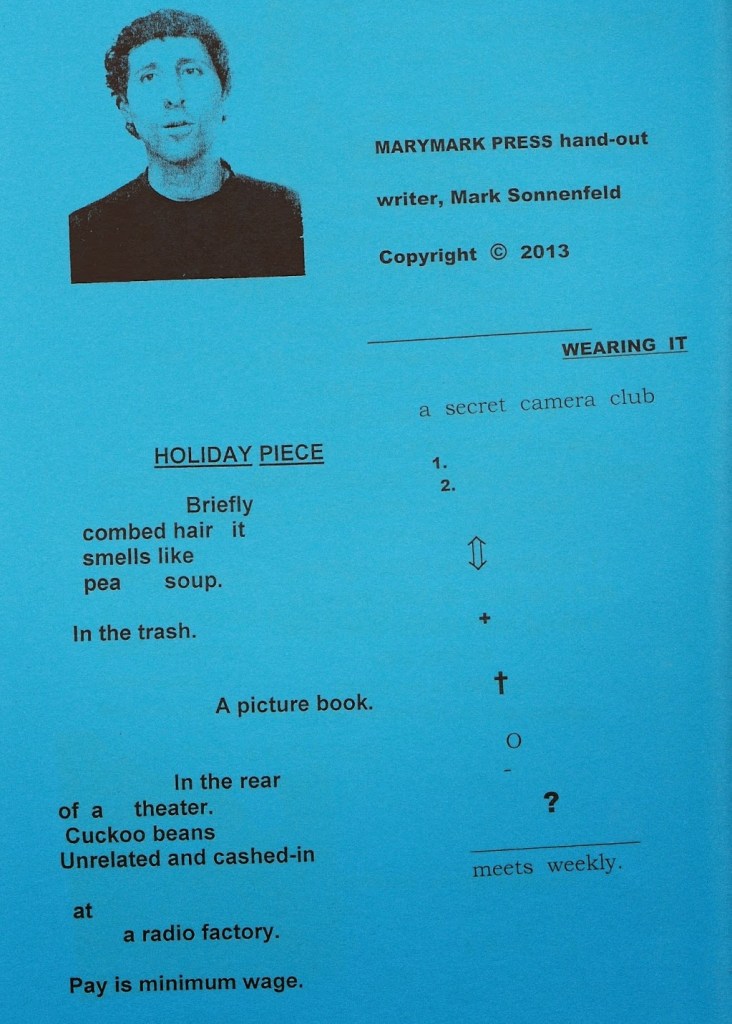
MS: I write about whatever pops into my head, whatever I can grab out of the air. Sometimes, I’ll come up with only a title and I’ll write a chapbook around that. I’ve borrowed lines from previous chapbooks and have made them into chapbook titles. I went this route with countersyncapationyeah and be d’Huh chapbook poems. Bleecker Street was conceived after a walk I made down the well-known New York City (Greenwich Village) street. Zine Workers was inspired by a nondescript political flier I received in the U.S. mail. I feel beginnings, endings, and middles to my poems are interchangeable. This also applies to pages of my chapbooks. Ideas like this can be bridged over into life. The older I get the more I feel the proper order of things matter less and less. It is important to concern ourselves with the present moment.
LB: You seem to be one of the few poets left in the country who writes for sheer self-satisfaction. You don’t seem particularly concerned with making it as a poet in any commercial sense: do you ever become discouraged that you may not be reaching the largest possible audience for your work?
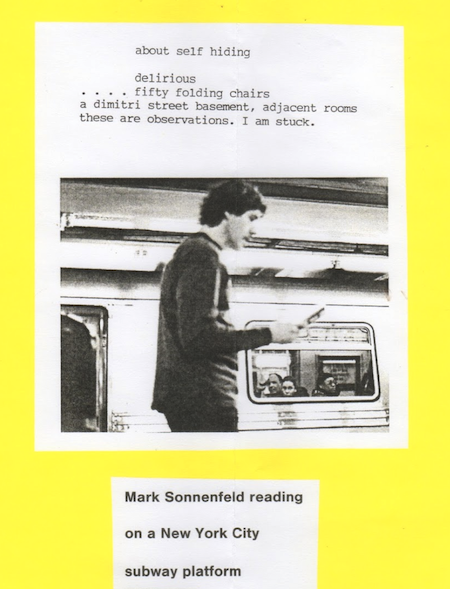
MS: In my current standing, I feel I am reaching the largest possible audience. My mailing list is growing, and is international. I hand out sheets in towns and cities regularly. I even have a broad mix of non-small press people who I (postally) introduce myself to. They include independent filmmakers, recording engineers, gallery curators, newspaper editors, yoga instructors, short order cooks, I mean just about ANYONE I can find an address for.
LB: Does reading literature play an important role in the way you write poems?
MS: No, not really. I get far more influenced from the day in day out living of life.
LB: Please describe the way you put together your sound recordings. Is recording collages more or less difficult than getting words down on the page?
MS: Sound collages are a dicey operation. They’ve always been. But I absolutely adore the form and so I continue to roll the dice. I use primarily a chance operation recording technique, with periodic checks where I stop and listen. As with my chapbooks and broadsides, I do not know how the finished product will turn out. I know what I don’t want, and it is that that guides me to a place more to my preference. I use a 4-track recorder, a micro cassette, and several standard-size cassette players. I take the micro unit when I go out into the field. I am fascinated by sound, especially urbanized sound. I am affected by location, too. From solely an artistic perspective, I am captivated by machine sounds, by mass media, by conversation, by crowd events, by social subtleties, and so on. I take in all of these as an observer, though. My true sound-collage sense lies deep in the underground of Post-Beat individualistic work ethic. I would say it’s a toss-up between sound collages and printed matter projects as to which is more difficult to do. A printed project will usually take longer in calendar days. Sound collages require more of a condensed effort.
LB: How do you manage to work a full-time job and continue to write as much as you do?
MS: Discipline and desire.
LB: Are there any contemporary poets who interest you? Are there any contemporary poets you respect?
MS: Currently, I’m not reading any contemporary poets. I get overwhelmed by what’s already out there. I respect poets having an individual sense of themselves. I respect chance-takers.
LB: Do you think the small press world is still a vital factor in the world of contemporary poetry?
MS: The small press is a great way for writers, artists, photographers, who are not yet widely published, to get their work into print. It is very important. Another benefit is that the small press allows a way for people to meet.
LB: You are, to my mind, an American Dadaist. Has Dadaism as a literary school of thought played a part in your development as a poet?
MS: For years I have been a Dadaist without even knowing it. It was fun to find out there was a movement promoting meaningless art. I’m definitely all for that. I ask: must everything need a meaning, be about something, stand for something? I like the promise that some things just ARE.
LB: What do you think about writing programs? Is writing something that can be taught? Rather, should writing be taught?
MS: What I know about writing programs is minimal. It sounds like you must mean something at the university level. In my opinion, writing can be taught. There are also born writers. Anything that sparks an imagination is a step forward, I believe.
LB: What advice might you give for someone just entering the world of small press publishing?
MS: For someone entering the world of small press publishing, I would say this is the way to go. However, do not give up submitting material to outside publishers. Still keep going. But now you have the means to get your own work out, as you choose, when you choose. Realize there’s great power in that. The self-publishing of a chapbook or broadside is relatively easy. You can go to a print shop, explain what you’d like, follow it along, and done. The bigger hurdle comes in getting your release distributed. Finding people to sell it to is harder than finding people to give it to. So my advice would be to put making money secondary, and to put publishing your best effort and circulating it to as many people as humanly possible as the primary. I’ve handed my stuff out on street corners and on college campuses. I’ve asked people to do that for me in other cities, in other countries. The offer is always there that I would do the same for them. Getting the word out is more important than turning a profit, especially in the beginning, when you need to establish yourself.
LB: Your book, 14th Street, is a collection of found poems. Could you talk about the genesis of the book? What led you to the found poem? It seems like the found poem is a bit in vogue these days.
MS: I got the idea for 14th St. Sta. Founditems while talking to a friend at work. We’ve been verbally going back and forth for years, debating various literary/art/music concepts, all in the spirit of good fun. This friend, who is a musician, is more of a traditionalist in his approach to “art” than I. We got to talking about ideas and where one finds them and I said there’s no need to look any further than where we are. I pointed to the shadows against a nearby wall. These shadows are art, I said. The texture of the carpet is art. The sunlight coming from the ceiling window and the prisms that result are art. Art is everywhere. Why, I said, I’ll bet I could go to any New York City subway station and pick up discarded items from the ground and make a project out of them. Of course, I said this half-jokingly, but the more I thought about it throughout the day, the more unique of an idea it became. I picked a day to bus to New York. Going to the 14th Street station was an arbitrary choice, although I was partial to the way 14th St. Sta. looked on paper. I brought a big plastic bag and wore gloves. The whole thing, give or take, took about 30 minutes. I picked up what I saw and when I figured I had enough finds, I walked to the nearest stationary store to make copies. Some of the items needed to be reduced or enlarged. This was so each piece could be displayed optimally on the page. When I had good copies, I discarded the originals in the trash and left. The chapbook came out the following month.
I feel the appeal of doing projects such as this or a “found poem” type project is in not knowing what the end result will be. All the pieces required for assembly already exist in the world. It is up to the artist, guided by whatever force, to fit them into a sequence. It’s definitely a cool way to create.
LB: Would you describe your poetry as being political in any way?
MS: I would not describe my poetry as political poetry.
LB: Is East Windsor, New Jersey, a good place to write poetry? Do you see yourself as an urban poet?
MS: Where I live I’d describe as 90% suburbia. East Windsor’s as good a place as any to write. I write in East Windsor, meaning I sit at the table at home and write and/or copy things down. Sometimes I hang around town and do it there. I recorded a segment of Experimental Tape New Jersey #1 right here in town. But I am drawn to larger urban areas and yes, I see myself as an urban poet/urban writer/urban sound collagist/urban avant-gardist. This might sound cliché, but I love the pulse of a big city.
LB: In what direction do you see poetry going over the next decade?
MS: I have no prediction on that. Poetry will go where it will go. How about, the emergence and fading away of both new and old talent. All that and more. Or all that and less. The main thing is for the poet to keep at it. Longevity’s the ticket.
LB: Any last comments you would like to make to readers about your work or about poetry in general in the 21st century?
MS: Over the years I have received a fair amount of press about my abstract style, some of it not so flattering. Actually, I was never bothered by negative press. I knew I was different and I enjoyed causing a stir. I believed what I was writing so well expressed what was in my “head” during that time. I was running these experiments, where every word had power, where every word counted, and through it all I learned a great deal. I realize now that I had to go through that period to get to where I am today. And where I am today still offers me the freedom to write what I want to write, and to work with who I want to work with. The making of money is secondary. I have the next several writing projects sketched out in my head. Thank you for taking the time to conduct this interview. I enjoyed our time together.

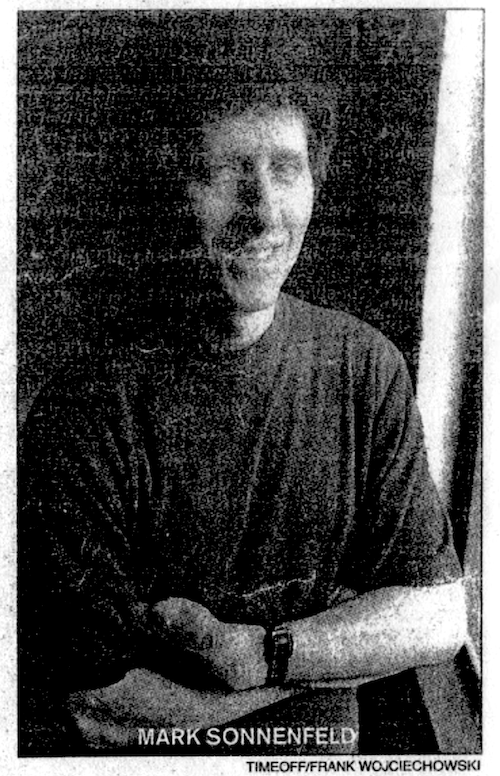
Mark Sonnenfeld is an experimental writer, collaborator, and publisher through Marymark Press. His writing and correspondence are currently being archived at two major American Universities. He is active in the international small press scene, having produced numerous chapbooks, broadsides, give-out sheets, and audio collage on cassette and CD.
Louis Bourgeois was born in New Orleans, Louisiana. He is primarily a poet, but he has published translations, fiction, memoirs, poetry and interviews in over two hundred magazines and journals in North America, Europe, and Asia. He graduated from Louisiana State University with a BA in English and was the first graduate of The University of Mississippi’s MFA program in Creative Writing. He is the Executive Director of VOX PRESS, as well as the Program Director for the Mississippi Prison Writes Initiative.

