
The novel attempts to create meaning on this side of language. How can it do this when it has nothing but language itself. First, language itself was born of a stratum on this side of language and is a derived system of signs referring back to that reality. Second, it is in itself a reality beyond language. For example, we simply retranslate its crude generalizations, its abstract functions, we assemble what it has torn apart and use it in its entirety. In the beginning was not the word but the sentence; it is this we break up into its component parts. In the beginning was not the sentence but the paragraph; it is this we expound into sentences! In the beginning was not the paragraph but the novel, and the novel was preceded only by silence itself.
— “On the Novel” by Geza Ottlik
2. Considerations on Baron Wenckheim’s Homecoming, a novel translated into English from the Hungarian of László Krasznahorkai.
2a. During the writing of this essay I became a little unhappy with the above title which is a line from a Roxy Music song by Bryan Ferry. I keep thinking a better title would be “All for Nothing” but many readers of this journal are also great movie watchers and they would remember it is the last line a retired marshal says as Gary Cooper goes out to face…in the movie High Noon.
This movie has probably the darkest ending of any of the so-called popular classics: filled with the most awful sense of foreboding as we see the marshal and his wife leaving town after he pats on the shoulder the only person who came freely to offer him help, so we are left to the fate of these three people which cannot be anything except grim. No small town would ever forgive that boy!
So be warned as to what is to follow, yet…László Krasznahorkai is necessary in order to navigate the world…but you will be navigating without a compass…led by a person who must recite the English alphabet to remember that r comes before s and then comes t.
3. Rarely do essays begin with a note, a preface, a suggestion, a confession, an excuse but here goes…

4. The essay you are reading began in the Spring of 2016 when I met László Krasznahorkai at the annual party New Directions has in May at the same time as Book Expo in New York City. While not the guest of honor—as these parties are not like that—he was at least for me the center of attention and he turned out to be incredibly easy to talk with and it did not bother him when I asked if he would autograph Satantango, his most recently available novel and innovative right down to being issued without a dust jacket.
He was telling me he was happy to be at his publisher’s office, pleasantly stuffed with books and away from anything hinting at the corporate world of mid-town, and he was finally ready to be leaving Manhattan where he had been a fellow at the Cullman Center of the NY Public library: he was saying you could not imagine how awful this experience has been: the regimentation, the constant prying as to what you might or might not be doing, the intruding rules and one’s constant awareness of security regulations surrounding everything you did, much like the old days in Hungary, “I only escaped it by looking for Herman Melville in New York City.”
We talked for a few moments more and I mentioned I had once tracked the steps of James Thomson BV in Manhattan where he had waited to return to London as a failure and where he would drink himself to death. Melville knew his poetry and in turn Thomson knew of Melville but they never met. And I was aware that Thomson’s name passed by Krasznahorkai…
A book resulted from the New York time of Krasznahorkai, The Manhattan Project (2017), complete with startling photographs by Oman Rotem of Krasznahorkai himself, scenes of New York City witnessed by both LK and evocative of Melville, including the memory of an excursion to the house in Massachusetts where Moby Dick was written. All the photographs, a word essay on Melville and the pictorial remains of Melville in Manhattan, are filtered through another writer’s attempt to find Melville in Manhattan: Malcolm Lowry. Krasznahorkai had been given a copy of Lunar Caustic in London before he came to his residency in Manhattan.
Of course Krasznahorkai and readers of this essay know that “The Manhattan Project” was the code name for the building of the atomic bomb.
By coincidence I know of another writer who also followed in the path of Lowry: Kenneth Tindall, known only for one novel, Great Heads, the last literary novel published by Grove Press before it became just another mostly forgettable house, but Tindall also sent a character to Bellevue (echoing his own stay in that hospital) in his second novel Banks of the Sea, yet Tindall himself ended up after many years as a happily married now retired postman in Denmark living on the coast not far from Copenhagen, wondering how anyone can live in such a place as Manhattan with its cargo cults on Avenue C and Bellevue as a sure destination still for too many.
But for LK: “Manhattan, Melville, Lowry, the three words whirled in my head. I was aware that some connection existed between the two names and the place. I had not the least idea that there would be a fourth name as well but by the time I discovered it, I would already be subject to a heavy gravitational force. That is: I would be toppling headlong down the slope, in a state of free fall.”
9. INSERTED NOTE: From Malcolm Lowry in Lunar Caustic, what the inmates could see from their windows: a passing ship on the East River: “as though roused suddenly from nightmare or from the dead, while their lips would burst with a sound, partly a cheer and partly a wailing shriek, like some cry of the imprisoned spirit of New York itself, that spirit haunting the abyss between Europe and America and brooding like futurity over the Western Ocean.
9a.1 Krasznahorkai has currently ended up with Baron Wenckheim’s Homecoming and soon enough we will be to it.
9a.2 I wish The Manhattan Project had been available before I met Krasznahorkai—as I well imagine I will never be meeting him again, in this life—because he writes of earlier visits to Allen Ginsberg in his apartment that is in fact rather close to where I am typing this essay on the Lower East Side of Manhattan. Krasznahorkai came away from his visits to Ginsberg thinking, “[He] was not just a friend but also a teacher who enlightened not by solving your problem himself, but by guiding you towards a solution. For this I admire him to this day.”
9a.3 Now when I look at the calendar, I realize it is 25 years since I too went to that apartment to meet Ginsberg. I had admired him from “Howl” in the 1960s and even read much of that poem at a meeting on the classic and modern lyric at the Classical Society of University College, Dublin.
9a.4 I came to talk to Ginsberg for The Guardian in London and in that small hot close apartment I discovered not a teacher but the manic conspiracy buff wanting Guardian readers to know about how the CIA had unleashed the crack epidemic in New York City. My editor, Helen Oldfield, delighted in a detail I noted about Ginsberg’s newspaper clippings: they had all been neatly clipped, dated carefully, underlined, and annotated.
5. CONFESSION: In the fall of 1965 upon my return from Dublin, I announced to David Stocking, a professor at Beloit College, that Samuel Beckett’s novel How It Is had ended the novel. Stocking replied, “No, he ended it for himself.”
For a long time I gloated over the thick-headedness of Stocking but history soon enough supplied many more examples: Hopscotch by Julio Cortázar, Paradiso by Jose Lezama Lima, Life A User’s Manual by Georges Perec, Thomas Bernhard would write Correction and then down another path would be Julian Ríos with Larva and Arno Scmidt with Bottom’s Dream and soon enough Parallel Stories by Péter Nádas to which we came by the many novels of Péter Esterházy and over there ever present—Imre Kertész’s novels—while the resurrected shade of Embers by Sándor Márai re-introduced a major Hungarian writer—who had carefully escaped the tempting fantasies of both fascism and communism—in his novel Embers as one found confirmed in his Memoir of Hungary and last notes before his suicide in California in 1989 so thus we find ourselves in Hungary and in the midst of Hungarian literature we come to: Baron Wenckheim’s Homecoming by Krasznahorkai…
12. But not yet.
Two years after that party where I had met Krasznahorkai, I met at the same annual party Georgi Gospodinov, a Bulgarian who had just completed an entirely successful year at the library and who is seen in Bulgaria as being the most important contemporary writer and in whose last translated novel into English, The Physics of Sorrow, one finds the memory of the Bulgarian army that had been sent into Hungary to fight against the Germans…this was after the Russians’ entering and defeating the pro-German government in Bulgaria on 9 September 1944.
But that novel and that war are for a later moment.
Friendlier than Krasznahorkai, as I had a deep and long connection to Bulgaria, we walked after the party across the West Village and he asked why I had not gone to the Literature House in Sofia as you should go there since there is really interest in seeing your novel The Corpse Dream of N. Petkov done into Bulgarian.
That suggestion led to this year’s residence of 42 days for me at a grand apartment in the center of Sofia as a guest of the Literature and Translation House so that I could write: Recently in Sofia I was talking with Dinko Telećan, the Croatian poet, novelist, and translator of among many books, The White Goddess and The Golden Bough, and who was saying that Krasznahorkai’s novels and other prose work is done in a manner that defeats easy description or summary and are without any urgency to simplify or to mystify his potential readers, but they do, so one has to believe this is all conscious on his part and that makes him unique even when translated into Croatian…so nothing becomes clearer.
12a. And I cannot do better really than echo this essential understanding of Krasznahorkai’s work. All his work refuses the usual teasing come-ons, the invitations that seem to be so essential to the success of the vast majority of novels now being published and once published are on a sure path to being replaced by the next day’s version.
12b. Some years ago Wilfrid Sheed announced the death of the long serious many-years-in-the-making novel by remarking to the effect why spend six, seven, ten years on a book that has an up-front shelf life of possibly four weeks in the bookshops of America…today of course he would be seen as hopelessly optimistic.
13. So to War & War, the novel Krasznahorkai was working on when visiting Allen Ginsberg but only appearing in English 2006. It comes with an epitaph: “Heaven is sad.”
The novel begins, “I no longer care if I die, said Korin, then, after a long silence, pointed to the nearby flooded quarry: are those swans?” And a bit later, “It had begun suddenly, without preamble, without presentiment, preparation or rehearsal, at one specific moment on his forty-fourth birthday, that he was struck, agonizingly and immediately, by the consciousness of it, as suddenly and unexpectedly, he told them, as he was by the appearance of the seven of them here, in the middle of the footbridge, on that day when he was sitting by a river at a spot where he would occasionally sit in any case this time because he didn’t feel like going home to an empty apartment on his birthday, and it really was extremely sudden, the way it struck him that, good heavens he understood nothing, nothing at all about anything, for Christ’s sake, nothing at all about the world, which was the most terrifying realization, he said, especially in the way it came to him in all its banality, vulgarity, at a sickeningly ridiculous level, but this was the point, he said, the way that he, at the age of forty-four, had become aware of how utterly stupid he seemed to himself, how empty, how utterly blockheaded he had been in his understanding of the world these last forty-four years, for, as he realized by the river, he had not only misunderstood it, but had not understood anything about anything, the worst part being that for forty-four years he thought he had understood it, while in reality….”
21. Autobiographical Incursion: for more than twenty years I was a foot messenger in Manhattan for Maple-Vail Book Manufacturing Company and I collected a number of handwritten, sometimes photocopied obsessional posters concerning the writers’ political views, complaints of dishonest former employers, visionary religious matters, predictions of the end of the world and all of them had the same tone as much of War & War but I refuse to clearly link the prose of this novel even as Korin in Manhattan bears much resemblance to the authors of these remembered screeds.
32. After much moving about in Manhattan Korin ends up in a hotel a few streets from the apartment where I am still typing this essay: “Rivington Street was where he was and down to the right and to the east was Chrystie Street, with the long windy park at the end, but as he went down and turned left it led to the Bowery, he noted after days of sleeping and nights of watching uncertain how long he had been there, but on the day, whichever day it was when he finally ventured out through the doors of the Suites Hotel….”
The wanderings about Manhattan are believable, detailed and reflect, one may assume, Krasznahorkai’s fine eye and memory and there is a comic moment when Korin tries to gain entrance into the Sunshine Hotel which he decides must be a nice place because of its name, but not knowing English and not realizing that it is really a mostly derelict flophouse, fails at moving in.
But going on. Korin eventually finds a place to stay and we are launched into the rest of the novel which concerns: “[he had come into possession of] an extraordinary document, something so out of the ordinary…astonishing, foundation shaking, cosmic genius, and, thinking so, he continued to read and re-read the sentences till dawn and beyond, and no sooner had the sun risen but it was dark again, about six in the evening and he knew absolutely knew, that he had to do something about the vast thoughts forming in his head, thoughts that involved making major decisions about life and death, about not returning the manuscript to the archive but ensuring its immortality in some appropriate place.”
With plot now set in place the rest of the novel is that quest and an ending with a boxed address: http://www.warandwar.com and of course one finds:
The requested URL / was not found on this server.
Additionally, please be informed that this homepage service has been called off due to recurring overdue payments. Attempted mail deliveries to Mr. G. Korin have been returned to sender with a note: address unknown. Consequently, all data have been erased from this homepage.
78. YES, GETTING TO: Baron Wenckheim’s Homecoming BUT NOT YET.
Krasznahorkai published two other novels that deserve some mention and then there are the so-called non-fiction books and collections of pieces.
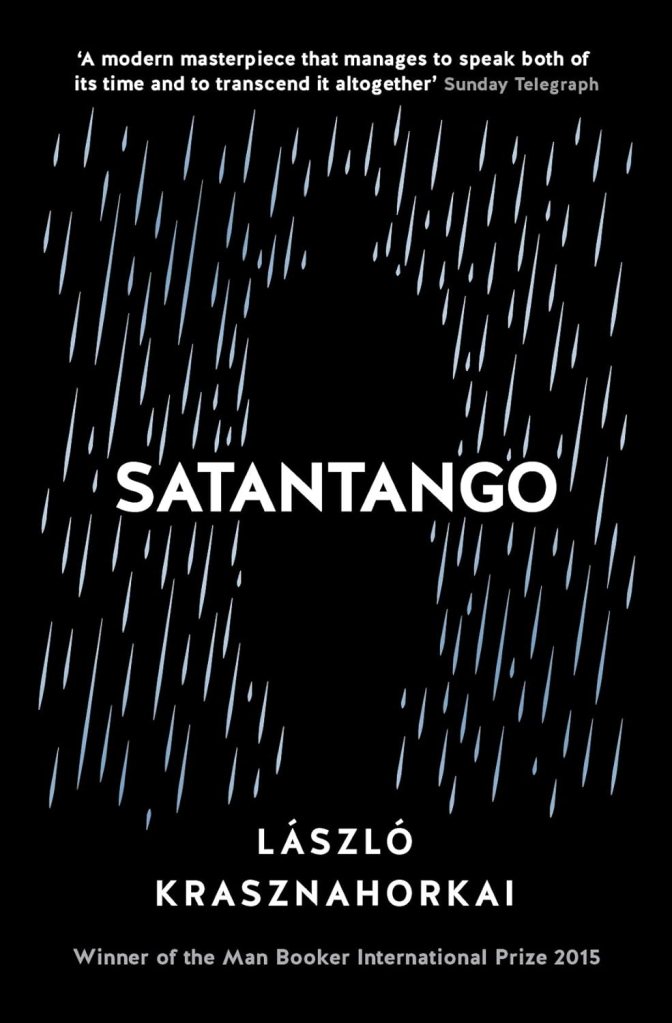
78.a Satantango, the novel, of course is probably better known via the 420 minute film by Béla Tarr which in turn was one of those very long films of recent times that seemed and possibly continues to be seen as essential: Our Hitler A Film from Germany (450 minutes) by Hans Jurgen Syberberg and of course Rainer Werner Fassbinder’s Berlin Alexanderplatz (940 minutes).
45. Satantango is set in a Hungarian collective farm that has come to its end and I guess we can see this as one of the consequences (depending on your political point of view it should be understood but whether this has any connection to so-called actual reality is beyond the purposes of this essay) of the changes in Eastern Europe following the endings of the various communist regimes but it is about Krasznahorkai’s world: “Suddenly there was a sour taste on his tongue and he thought it was death. Ever since the works had been split up, since people had been in as much of a rush to get away as they had been to come here, and since he—along with a few families, and the doctor, and the headmaster who, like him, had nowhere else to go—had found himself unable to move, it had been the same day after day, tasting the same narrow range of food, knowing that death meant getting used to, first the soup, then to the meat dishes, then, finally to go on to consuming the very walls, chewing long laborious mouthfuls before swallowing, slowly sipping at the wine rarely enough set in front of him….”
09/8. Yet the novel gives me the thrill of passages recalling: Malaparte and Céline-the latter of course who was famous for saying, you have to be a little bit dead to be really funny.
Yet Krasznahorkai’s rhetoric is more physical and graphic: “…and he saw himself nailed to the cross of his own cradle and coffin, painfully trying to tear his body away, only, eventually, to deliver himself—utterly naked, without identifying mark, stripped down to essentials—into the care of the people whose duty it was to wash the corpses, people obeying an order snapped out in the dry air against a background loud with torturers and flayers of skin.”
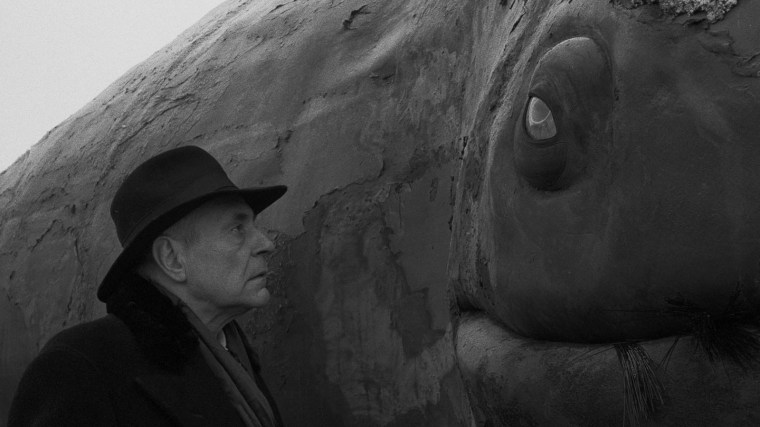
98. The Melancholy of Resistance was the novel that introduced Krasznahorkai to English language readers and it too is probably better known via a Bela Tarr movie, Werckmeister Harmonies.
The Melancholy of Resistance is set in the constantly rained upon small town somewhere in Hungary that gets a visit from a traveling carnival that features a whale as its central exhibit and there is much dense description and a constant possibility of drunken violence. But in truth the movie version, forced to be visual, is the one that implants itself on one’s memory and in particular when a man organizes the drunks into a sort of whirling imitation of the planetary universe within the walls of the local tavern.
Yet the goal of the novel is a long final section’s last paragraph that begins, “The unchained workers of decay were waiting in a dormant state for the necessary conditions to be established, as soon enough they would be, when they might recommence, their interrupted struggle, that predetermined, merciless assault in the course of which they would dismantle whatever had been alive once and only once, reducing it into tiny insignificant pieces under the eternally silent cover of death.”
98.a As I read this novel of that traveling whale, a memory surfaced that whales seemed to have traveled about in Eastern Europe: The Strange Story of the Great Whale, Also Known as Big Mac by the Bosnian Serbian writer Erih Koš, which I had read a long time ago as it was published in English by Harcourt in 1962 but who can forget that Melville seemed to have the monopoly on whales though the only reason for the rest of this sentence is that it is to be in this essay to be published in The Hollins Critic which many or few might connect to George Garrett who back in 1970 was telling Hollins students, you can do anything you want with a classic, as his uncle had written a movie for Hollywood that was actually made in which the whale dies and Ahab lives. So, yes, a whale, though stuffed, appears in The Melancholy of Resistance.
85. ONE LAST ASIDE BEFORE…Krasznahorkai has published many other texts: travel narratives, art criticism, more short fiction, and a collection of occasional pieces, The World Goes On, which contains his reflection on 9/11, the attack on the World Trade Center in New York City, but this piece tries to escape the many published responses to this event and in the trying reveals such an extravagant extraordinary getting it all wrong as in, “It had been fairly securely bound but then it got loose…the for us forever incomprehensible workings of the ineluctable modality of chance, in which we have sought and found laws yet in fact over the heroic centuries of the past we have not got to know it, just as we can be certain that we shall not get to know it in times to come for all we have ever been, are, and moments when the whip cracks and comes down on our backs just as the whip cracks over this fortuitous universe we call our world.”
WELL…I saw the second tower come down on a bright sunny day much like today from the roof of the building on East First Street in which I am typing. A few hours later my daughter had walked home the 86 blocks from her school uptown and I took her to walk across town and then down toward the now fallen down towers…many people were still walking away and as we walked we noticed in front of one building police armed with machine guns and as we talked the smoke got heavier so we turned back and as we crossed Houston Street, barriers went up to prevent people from going south. That night we watched the fighter planes fly overhead and candles appeared in windows.
I was born into a war in 1944 and my daughter in 1988 was born into a world of war, but that has been true for all of history. (Last editorial aside)
77. YES, the Baron does return to Hungary in Baron Wenckheim’s Homecoming but so does a Jacobi in Géza Ottlik’s much shorter fiction, Nothing’s Lost. I do not introduce this intrusion as a way to mimic the practice of the man who has created the Baron and sent him back to Hungary either as a total bankrupt or possessor of fabulous wealth or for some other reason. In Ottlik’s much shorter work, Jacobi has returned to receive a golden violin for his successes abroad. But this sentence mimics the eighty-some pages that come more or less before the Baron of the title appears in the novel bearing his name. It is worth the wait.
We finally realize…and by not completing MY SENTENCE I want to get to that first appearance, though I am eager to get to St. Pantaleon’s name being invoked by the Baron. (Direction: please go to your martyrology and you will understand my eagerness as I am typing this first draft on the day before his feast day (9 August).
Also unlike many of the inhabitants of the Hungary of the novel you do not have to rush off to the library and check out all the books on Argentina—even a novel by Gilbert Adair gets mentioned—and you do not have to sing the lyrics of the musical Evita which are now being broadcast almost round the clock in this fictional Hungary of Krasznahorkai’s novel.
The long preface to the Baron’s appearance serves to establish the place he is returning to where we are first introduced to a man barricaded into a cabin or small fortress in a wasteland near a large city, surrounded by many who want something and then a circus-like atmosphere, tinged with dreadful threats of violence as this man’s daughter appears from abroad wanting something of this man….
Many further pages develop the hysteria whipped up by the press and television and the various armed groups with vague political points of view, all vague and I guess, if one has no experience of the complex political situations in each of the countries in Eastern Europe, all this will seem opaque but then in reality much of it is and as none of these countries occupy much of the average American’s experience it might seem all in the region of pure fantasy. I guess the only way to approximate the goings-on in the novel is to imagine it was taking place in the United States with the current large number of Democratic presidential hopefuls matched by an equal number of Republican hopefuls and still the distant figure of him, whose name I do not need to mention.
55. A far more appealing aspect of the novel is in the voices and in particular the woman who we realize is the reason—though one is never sure—for the Baron’s return: “he read some pretty strange books, books which—look, it was so long ago that I’ve long since forgotten what kind they were—I do know, however, that they were those kinds of philosophical books, because when he saw that I didn’t understand what he was talking about we turned to Russian literature, and with that he crept into my heart, because at that time I had discovered Turgenev, I simply had a passion for him and this boy knew a lot about Turgenev, moreover when we met for the second time on the banks of the River Koros and I walked with him all the way from the town center up to the Castle, I realized that he already knew everything about Turgenev, and he just kept on speaking and he spoke about so much the words just poured out of him, I remember it well and somehow, you know, I liked him, I’m not saying that I took to him as a man but I liked him, his green eyes and everything and well, I stuck it good to Adam with these little walks….”
55a. Is not Turgenev’s short novel First Love a perfect novel?
49. But I must resist hinting at the fate of the Baron as I do not wish to be the person who might have told me the plot of Psycho before I had seen that film or even another film like Vertigo, such would be an unforgivable insult to any potential reader, but I can reveal that Krasznahorkai continues the opening chaos of the novel and as a whole: the novel resolves itself in a strange inviting apocalyptic scream so that the novel ends with two long listings under the title: Sheet Music Library: Utilized materials—missing and Utilized materials—destroyed.
78. However for this reader the pleasures of the novel were in my identification with the Baron and his wish to meet a girl from so many years ago and never forgotten; a letter is sent and the now aged woman awaits this man and the Baron, “chilled to the bone, and he just kept squeezing the envelope in his hand, then he took out the photograph and he looked at it again—who knows how many times he had gazed at this photograph in his long life—because this photograph had always been with him he never parted from it, it was with him everywhere he went and at all times, no matter what happened, he never left it behind, and during these more than forty years it hadn’t even gotten bent even once.”
84. My identification, a terrible flaw in a reader, I fear, for a particular one who is writing a serious essay, and something students are always warned against—comes out of my own first travels to Europe when going (in 1964-65) to be an Occasional Student at University College, Dublin I carried with me a photograph of Melinda, a girl I had not had the courage to talk to back in America.
48. But it was not an idle aside mentioning being in Bulgaria because I found myself talking with a young librarian who was familiar with the choir at the Alexander Nevksy Cathedral in Sofia and I could not resist asking him if he could enquire if Harittena Belleva was still in the choir as I had known this girl—now a much older woman I could assume—for two days in the Winter of 1973 in Sofia when she assured me that I would forget her and I so wanted to meet her and say I had not forgotten her 46 years later.
I still remembered sitting with her in the modern café on Plastat Lenin (now Sveta Nedelya Square) that was very quiet as it was filled with deaf mute students from their school around the corner and I still remembered walking back with her in the snowy streets to 53 Vistosha Boulevard and spending the night and remembering her telling me she had met a Swedish boy that previous summer who did not write to her when he got back to Sweden as he said he would and she hoped to go to Rome to sing in the school run by Boris Christoff and I did write to her but never heard back and I had gone looking for her in the 1990s but the street names had changed…I hope such a confession will reveal the power of this novel and the situation of the Baron, “another voice within him kept repeating that he had arrived, and so here was a task that appeared to be insoluble, and he really didn’t know how to resolve it, because how could he make a distinction between the fact that he had to get away from here at once, and yet here he was, the place he’d longed to return to for so many years, and where he had wanted to see everything again, everything that history and his own personal misfortune had stolen from him—what should he do, he stared into the fire and he couldn’t look anywhere else because the springs of the armchair he was sitting in were completely broken….”
100. But I must leave you with these tender moments of the Baron’s return (and my possibly pathetic allusion to my own past/present) and I am finally going to read Géza Ottlik’s School at the Frontier (Harcourt, 1966) which seems to have left no scratch on the great American memory and I am waiting for in a few days another of his novels Buda that is coming from that graveyard of millions of books in Indiana via the post office because it is Ottlik’s shadow—and (now you the why of that opening quotation) out of which Krasznahorkai and all the other Hungarian writers I have mentioned come and even The Withering World, a finally published collection of Sándor Márai’s poetry, awaits you and like me you can read in the words of Tibor Fischer, “I admire Márai because of his diamond hardness: he only yielded, finally, when he was old, ill and alone, shooting himself in the head, having first masked himself with a bag, so there would be less mess.”
100. Scrupulosity is either the great enduring virtue of the very best Hungarian writing or its vice—which I must allow for I am writing this in the United States of America, a country that seems to be living now in a condition of imposed amnesia as was recently stated in the press: “William Faulkner? Oh boy. The phrase ‘trigger warning’ might have been coined to protect the young against Absalom, Absalom.” Of course this was in the Times Literary Supplement in London (August 2, 2019) where there is a listing of all the possible books soon to be banned from American higher education beginning with Nabokov, T.S. Eliot, William Burroughs, and moving on to Camus, Flaubert…while containing an ironic tone, the reality has crept in.
101. But let this all end as does the Baron Wenckheim’s Homecoming: “The city’s burning, the city’s burning / Fetch the engines, fetch the engines / Fire, fire, fire, fire / Pour on water, pour on water. And at the end he looked up to the sky, the darkening sky, raising both his hands, and as he had clearly seen someone, maybe a conductor, do before, he motioned to the invisible audience, at the same time cheerfully calling out the encouraging summons:
And now everybody—
as I was there I began to read:
And have toppled…
This essay was originally published in The Hollins Critic in 2020.

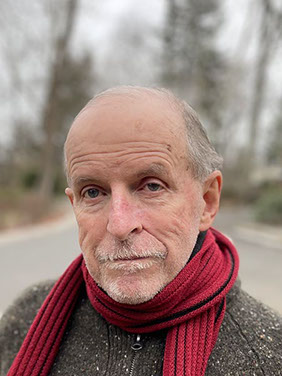
Thomas McGonigle is a writer, literary and art critic, university professor, and journalist. He has received several awards, including the Notre Dame Review Book Prize (2016). His novel The Corpse Dream of N. Petkov was first translated into Bulgarian by Ivanka Tomova for the Syvremennik magazine in 1991 and was republished by Ciela Publishing House in 2019. Inspired by the story of Nikola Petkov, a politician and member of the opposition, executed by the Communist regime, McGonigle introduces his readers to the setting of the National Court through the stream of consciousness of Nikola Petkov himself.
McGonigle is also author of the novels St. Patrick’s Day: Another Day in Dublin (2016), Going to Patchogue (1992), Party of Pictures (2023), and Empty American Letters (2023). He is a contributor to the Los Angeles Times, the Washington Post, Newsday, the Chicago Tribune, and The Guardian in London.


Just saying Hi. Glad to be here (smile.)
LikeLike