
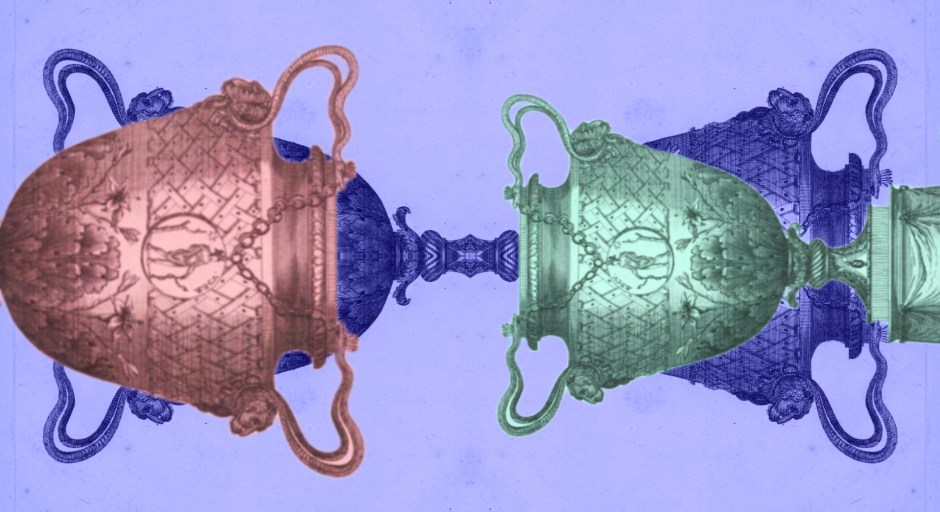
Diana. Why did her mother and father give her that mournful, moonful, maidenly name? And who was she to claim that throne? A gangly girl in tortoise shell glasses, torn jeans and oversized flannel shirt, crawling on her hands and knees in a grave-sized plot of dirt in a sun-scorched field of ancient ruins, brushing strands of mousy blond hair from her face and weeping, her teardrops raising tiny craters in the powdery gray dust, the first rainfall in months for a ragged green patch of weeds, as well as an ants’ nest she has tried not to disturb, her mind a frantic mix of jubilation and despair as she sucks at a small wound in the web of her left hand, living blood drawn forth by the dried blood of terra cotta. These shards of primitively fired and glazed pottery she has pried, chipped, brushed, and sifted from the ancient soil, and which, later that night in her little room, she will piece together with tweezers and magnifying glass, gluing antler to stag and tusk to boar, pomegranates, peacock feathers, the gold hem of a robe fallen from a noble woman’s shoulder. A goddess, perhaps? Grand temples raised in her name? Sacred olive groves planted? Diana’s excitement soars as she begins to discern scenes that were contemporaneous when this vessel was fired well over two thousand years ago.
Bespectacled, black-bearded Professor Anville laughed in her face, dismissed her claim without even having a look. Cheap imitation! Fraud at best! Despite his discouragement, she continued her work with ever greater determination, her breathing faster, her fingers trembling as the woman on this object, which she now recognized as a squat, two-handled vessel for mixing wine and water called a krater, became more complete.
Her hair is coarse, black, her arms strong. On her feet she wears simple leather sandals. She is standing next to the doorway of a plain, one-room stucco house. Certainly not a goddess then, but if not goddess, what? Freed woman? Freed from slavery by favor of a kind master? Freed from unwanted matrimony by the death of a husband from foreordained sickness or mortal wound in combat? The land that had been his and hers, placed by law in the eldest of many sons’ hands, spendthrifts all, her tiny plot grown smaller and smaller, until nothing remained but this one-room house. A rear window, a door in front facing the dusty street, a fig tree, beehive, grape vine, and clay oven in the small courtyard on the side, a couple of goats she lets roam the rocky outskirts of the city during the day, corrals in a crude wicker pen overnight. In order to make ends meet, she sells honey, homemade wine, cheese, and bread to passersby in the street.
As Diana affixes additional glazed fragments to the krater, she begins to make out muscular men in loincloths. Warriors? Athletes? One is leaning on a spear, or perhaps it is some kind of tool. Maybe they are slaves or common laborers.
One day men came to repair the wall across the street. The woman watched them wield heavy iron bars, swing picks and sledgehammers. They laughed and swore and grunted like animals, and when their muscular bodies gleamed with sweat they looked like gods. She also saw how they watched her when she went to pick swollen, purple figs from the tree in the courtyard, or bent over to remove loaves of bread from the clay oven. She heard their crude comments and their laughter and, in spite of herself, she was flattered. She was not young. She had borne more than her share of children. So it did not escape the men’s notice, nor Diana’s after another night’s work, that, ironically, perhaps, the woman depicted on the krater was herself bearing a krater.
How could she not take pity on these men? It was hot, their work hard. Thinking to quench their thirst, she drew cool water from the cistern, filled the krater, the last of her few valued possessions, along with the gold-hemmed robe she had changed into on a whim, and took it out to the men. They thanked her profusely, gulped the water greedily.
Diana’s luck improves when, examining today’s fragments of terracotta and glazing, she finds several that belong together. Platters of food have been placed on the stone wall the men are repairing. Roasted goat, grapes, bread, honey, figs, cheese. The woman has clearly taken the men something to eat, a good part of her larder, it would seem, and even filled the krater again, this time with red wine, because—meticulously affixing splinters as tiny as the glint in a person’s eye—she, Diana, can see now that the men are jovial, laughing, as they lift their drinking cups again and again.
The woman, too, is enjoying the wine. Why not allow herself this small pleasure? This is the happiest she has felt in ages. The attention of these men makes her feel young again. She has noticed one in particular, a great hulk of a brute, with flashing black eyes, curly black hair, and a heavy black beard. When she refilled his cup, he laughed, showing his healthy white teeth. Perhaps he was thinking, I wouldn’t mind giving this one a roll in the hay. Perhaps she was thinking the same thing.
Diana examines more closely the fragments she has just attached. The resemblance is uncanny: the black-bearded Professor Anville without glasses, or the paunch. She remembers with disgust the bacchanalia at the taverna. Everyone acting like beasts, drowning themselves in alcohol, gorging themselves on food they’d throw up later. Randall and Travis got into a fight, possibly over her, of all unlikely possibilities. Fortunately, they were both feckless at fisticuffs, or didn’t really care that much. During this melee, with the excuse of explaining a finer point of archaeology, Professor Anville backed her into a broom closet, his prodigious belly leading the assault, his sky-blue eyes glowering at her Svengali-like over his steel-rimmed glasses, his hair twisted into satyr’s horns, drunk with an indiscriminating lust inspired less by her charms than the must of the grape, she knew very well, but that didn’t prevent him from shoving his tongue down her throat. She didn’t slap him across the face, call him out, wished she had later, but couldn’t, didn’t know how to react then.
It didn’t go unnoticed—rumor, gossip, an academic interest, to be sure. Made more tantalizing by the fact that she had reputedly refused all other advances, including those of an angular young woman who attempted to befriend her, presuming her to be gay, then just strange. Intelligent minds wasted on trivial pursuits. But even if one had at least partially won her trust, managed to find her alone, to steal a kiss, to seek a caress, he (or she) would have found the proffered hand shoved aside. No! That’s enough! But to suppose even further, had one somehow persuaded her to allow him (let’s presume) to unbutton her bumpkinish flannel shirt and reveal her hidden treasures, he would have found her chest bound round and round with linen and thought, oh my God, she must be horribly scarred, a monster. Little could he have guessed.
The doctors explained everything to her parents in medical terms, a condition that produced multiple or supernumerary nipples, although the learned physicians were a little nonplussed that there were so many, and perfectly aligned, four on each side of her chest and rib cage, eight total. But rest assured, they said, utterly full of themselves, they won’t develop. But, controverting science, with the arrival of puberty, they did. Her parents were resolute farm stock and simple people, but they loved their strange daughter, even if she was not quite like them. Or anyone. This—what else to call it but gift?—was God’s business, not theirs to explain. Out in the country like that, few neighbors, she a solitary, bookish child, it was easy enough to keep her secret.
When it came time for Diana to think about college—that was beyond her parents’ means. Fortunately, she was not only bookish but extremely bright and industrious. Rising at four a.m. to milk cows, feed calves, slop hogs, and collect eggs from the henhouse, as well as working a job on weekends and over the summer sorting poultry parts, she still earned the highest grades in her class and was chosen as valedictorian. Academic scholarships arrived in Diana’s rural mailbox like magical, gift-bearing birds from far-off kingdoms.
In college her studies led her, she couldn’t explain why, to ancient Roman and Etruscan cultures. One day in the classics section of the main library an untoward gasp broke the strictly enforced silence. Diana sat staring at a representation of herself, that is, an eight-breasted female creature.
A single fragment alerted her. At first she had thought it might represent a strange flower or, knowing the ancient artists’ eye for detail, a suction cup on the tentacle of an octopus or other exotic sea creature. But now, the hot salt water of her tears beginning to burn her eyes, alternately gasping, laughing, sobbing as she fits the adjacent fragments in place, she can see, below the woman’s already exposed breasts, another pair, and below that the suggestion of another and possibly even another. She can also see, an artisan’s trick, that from a certain angle the woman seems to be staring back at her.
Who’s to say what’s right or wrong in the face of necessity? The children just kept coming, one every nine months, sometimes in twos or threes, all by different fathers. Mother to many, she became a second mother to many more as a wet nurse and midwife to further supplement her income. Her gifts, as she thought of her many breasts, made suckling the children so much easier. Other women spoke of her with envy. How does she do it? But she kept her secret lest people suspect her of being a witch or some unnatural beast, a she-wolf nursing cubs not humans, the recompense for such sorcery most likely a brutal death.
Ah, well, by now both of them drunk, laughing, the woman on the krater and this big black bearded brute who had backed her into a shady corner. He was kissing her and squeezing her buttocks, fondling her breasts. She should have known better but she didn’t really want him to stop. She heard his gasp, saw the shock in his eyes. But instead of being horrified, Blackbeard seemed delighted. The more the merrier, eh? he laughed. And she laughed back. At last! She had found one truly deserving of her charms.
At that very moment, Blackbeard bumped into the krater and it crashed to the ground, shattering into a thousand pieces. He should have known better but, stupid inarticulate beast, he only shrugged, It’s just a vase. And then stared in astonishment as she fled in tears back into the house.
After the men had shouldered their tools and gone home at night to lie down with wives or lovers, she went back out to the street to crawl in the dust on her hands and knees, weeping as she held up the sharp fragments to the moonlight, indifferent to the small wounds they caused, trying to fix in her mind forever the scenes they had held of hunt and chase, of lying down in green glades with half-men, half-beasts who bellowed and bleated in the dying echoes of a never satisfied lust, and no super glue or alchemist’s cement to fix them together again. Perhaps she was thinking now of her last child, her poor, lost daughter, so knowledgeable in the sciences, a true scholar. Alas, she denied the gods of sacred groves and mystical springs, refuted love and the lust for life, inexplicably chose to devote herself to a religious order of chastity and solitude. Diana.

REYoung was born in Pittsburgh, Pennsylvania and currently resides in a limestone cave deep beneath the city of Austin, Texas. He is the author of six novels: Unbabbling (Dalkey Archive Press 1997), Margarito and the Snowman (Dalkey Archive Press 2016), Inflation (TageTage Press 2019), The Ironsmith: A Tale of Obsession, Compulsion and Delusion (TageTage Press 2020), Zol (TageTage Press 2020), and Daaa … SnowBiz! (TageTage Press 2024). REYoung’s latest novel, The God Book, is currently unhoused. His website is here.

