
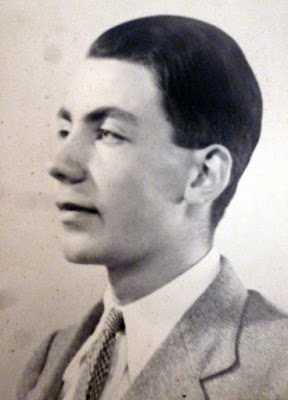
About Tom Mallin: “Mallin was born in the Black Country in 1927 and studied on scholarship at the Birmingham School of Art from 1943 to 1945. Upon returning from national service, Mallin studied at the Anglo-French Arts Center in St. John’s Wood and became interested in the ‘New Realist’ school of painting, popular in Paris at the time. He worked as a picture restorer for many years, and moved to stables in Suffolk, converted into an artist’s studio, in 1955 to raise his two children, meanwhile producing a significant body of artistic works, from lifesize sculptures to cartoons and paintings. Mallin began writing around this time and completed his first novel, Erowina, in 1962.”
From Christine Brooke-Rose and Brigid Brophy to Ann Quin and B. S. Johnson, the British innovators of literature are about as celebrated as their American counterparts, which is to say not very. Another Brit in this practically clandestine cohort is Tom Mallin, a painter, sculptor, illustrator, and playwright who fully dedicated himself to writing only at the age of 43 in 1970, seven years before his untimely death from cancer. In that relatively short span, he wrote some 15 plays and published four novels (as well as a posthumous one a year later), all five of which were brought out by the London publishing house Allison & Busby. Unfortunately, just two of these novels have been reprinted: Knut in 2014 and Erowina in 2015, both revived in POD format by the defunct “micro not-for-profit” Verbivoracious Press.
Although Erowina was published in 1972, one year after Knut and two years after Mallin’s debut Dodecahedron, it was written a whole decade earlier, which makes the book, in the wider eye of history, if not in the narrower, dead and dying eyes of early 70s readers, his true debut, and it’s undeniably an ambitious one at that. It lies prostrate before, if not shows its prostate to, James Joyce’s Ulysses, mostly due to its polyphony in style from the first chapter to the twentieth, its unorthodox structure, and its treatment of sexual and psychological subject matters. Mallin even references the sentence in which Joyce all but outs himself as an infamous fart-huffer: “He kissed the plump mellow yellow smellow melons of her rump, on each plump melonous hemisphere, in their mellow yellow furrow, with obscure prolonged provocative melonsmellonous osculation.”
Well before that reference, the novel opens with a hyper-detailed autopsy of the titular character:
The urogenital cleft is covered with strong, crisp hair which extends from the posterior boundary of the vulva orifice, over the fatty collection of the mons veneris and upwards, evidencing by its strong growth and extended borders persistent depilation. There is, in this urogenital region and in the post-anal furrow, an almost excessive bronzing of the skin which one would normally associate with the later stages of cancer, but there is no evidence of this. The linea nigra, running up to the umbilicus along the mesial line, is very marked, broad and bronzed. There are some areas of striae albicantes on adjacent parts of the buttocks, thighs and below the umbilicus. These cicatrical indentations are consistent with abdominal distension during pregnancy.
Thus, it should come as no surprise that the novel is achronological, although dates in the chapter titles help orient the reader within this extended exercise in temporal disorientation, not to mention cerebral, corporeal, and the like. In my first interview with the short story writer Garielle Lutz, she explains that “Every name, whether in fiction or in life, is a misnomer most of the time. To be accurate, a person’s name would need to change many times throughout a day.” While Erowina’s name doesn’t change that often, she does take the form of Emily, Emma, Eunice, Evelyn, Esmeralda, Erica, and Esbiel. Why? Because names are our identity, and identity isn’t marmoreal but rather far more fluid than one might expect, or admit. As it is with monikers, so it is with the book’s structure and style. While Erowina is indeed a child of Ulysses, it’s also an indirect progenitor of Mulligan Stew by Gilbert Sorrentino, one of America’s most wrongly ignored innovators. One chapter in Erowina is chiefly comprised of dialogue with well-nigh indecipherable dialect at times; another is a One–Flew–Over–the–Cuckoo’s–Nest-esque visit to an asylum, in which little orphaned Erowina is taken by her charge, the overbearing Nancy, to see her transgender uncle at an asylum (like her uncle, Erowina also exhibits a fluid sense of gender and sexuality, perhaps in part as a rebellion against the victimization that can come with girlhood/womanhood); there’s a chapter in which parentheses cordon off all adjectives and adverbs so that it reads almost like a still-life, appropriately so, for it describes, among other things, the artist Pazzeroni the Jew and his models, Erowina among them; a chapter on the ponderous minutiae of an occult ritual, complete with words recited in reverse; a theological/historical debate framed by a sexually charged one-on-one modeling session; and a chapter in which newspaper headlines inform or appear in conversation within the text proper, similar of course to the “Aeolus” episode in Ulysses.
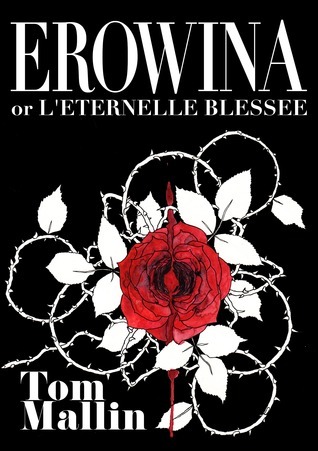
There’s also a chapter that explains the ways in which Erowina’s allergy to roses, or more accurately her rose-phobia, has manifested over time, often involving fainting and other more visceral reactions. Roses are tesseractal in their possible interpretations, from the blood of Christ on the cross (Iron Nails Rain In) to a womanly deflowering (which literally causes a flowering of the labia over time). The book is graced with the following alternate title: L’eternelle Blessee, The Everlastingly Wounded One, which, aside from referencing the mental wounds of our protagonist, also alludes to the feminine wound between the legs that exists from the first, penile impalement unneeded.
The Erowina stew is made more Stew-like because, as explained early on in the book, some or all of these chapters were penned by the titular character in the form of diaries, essays, plays, dreams, fictions, etc., which call into question not only veracity but also authorship, especially because Erowina is deceased and one of her former lovers, the married man Tammy Lamlin, gives some of his perspective directly and indirectly. Despite the novel’s polyphony, it doesn’t come across as varied as it should, partly because the focus on Erowina feels acute even when it’s oblique and partly because the opening chapter is the most alien and extreme in its style when compared to the rest.
While the prose is assured and vivacious on the whole, far too many sentences, back to back to back, in chapter after chapter after chapter, are used as the gallows from which dangling modifiers hang in agony until they’re dead, and even if we allow the excuse of prescriptive grammar, there are still instances in which the modifier, dangling like no such tinkling windchime, defies its own internal logic. In the following example, an emotion is inadvertently anthropomorphized: “Greatly disappointed, fear is replaced by the puzzlement of ignorance.”
In essence, Erowina is a story about a girl who, having been sexually and mentally traumatized, grows up to sexually and mentally rebel in ways large and small, yet all are futile attempts to heal the wounds of her psyche, let alone the wound betwixt her legs, or maybe such rebellion is in lieu of trying to heal altogether. Either way, it’s a tragedy that, chronologically speaking, ends in suicide. Ultimately, it’s difficult to say that Erowina amounts to more than the sum of its parts, even if it’s an undeniable curiosity in the history of British experimental literature.
Editor’s note: The aim of Invisible Books is to shine a light on wrongly neglected and forgotten books and their authors. To help bring more attention to these works of art, please share this article on social media. For early access to literary content like this, consider supporting The Collidescope on Patreon.
The Collidescope is an affiliate of Bookshop.org and will earn a small commission if you click through those specific links and make a purchase.


George Salis is the author of Sea Above, Sun Below and Morphological Echoes. His fiction is featured in The Dark, Black Dandy, Zizzle Literary Magazine, House of Zolo, Three Crows Magazine, and elsewhere. His criticism has appeared in Isacoustic, Atticus Review, and The Tishman Review, and his science article on the mechanics of natural evil was featured in Skeptic. He has taught in Bulgaria, China, and Poland. He’s the winner of the Tom La Farge Award for Innovative Writing. Find him on Facebook, Goodreads, Instagram, Twitter, and at www.GeorgeSalis.com.

